Introduction
In today’s interconnected world, air freight plays a vital role in keeping the global aviation supply chain moving effectively. From aircraft parts to vital spare parts, the aviation industry depends on fast, secure, and dependable logistics approaches. As aviation manufacturers expand their work globally, air freight helps maintain smooth global trade facilitation, confirming that every shipment reaches the given location with accuracy and speed. Also, effective freight forwarding services and strong customs clearance support are necessary for reducing maintenance and issues.
Key Benefits of Air Freight in Global Supply Chains
Air freight brings significant advantages to the global supply chain services ecosystem. It ensures rapid delivery of high-value aviation parts, reduces lead times, and supports international export regulations compliance. Businesses engaged in import export registration and exporter of record services benefit from the predictability and control air freight provides. Also, with Comprehensive import-export support, organizations can handle urgent aircraft-on-ground (AOG) situations more effectively. Air freight’s real-time tracking, efficient handling, and dependability make it a basis of the import export business, confirming manufacturers and workers meet global demand without delays.

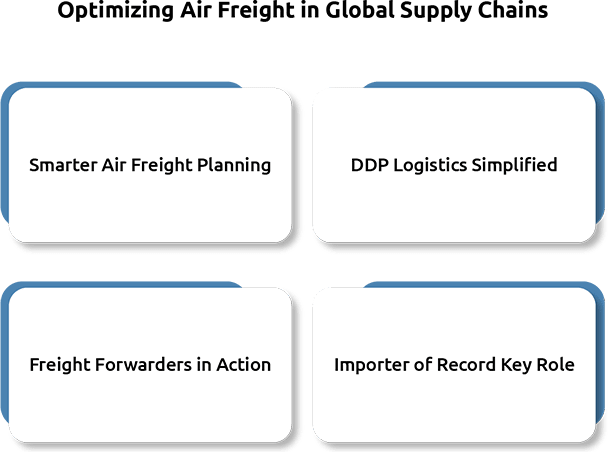
Optimizing Air Freight in Global Supply Chains
Improvement in air freight begins with major route planning, collaboration with leading freight forwarding companies, and using Incoterms such as DAP and DDP shipping to define responsibilities clearly. Using Delivered Duty Paid logistics allows businesses to manage customs and taxation effectively, reducing the risk of clearance delays. Many aviation suppliers also depend on the importer of record services to confirm smooth delivery of regulated parts across borders. This level of agreement and transparency simplifies operations while conforming to the HTS harmonized tariff schedule and HS code classification systems for accurate duty calculation.
Aviation Demand Surge: Effects on Air Freight & Supply Chains
The global aviation market is seeing a recovery, driven by increased passenger traffic and cargo movement. This demand surge directly affects logistics and the required for specialized air freight forwarding services. As airlines expand fleets, the requirements for spare parts, maintenance tools, and high-tech components grow quickly. Effective export customs brokerage and adherence to global supply chain services systems help confirm timely delivery. Also, the generalized system of preferences supports global exporters in developing countries, promoting balanced trade within the aviation sector.
The Future of Air Freight in Global Supply Chains
Technology, sustainability, and automation will show the future of air freight in aviation global Supply Chains. Combining digital customs clearance support systems, blockchain-related tracking, and AI-using route improvement will increase efficiency. Air freight providers giving comprehensive import-export support will remain central to global trade facilitation, helping businesses stay competitive while confirming agreement with international export regulations. The combination of freight forwarding services, importer of record services, and Delivery Duty Paid services confirms a fully clear and complete logistics chain for aviation customers globally.
Conclusions
Air freight is more than just a transportation method; it is the support of the aviation supply chain. It allows manufacturers, suppliers, and airlines to stay connected through dependable global supply chain services, while confirming adherence to trade laws, HS codes, and tariff systems. By combining freight forwarding services, importer of record services, and Comprehensive import-export support, businesses can optimize their performance and ensure smooth operations in today’s competitive aviation landscape. Air freight continues to be the key driver of speed, compliance, and connectivity in global aviation logistics
DID YOU KNOW?
According to Xeneta, air cargo volumes increased by 5% in July. During such volatile times, air cargo charters are leading the industry because they offer premium express delivery. The arrival date of a shipment in the US is more important than the purchase date, notes Burt. For this reason, fast delivery becomes an important tool in supply chain management. This explains the 5% increase in air cargo in July.
FAQs:
Why is air freight important in the global aviation supply chain?
Air freight ensures the quick transport of aviation parts, equipment, and tools worldwide, minimizing downtime and maintaining smooth operations in the aviation industry.
How does air freight help during Aircraft on Ground (AOG) situations?
In AOG cases, air freight provides immediate shipment of vital components, ensuring aircraft return to service rapidly and reducing operational losses.
What role do Incoterms like DAP and DDP play in air freight logistics?
Incoterms such as DAP and DDP clarify delivery responsibilities and customs duties, allowing aviation companies to manage cross-border shipments efficiently.
How do importer of record (IOR) services assist in air freight for aviation?
IOR services handle import compliance, documentation, and regulatory approvals, ensuring seamless global delivery of aviation components and tools.
What trends will shape the future of air freight in aviation supply chains?
Automation, blockchain tracking, AI-based route optimization, and sustainable aviation logistics are redefining the future of air freight efficiency.