
Introduction
The global trade landscape has out through a major change, as the United Kingdom officially left the European Union. Brexit has not only changed the country’s trading ties with its nearest nations but has also affected supply chain policies, customs clearance processes, and global trade facilitation efforts. Businesses that depend on import-export business now face both challenges and opportunities in guiding the new guidelines of international export regulations and customs processes.
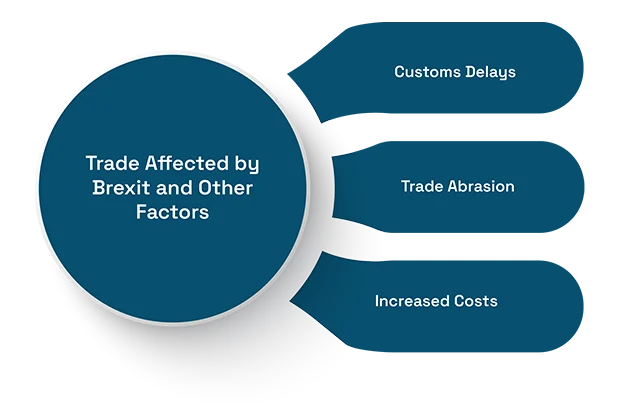
Trade Affected by Brexit and Other Factors
Brexit created immediate trade abrasion, with new requirements such as import export registration, exporter of record services, and detailed documentation tied to HS code and HTS harmonized tariff categorizations. Tariffs, regulatory approval, and customs delays have impacted everything from small exporters to large corporations. Beyond Brexit, other factors such as the pandemic, geopolitical tensions, and global changing trends have increased these challenges. To confirm smoother trade, companies increasingly depend on freight forwarding services, global supply chain services, and customs clearance support. At the same time, trade guidelines such as the Generalized System of Preferences and rules defined under Incoterms (such as DAP and Delivered Duty Paid logistics) remain central to reducing risks.

Impact of UK Post-Brexit Trade Policy on Major Industries
The UK’s independent trade policy has brought changes across industries:
- Automotive sector: Faced higher costs due to new export customs brokerage requirements and delays at borders.
- Healthcare: Stricter regulatory checks on product standards have slowed supply chains.
- Technology and IT equipment: Increased dependence on importer of record services and DDP shipping solutions to confirm approval with international export regulations. Customs procedures under new Incoterms arrangements, such as DAPs, have made logistics more difficult and costly.
- Companies are turning to comprehensive import-export support providers to remain competitive and resilient.
Visualizing the UK’s Imports and Exports Post Brexit
UK trade data post-Brexit declare a redirection of trade flows. Exports to the EU declined in the immediate aftermath but are gradually stabilizing as businesses adapt to new systems of export register and customs processes. Imports from non-EU countries have grown, showing a variation strategy supported by new long-term trade deals. Modern digital platforms for global trade facilitation allow businesses to visualize trade flows, track approval with exporter of record services, and improve delivery with the Delivered Duty Paid service. These tools not only increase visibility but also allow predictive planning across logistics networks.
Managing Brexit Challenges with Global Trade Technology
Technology has grown as the support of effective post-Brexit trade management. AI-powered agreement tools now assist organizations in classifying goods under the correct HS code, automating customs documentation, and aligning shipments with Incoterms such as DAP or DDP shipping. Complete platforms providing global supply chain services combine freight forwarding, customs clearance support, and Delivery Duty Paid logistics to simplify difficult trade processes. Through using such systems, businesses gain access to faster customs clearance, accurate tariff evaluation, and smoother border change, all while confirming agreement with international export regulations.
Conclusions
The post-Brexit trade landscape is both challenging and changed. From customs clearance difficulties to adapting to import export business regulations, organizations require strong plans to remain globally competitive. Improving technology-driven freight forwarding services, using importer and exporter of record services, and working with global trade facilitation systems, businesses can turn Brexit-induced hurdles into opportunities for growth. In this new era, success lies in accepting comprehensive import-export support, strengthening the logistics chain, and including flexible solutions such as DDP shipping to guide the complexities of cross-border trade.
DID YOU KNOW?
While the full official text is awaited, the FTA is expected to eliminate tariffs on almost 99% of Indian exports to the UK, opening up significant business opportunities. Conversely, the UK will see a reduction in Indian tariffs on 90% of tariff lines, of which 85% will become tariff-free within a decade.
FAQs:
Q1: How has Brexit impacted global trade?
Brexit has introduced new customs clearance requirements, tariffs, and documentation tied to HS codes and Incoterms, affecting both EU and non-EU trade.
Q2: Which industries are most affected by the UK’s post-Brexit trade policy?
The automotive, healthcare, and technology sectors face higher costs, delays, and stricter compliance requirements due to new trade rules.
Q3: What role do Incoterms like DAP and DDP play in post-Brexit trade?
Incoterms such as DAP (Delivered at Place) and DDP (Delivered Duty Paid) define responsibility for costs and risks, helping businesses manage customs and delivery obligations.
Q4: How can businesses manage Brexit-related trade challenges?
Companies rely on freight forwarding services, importer/exporter of record solutions, and digital platforms to automate customs, track compliance, and reduce risks.
Q5: What technologies are supporting post-Brexit trade?
AI-powered compliance tools, digital supply chain platforms, and global trade facilitation systems streamline HS code classification, customs documentation, and logistics visibility.