Introduction
Modern global business operations often create intricate challenges for exporting merchandise, which can cause significant difficulties for companies. Businesses that use Exporter of Record services (EOR) will face export difficulties with greater ease. A business advances its export compliance and logistical efficiency and lowers its exposure by using an Exporter of Record (EOR) as its essential partner. This blog examines the function of the Exporter of Record, their job duties, and how they help companies establish worldwide operations.
What is Exporter of Record?
A Global Exporter of Record (EOR) service controls global trade compliance by following export rules throughout the entire shipment duration. The EOR performs all export duties for international transactions by handling procedures while checking compliance and managing import duty payments to function as the official exporter. The service plays an essential function in various commercial sectors, including IT/data centres and automobile, aviation and medical equipment, since these industries face strict border restrictions for their product exports. Through its services of managing customs rules and foreign logistics management, the EOR platform allows companies to thrive in complex worldwide trading systems and successfully enter international markets.
AI customs compliance substantially changes global trade operations by allowing artificial intelligence tools to automate customs procedures, analyze data, and forecast compliance issues. The ongoing trend affects the export operations of IT and aviation companies and medical equipment providers, who need to apply these trends to their export operations and maintain compliance with regulations.

Responsibilities of the Exporter of Record
The Exporter of Record has several critical responsibilities. These include:
Customs Compliance: An EOR makes sure exported goods meet all customs requirements set by the countries from where they originate and the destination nation. An EOR performs HS coding properly, confirms export licenses, and manages export register documentation.
Documentation Management: The EOR handles and manages the full range of necessary export documentation, including invoices, bills of lading, and export declarations. A proper documentation system remains essential for preventing delays and associated penalties.
Tariffs and Duties: As an EOR agent, the company is responsible for handling payments, tariffs, and proper tariff code classification and HTS (Harmonized Tariff Schedule) classification.
Export Compliance Screening: Export Operations Representatives must screen export products and participants to verify compliance with the Generalized System of Preferences (GSP) and other sanctioned entities.
Risk Management: Recognizing possible risks & implementing mitigation strategies are crucial to the EOR’s role. This includes assessing political and economic risks and monitoring supply chain vulnerabilities.
Creating Smooth Export Processes for International Trade
A smooth export process allows companies to ship products to nearby countries without needless delays. In following the regulations of the destination nation, businesses should create proper documents, use correct product details, and complete customs clearance. Additionally, effective logistics management allows efficient product delivery, cargo tracking, and transportation planning. By taking these actions, you may improve international trading, reduce shipping issues, and improve customer fulfillment. Businesses may reduce costs, avoid difficulties, and forge strong ties with customers in global markets with careful planning and compliance.
Why an EOR is Your Best Trade Ally
Choosing the right Exporter of Record can simplify many of international trade’s complex and time-consuming aspects. Here are several reasons why an EOR can be your best ally in the export business:
Streamlined Supply Chain Management: Streamlining Supply Chain Management happens when exporters let an EOR handle their logistics operations while they concentrate on developing their core business disciplines, including product development and marketing. Through its EOR services, the organization enhances the overall process, from cargo forwarding to air forwarding, to deliver products efficiently and at reasonable costs.
Financial Management and Reporting: Through financial management tools, EORs provide organizations with equipment to follow expenses, monitor client billing activities, and create better cash flow management strategies. The financial reporting capabilities of these tools prove essential for businesses to determine export profitability and handle expenses in international trade operations.
Access to Expertise: Through collaboration with an EOR, businesses obtain professional expertise for global payment support, tariff classification, and export compliance expertise. Working with an EOR delivers essential market regulation understanding, leading to enhanced export procedure optimization.
Best Tools for Export Business The management of export operations can be improved through specific tools designed for businesses that want optimal export performance. These platforms enable companies to streamline both compliance requirements and financial tracking.
Financial Management Software: The program provides businesses with an interface for processing expenses and generating bills, flow adjustment capabilities, and financial statement creation tools. A software platform enables businesses to monitor their shipping expenses and related fees alongside duties while maintaining centralized financial operations.
Global Payment Support: Most exporters must handle payments that use multiple foreign currencies. The global payment tools help exporters handle transactions, verify they follow international payment laws, and provide multiple currency processing functions.
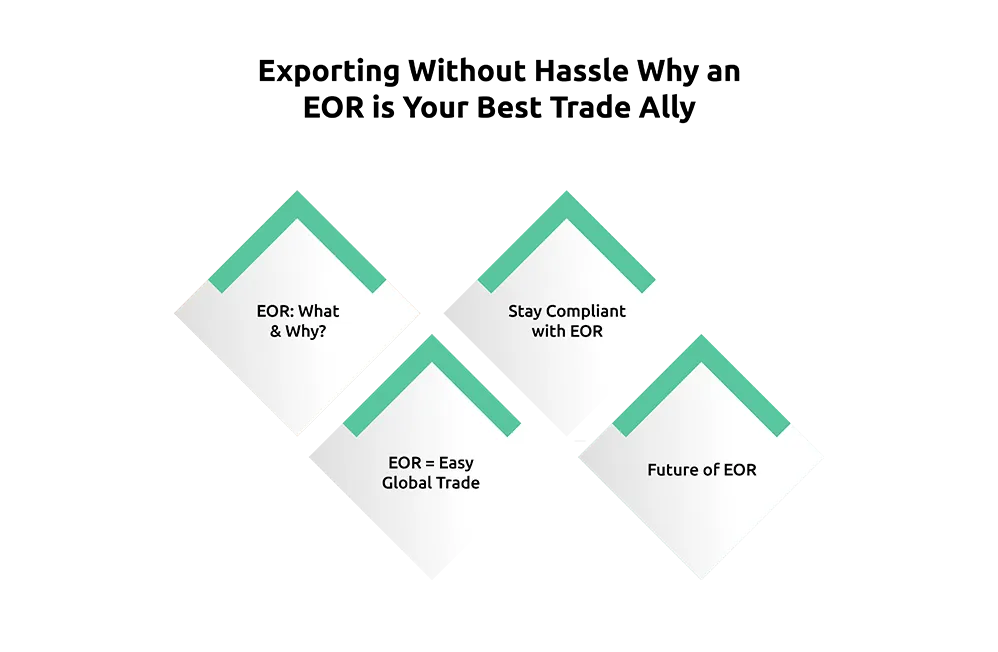
Exporter of Record (EOR) Compliance and Customs
To succeed in exporting, one must meet all customs requirements in the exporting country while adhering to laws established by the importing nation. The EOR oversees customs clearance procedures, document management, and proper tariff application duties. A company’s tariff classification needs proper analysis by the EOR while using Harmonized Tariff Schedule (HTS) to pair goods with their accurate designations. Companies benefit from their expertise by correctly filing trade documentation and customs duty payment management, which lowers potential delays.
An EOR takes export compliance and customs duties away from the business to dedicate full attention to developing products and making sales. This ensures businesses stay productive in international operations by handling complex procedures, allowing faster market expansion.
Conclusion
International trade becomes more manageable through a strategic partnership with an Exporter of Record (EOR).
As an Exporter of Record (EOR), one assumes responsibility for compliance obligations while managing logistics, paying fees, taking care of customs requirements, and acting as a risk management specialist. Businesses that aim to extend their reach across international borders should depend on EOR services because they simplify global business and minimize errors’ financial consequences.
Our team prepared multiple straightforward approaches to guarantee a comfortable and effortless experience. Every exporting company, from new businesses to experienced firms, will find support here. Follow to explore refining your export business operations into pleasant experiences. Contact One Union Solutions Now To Gain Deep Insights About Export-Import Businesses.
Did You Know?
As per the World Trade Organization, global trade activities have shown a 4% annual expansion within the past decade. Companies that depend on Exporter of Record services need to address essential requirements after supply chain complexity grows to reduce operational risks coupled with regulatory compliance needs.
FAQ’s
1. What is an Exporter of Record?
Ans: An Exporter of Record-EOR ensures that exports comply with regulations and handle tasks like documentation, tariffs, and duties during international trade.
2. How does an EOR streamline global logistics?
Ans: Companies can access border-compliant delivery and cargo forwarding services including air forwarding through the expertise of EOR providers.
3. What are the key responsibilities of an EOR?
Ans: The EOR manages compliance, customs documentation, risk management, and payment of duties & tariffs related to international exports.
4. Can an EOR help with compliance screening?
Ans: An EOR ensures that goods and involved parties comply with global regulations, including screenings for restricted entities.
5. How can an EOR reduce risks in global trade?
Ans: The EOR establishes systems to detect international market risks and implements protective measures to create continuous performance throughout worldwide supply chain operations.