Overview
The global aviation industry is facing a critical challenge in 2026—the shortage of certified aviation technicians. As air traffic continues to recover and expand, the demand for skilled maintenance professionals has outpaced supply. This gap is not only affecting airline operations but also disrupting cross-border aircraft maintenance trade, where timely servicing and compliance are essential.
Aircraft maintenance, repair and overhaul activities need technicians. These technicians must meet rules. There are not certified professionals. So airlines and service providers are working more with countries. They are sharing skills and parts. This is making it harder for businesses that import and export aviation parts. They must deal with complex rules for moving parts, equipment and experts around. The aviation MRO industry relies on technicians. They must follow regulatory standards. Fewer certified professionals are available.
Certified Aviation Technicians
Certified aviation technicians are highly trained professionals responsible for ensuring aircraft safety, performance, and compliance with aviation regulations. Their expertise covers everything from engine diagnostics to structural repairs and advanced avionics systems.
To become certified, technicians must undergo rigorous training and meet standards set by aviation authorities. These certifications are often region-specific, which adds complexity when technicians or services are required across borders. As a result, companies involved in international operations must navigate regulatory differences while ensuring that maintenance work meets global safety standards.
The use of aircraft technologies is becoming more popular and this is making the need for specialized skills even greater. Modern aircraft need people who can fix them. These people have to be good with their hands and also know how to work with computers and figure out problems using data. Aircraft technologies are very important. The people who work with aircraft have to know a lot about these aircraft technologies.
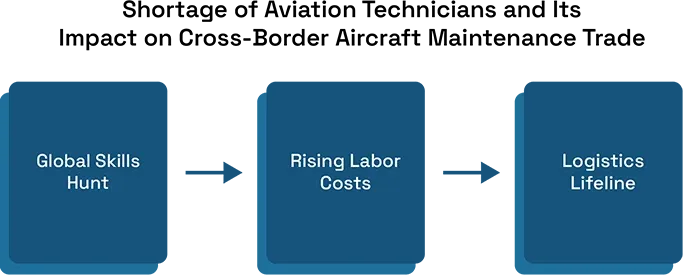
Shortage of Aviation Technicians and Its Impact on Cross-Border Aircraft Maintenance Trade
The shortage of aviation technicians is having a direct impact on cross-border aircraft maintenance trade. One of the most immediate effects is increased turnaround time for aircraft servicing. Delays in maintenance can lead to operational disruptions, higher costs, and reduced fleet availability.
Airlines and maintenance companies are trying to find a solution to a problem. They do not have people with the right skills to do the maintenance work. So airlines and maintenance companies are sending this work to places where they can find people who are good at fixing airplanes. This means that more and more airplane parts are being moved across borders. International freight services are very important in this situation. They have to make sure that the parts get to where they need to go on time. International freight services also have to make sure that airlines and maintenance companies follow all the rules. Airlines and maintenance companies need freight services to deliver airplane parts quickly and correctly.
The need for efficient importer of record service and exporter of record services has also grown significantly. These services help manage documentation, duties, and regulatory requirements, ensuring smooth cross-border transactions. Proper customs clearance is essential to avoid delays, especially when dealing with high-value and time-sensitive aviation components. Additionally businesses are focusing on making their supply chains work better to handle the complexity.
Good systems for managing inventory and orders are really important for keeping parts available and reducing downtime. Companies are also spending money on the software to follow trade rules, for importing and exporting to make sure they get it right and avoid risks.
The shortage is causing labor costs to go up. It is making companies compete for skilled technicians. This problem is affecting industries like the automotive industry and the medical equipment industry. These industries often use the supply chain networks and they need people with the same technical expertise. The shortage is a problem, for the automotive industry and the medical equipment industry.
Bridging the Gap: Strategies to Address the Technician Shortage
To deal with this shortage people in the industry are trying things. One important way is to spend money on teaching and certifying aviation technicians. One important way is to spend money on teaching and certifying aviation technicians. They help to make sure that there are trained technicians in the future.
Another important strategy is leveraging technology. Remote diagnostics, predictive maintenance, and digital platforms are enabling better utilization of existing resources. These innovations reduce dependency on physical presence and allow experts to support maintenance activities across borders.
From a trade point of view we really need to get logistics providers, customs authorities and service providers working together better. This is because when they coordinate well it helps to cut down on delays and makes cross-border operations run smoothly. By doing so we can make sure that goods move quickly and efficiently across borders.

Conclusion
The aviation industry is facing a problem. There are no certified aviation technicians. This is a big deal and it is changing the way the aviation industry works. The fact that there is a shortage of certified aviation technicians is having an impact on the aviation industry in different countries. This shows just how important it is to have workers who’re really good at their jobs to have systems in place to get things done quickly and easily and to have rules that everyone follows. The certified aviation technicians are crucial to the aviation industry.
Import and export businesses that work with aviation, IT, medical, and automotive sectors, have a problem to deal with. This problem can be bad for import-export businesses. Import-export businesses need to pay attention to supply chain optimization and international freight services to succeed.
The aviation industry is changing all the time. So it is very important to find a way to deal with the fact that there are not technicians. This is crucial for the safety of aviation, around the world. It is also necessary for aviation to be reliable and to keep growing. The global aviation industry needs to have technicians to keep everything running smoothly.
DID YOU KNOW
“The global aviation industry will require 710,000 new aircraft maintenance technicians by 2044, according to Boeing’s latest forecast, highlighting one of the most significant workforce challenges facing airlines and MROs over the next two decades. ”
FAQs
1. Why is there a shortage of certified aviation technicians?
The shortage is due to rising air travel demand, retirements, and limited training capacity for new skilled professionals.
2. How does this shortage impact aircraft maintenance trade?
It causes delays, increases costs, and drives the need for cross-border maintenance and parts movement.
3. What role do import-export services play in this situation?
They ensure timely delivery of aircraft parts and help manage compliance in international maintenance operations.
4. Which industries are affected by this shortage?
Primarily aviation, but also IT, medical, and automotive sectors due to shared supply chain dependencies.
5. How can companies overcome this challenge?
By investing in training, adopting digital tools, and improving supply chain coordination and compliance systems.