Brief overview of global trade expansion and rising customs complexity
International trade developed to record highs, growing to $35 trillion, driven by resilient customer demand, the technology & AI sectors, & developing South-South trade. This development is managed by geopolitical splitting, structural shifts in value chains, & a dramatic surge in regulatory risk that has transformed customs compliance into a main business challenge.
Role of AI in Modern Customs Systems
Artificial Intelligence changes modern customs systems by automating document processing and improving risk assessments. It transports borders from reactive risk into proactive, data-driven hubs, ensuring rapid clearance for using trade while mainly securing revenue & national security.
AI-Driven Trade Compliance: Classification, Risk Detection, & Fraud Prevention
Automated Classification & Valuation:
AI utilizes natural language processing to read trade documents in real-time, accurately categorizing products via Harmonized System codes & automatically calculating duty rates.
Predictive Risk Assessment:
Instead of random physical checks, AI mainly verifies global supply chain data & trader histories to identify risks & flag high-risk shipments before they arrive.
Intelligent Cargo Scanning:
Development with computer vision enables systems to analyze X-ray scans, automatically detecting hidden contraband & misclassified goods.
Fraud Detection:
AI algorithms cross-reference commercial invoices & cross-border certificates to spot differences, mainly minimizing tax avoidance.
Benefits of AI Adoption in Customs Authorities
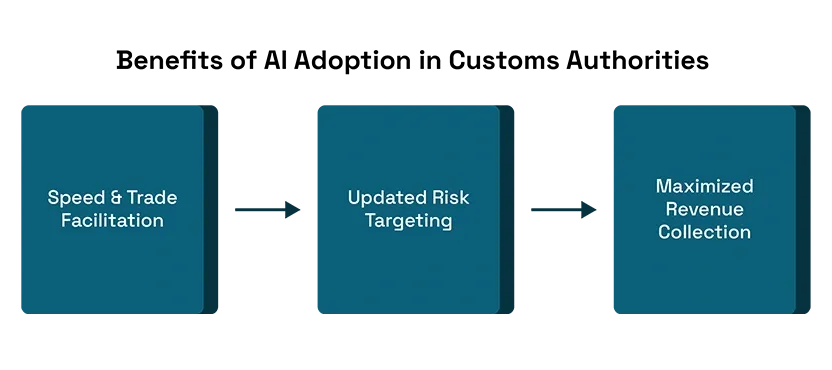
Artificial Intelligence adoption in customs authorities improves border management by automating data-heavy processes, simplifying cargo clearance, & mainly improving security. By using machine learning, authorities can minimize processing times, minimize revenue leakage, & transform human agents into strategic analysts
Main Benefits of AI in Customs
Speed & Trade Facilitation: AI automates document validation & HS code classification. This slashes customs clearance delays, minimizing processing times by 60-75% & mainly using the movement of genuine cross-border goods.
Updated Risk Targeting: Machine learning models analyze historical patterns & transporting declarations to flag anomalies. Smart computer vision & non-disruptive imaging X-ray analysis automatically detects concealed banned items, banned trade, & low value goods.
Maximized Revenue Collection: By finding misclassifications & systemic valuation errors before clearance, authorities plug revenue issues & ensure proper duties & taxes are collected.
Optimized Human Resources: Routine data entry & basic query management are automated, freeing up customs officials to focus on high-risk, complex verifications that require human judgment.
Coordinated Border Management: AI allows for unified, whole-of-government data processing, enabling seamless development between customs, border, & health agencies to enforce compliance.
Real-World Applications & Resources
Real-world applications of AI in customs implementation are already visible across many developed economies. The European Union uses collaborative AI platforms that help member states strengthen national risk assessments & develop coordination in detecting fraud & some trade activities. In the United States & Singapore, organizations such as Customs & Border Security and Singapore Customs use AI for automated cargo screening, risk-based targeting, & face recognition passenger processing to enhance both security & efficiency at country boundaries. For a deeper understanding of global standards, case studies, & development networks, the World Customs Organization gives complete guidelines on the use of artificial intelligence in customs operations. Insights into how public & private-sector models are developing AI-driven customs solutions can be found in reports such as PwC’s “Revolutionising Customs with AI,” which highlights practical adoption strategies & developing best practices.
Challenges & Limitations of AI Adoption in Customs
AI offers many benefits, but customs authorities also face many challenges when developing these technologies. One main issue is data privacy & national control, as sharing trade data across countries can create legal & security concerns. High development costs & the need to develop past systems can make AI adoption expensive, mainly for developing countries. Many customs agencies also struggle with system issues, where past systems cannot easily connect with new AI platforms. There is a risk of AI-driven inaccuracy if AI systems are developed using incomplete or inaccurate data, which may lead to incorrect risk assessments. Customs authorities also need skilled employees who can operate AI systems, analyze data, & manage digital customs operations effectively.

Conclusion
Artificial Intelligence is mainly changing customs authorities into smarter, faster, & more proactive enforcement agencies. Automating risk inspection, cargo verification, fraud detection, & trade classification, AI helps customs officials enhance working efficiency while developing border security & regulatory compliance. As global trade is mainly growing in difficulties, AI-driven customs systems will play an important role in verifying high-risk transportation, minimizing financial issues, & helping trade. Difficulties such as data privacy, system development, & workforce training remain, & continued investment in AI technologies & global collaboration will change the future of intelligent & secure global trade management.
Did you know?
Role of Fraud Detection Systems. The market for fraud detection and prevention solutions is itself booming; the global spend is projected to increase from approximately USD 32 billion in 2025 to USD 65.68 billion by 2030, reflecting a compound annual growth rate of 15.5 %.
FAQ
1. How are customs authorities using AI for fraud detection?
Customs authorities use AI to analyze trade documents, shipping data, and cargo scans in real time. AI systems can identify suspicious patterns, detect anomalies, and flag high-risk shipments that may involve smuggling, tax evasion, or false declarations.
2. What is AI-based risk scoring in customs?
AI-based risk scoring is a process where machine learning systems evaluate shipments based on factors such as importer history, product category, country of origin, and trade behavior. Shipments with higher risk scores are selected for additional inspection.
3. What are the main benefits of AI in customs operations?
AI helps customs authorities speed up cargo clearance, improve fraud detection, reduce manual paperwork, increase revenue collection, and strengthen border security while allowing officials to focus on high-risk inspections.
4. What challenges do customs agencies face when adopting AI?
Some major challenges include high implementation costs, data privacy concerns, interoperability issues with older systems, risk of algorithmic bias, and the need for skilled professionals to manage AI technologies.
5. Which countries are already using AI in customs enforcement?
Several countries and regions are actively using AI in customs operations, including the European Union, the United States, and Singapore. These authorities use AI for cargo screening, risk assessment, fraud prevention, and biometric border processing.