Introduction
China’s quickly growing electric vehicle production has created a large number of low-cost exports sweeping across the Global South. Backed by aggressive EV subsidies, deeply integrated supply chains, and a highly optimized logistics chain, China has made electric mobility both affordable and accessible. For Indian manufacturers, this rising competition is both a challenge and an opportunity. To stand strong, India must strengthen its own ecosystem from Import export documentation to live shipment tracking and even harmonizing agreement processes, such as HS code classification and HTS Harmonized Tariff Schedule for global markets. As import duties and tariffs continue to change trade flows in emerging economies, India’s EV exporters must confirm they understand the regulations of every destination country, including Incoterms like DAP and Delivered Duty Paid service options that increase landed costs and customer experience.
How Indian Manufacturers Can Compete in the Global South EV Market
India’s EV sector has grown steadily, driven by local demand, government incentives, and rising supply chain readiness. Also, in many Global South markets Africa, Latin America, and Southeast Asia, Chinese EVs enter at competitive prices due to massive economies of scale. Indian companies can overcome this by focusing on quality and affordability. Confirming the correct HS code and approval through IOR services, along with a good knowledge of Importer of Record responsibilities, allows exporters to expand into new regions with fewer regulatory delays. Meanwhile, using global standards in Import export documentation reduces clearance issues and increases the export process. Also, India can take advantage of preferential trade benefits like the generalized system of preferences (GSP), where applicable, improving pricing competitiveness without compromising good value.
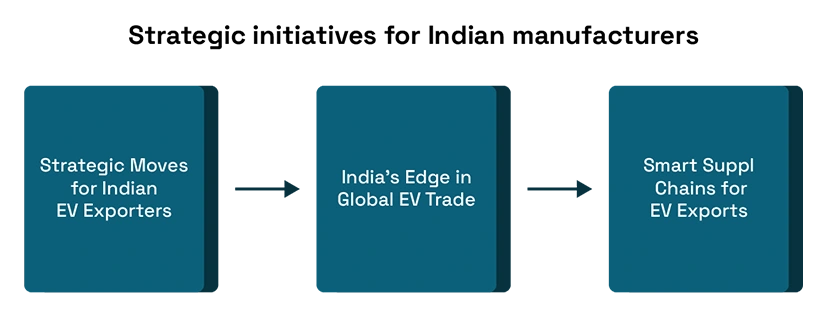
Strategic initiatives for Indian manufacturers
Indian EV exporters need major initiatives that go beyond manufacturing. Strengthening logistics efficiency, investing in International freight services, and using live shipment tracking help provide end-to-end clarity to overseas supply. In many regions of the Global South that have poor infrastructure, confirming dependable last-mile delivery services can differentiate Indian suppliers from their opponents. Exporters should also consider flexible Incoterms, such as DAP or Delivered Duty Paid, when entering new trades where buyers may want customs expertise. Simplifying Supply chain optimization to managing export packing can cut working expenses and reduce overall delivery times. Also, exporters can depend on IOR services to guide countries’ guidelines, improving trust among global buyers and reducing risks related to customs fees or delayed seaport clearance.
What Can India’s EV Industry Learn from Global Methods?
Indian manufacturers can gain valuable insight from global EV leaders. China’s success is deeply rooted in its mastery of Supply chain optimization, localized component manufacturing, and integrated logistics hubs. Europe, on the other hand, improves high-quality engineering, sustainable materials, and strong safety certifications. India can apply these lessons by working on manufacturing standards with global standards, confirming each exported vehicle meets or exceeds destination market safety. Adopting digital-first import–export systems, improving HTS Harmonized Tariff Schedule accuracy, and increasing Exporter of Record definition clarity within internal teams will further strengthen India’s global credibility.
Advancing India’s trade in International Value Chains
The automotive industry plays an important role in global trade, shipping vehicles to over 100+ nations. As EV use grows globally, India must see a manufacturing and export hub. Increasing International freight services, stronger port connectivity, and improving DAPs and related logistics approach will show India’s involvement in global value chains. The EV sector can mainly benefit from guidelines that simplify import duties and tariffs, expand R&D capabilities, and increase component localization. Improved real-time shipment tracking and combined complete delivery services, India can provide a smooth export experience similar to global leaders.
Conclusion
China’s export surge in EVs demands a major response from Indian manufacturers. By strengthening approval systems, optimizing logistics, mastering Incoterms, and improving Supply chain improvement methods, India can position itself as a credible alternative for Global South markets looking for affordable and dependable EV solutions. With the right guidelines and industry collaboration, India can rise beyond competition and develop the next breaker of electric mobility across growing economies.
DID YOU KNOW?
India’s twin goals of achieving net zero emissions by 2070 and reducing carbon intensity by 45 percent by 2030 have highlighted the critical importance of driving the energy transition in urban areas.
FAQs:
- Why are Chinese EVs dominating the Global South markets?
Chinese EVs benefit from large-scale production, aggressive subsidies, and deeply integrated supply chains, allowing them to offer low-cost vehicles across emerging markets.
- How can Indian EV exporters compete with China’s pricing?
Indian manufacturers can focus on quality, affordability, component localization, and using standards-based export documentation to reduce customs delays and increase efficiency.
- Why are HS codes and HTS classification important for EV exports?
Correct HS and HTS classification helps avoid penalties, customs delays, and additional duties. It ensures smooth cross-border movement and compliance with destination country regulations.
- What role do Incoterms like DAP and DDP play in EV exports?
Incoterms determine responsibility for shipping, duties, and risks. Using terms like DAP or DDP can improve buyer convenience and customer experience in new or complex markets.
- How do IOR and EOR services support EV exporters?
Importer of Record (IOR) and Exporter of Record (EOR) services handle regulatory compliance, permits, and documentation, helping companies expand globally without local entity requirements.