Introduction
Bangladesh’s export sector has faced a sudden challenge after India ended its long-standing air transshipment facility. For years, Bangladeshi exporters have depended on Indian airports to connect with global trades at competitive rates. The customs clearance has changed the way businesses manage logistics, pushing exporters to depend on local airports and invest more massively in freight forwarding services, importer of record services, and customs clearance support. This change highlights the importance of building independent capabilities in line with international export regulations and global trade facilitation standards.

Bangladesh Air Cargo Chain as India Ends Transshipment Entry
With India no longer providing transshipment, Bangladesh has been forced to enhance its air cargo infrastructure. Dhaka’s Hazrat Shahjalal International Airport is now the primary hub, handling a sharp increase in cargo volumes. The aviation sector is expanding its shipping capacity, while Chattogram and Sylhet airports are also being considered for broader operations. Exporters are turning to comprehensive import-export support and export customs brokerage to simplify processes and reduce delays. By simplifying import export registration and providing global supply chain services, Bangladesh aims to ensure uninterrupted international connectivity.
Why did India withdraw the Transshipment Facility for Bangladesh?
India’s decision was derived from guidelines changes, Import-export balancing methods, and national security considerations. Also, Bangladeshi exporters benefited from entry to major Indian hubs such as Kolkata and Delhi, which provided better connectivity and lower costs. Also, with the facility removed, Bangladesh must now handle shipments directly, depending on the exporter of record services and strong export register compliance. This change has forced businesses to review shipping strategies, with a greater focus on global trade facilitation procedures to remain competitive.
Why the Rates Increased after India Ends Transshipment
The rise in air freight rates was unavoidable once India closed its transshipment routes. Without access to India’s larger airports, Bangladesh’s exporters face limited options and higher operating expenses. Local handling costs, fuel surcharges, and ground services are pushing prices upward. Additional compliance with HS Code, HTS harmonized tariff, and Incoterms has also added to the complexity and cost. Exporters managing shipments under DDP shipping or delivered duty paid logistics face even higher fees due to full responsibility for duties, taxes, and delivery charges. As a result, the competitive pricing advantage that Bangladeshi exporters mostly used has now been hugely reduced.
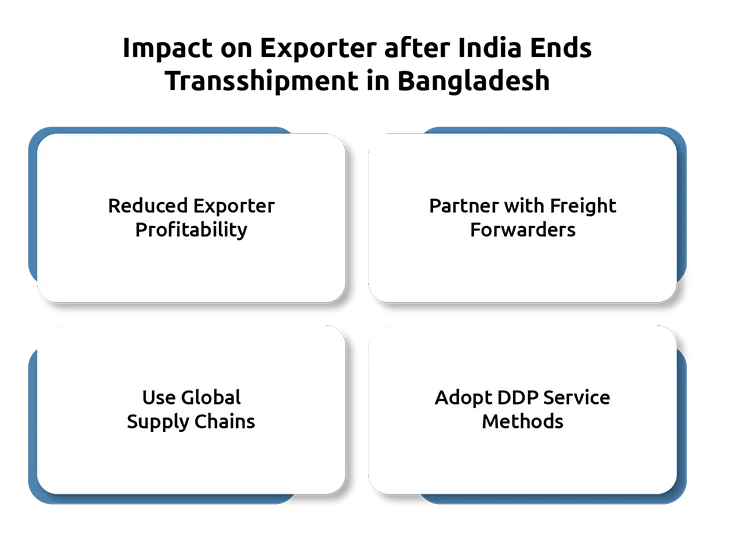
Impact on Exporter after India Ends Transshipment in Bangladesh
Exporters, mostly in the aviation, electronics, and medical industries, are experiencing high margins. Smaller businesses engaged in the import-export organizations are finding it difficult to compete in global trade, as higher freight fees reduce profitability. To adapt, many are partnering with freight forwarding companies that specialize in export customs brokerage and comprehensive import-export support. Most of the organizations are using global supply chain services and exporter of record services to manage agreements and maintain smooth operations. Also, unless effective solutions such as DDP service methods and customs clearance support are adopted more widely, small and medium-sized exporters may struggle to sustain growth in the current environment.
Conclusion
India’s decision to end the air transshipment system has clearly reshaped Bangladesh’s export logistics service. While the immediate effects include higher freight costs, capacity pressure, and operational complexity, the change also presents a long-term opportunity to improve local air cargo infrastructure and reduce external dependency. Investing in airport systems, exporter of record services, export customs brokerage, and global supply chain services, Bangladesh can build a more flexible and independent export. Success will depend on how quickly exporters accept new approval requirements, improve logistics, and work with international export regulations and the global trade facilitation system.
DID YOU KNOW?
Exporters in Dhaka also have to pay additional fees, including Rs 2.5 per kg for ground handling, Rs 2 per kg for scanning, and Rs 0.25 per kg for warehouse storage.
FAQs:
Why was India’s air transshipment system important for Bangladesh?
Indian airports such as Kolkata and Delhi provide better global connectivity, frequent cargo flights, and lower costs, making them a preferred routing option for Bangladeshi exporters.
How has the removal of transshipment affected freight rates?
Rates increased due to limited direct Aircargo options, higher local handling charges, surcharges, and the added load of direct customs and approval processes.
Which sectors are most impacted by this change?
Export-oriented industries such as aviation components, electronics, and medical products are most affected due to their dependence on fast and affordable air cargo.
What role do freight forwarders and exporter of record services play now?
They help exporters manage documentation, regulatory approval, customs clearance, and global shipping responsibilities more effectively in Indian logistics hubs.
How can Bangladeshi exporters stay competitive going forward?
Using complete import-export support, improving HS code and Incoterms agreement, using DDP shipping where suitable, and global supply chain services to reduce delays and control costs.