Introduction
South Asia is growing fast in global trade. Countries like India and Sri Lanka have built strong logistics hubs that connect them to international markets.
But Bangladesh contributes less than 5% of the region’s total logistics.
Even though it has a good location, weak logistics slow down imports, exports, and industry growth.
Bangladesh needs better trade systems, modern logistics, and efficient supply chains to improve.
Bangladesh’s Logistics Challenges
Bangladesh’s logistics system faces many problems:
- Small port capacity
- Slow customs clearance
- High freight costs
- Old warehouses
These make trade slower and more expensive. Other South Asian countries use Incoterms like DAP (Delivered at Place) and DDP (Delivery Duty Paid) to make trade easier.
Bangladesh struggles to use these systems effectively.
Exporters relying on customs brokers or Exporter of Record (EOR) services face extra difficulties. This keeps Bangladesh’s share in regional logistics very small.
How It Affects South Asia
Bangladesh’s weak logistics slow down the whole region.
Mistakes in HS Codes, tariff schedules, and import rules delay shipments.
Businesses using Importer of Record (IOR) services face higher costs and more red tape.
Because of this, many companies avoid shipping through Bangladesh.
This reduces South Asia’s logistics performance by about 5%.
Regional Impact
When Bangladesh underperforms, South Asia loses competitiveness.
Freight forwarders and supply chain companies miss opportunities to use Bangladeshi routes.
Slow customs and poor trade support also discourage foreign investors.
It limits the region’s benefits from programs like the Generalized System of Preferences (GSP), which helps developing countries grow exports.
Bangladesh’s Growth Potential
Bangladesh can improve and become a strong logistics hub.
Key steps include:
- Upgrading ports and transport
- Digitizing customs clearance
- Improving DDP (Delivery Duty Paid) shipping
- Simplifying import and export registration
- Following Incoterms and global trade rules
Working with global logistics providers offering IOR and EOR services can help Bangladesh connect better to world markets.
The Way Forward
Bangladesh should invest in infrastructure, technology, and policy reforms.
Better coordination between freight companies and customs authorities can reduce delays and costs.
With these steps, Bangladesh can grow from a small trade route into a major logistics hub in South Asia.
Conclusion
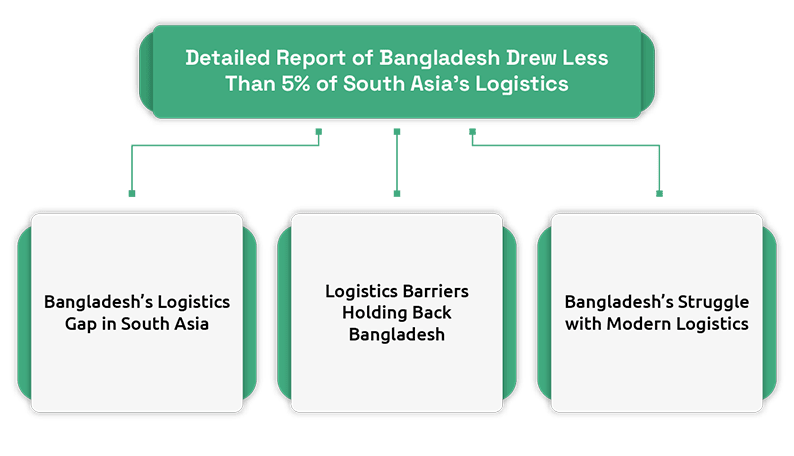
Bangladesh’s current share — less than 5% of South Asia’s logistics — shows challenges in infrastructure, customs, and policy.
With smart investments and partnerships, it can improve quickly.
By modernizing freight forwarding, customs processes, and DDP logistics, Bangladesh can become a key player in regional trade and attract more global business.
Did You Know?
In FY24, Bangladesh imported goods worth USD 63.22 billion.
Imports from SAARC countries were 15.44%, slightly higher than last year.
Exports to SAARC were only 4.47% of total exports (USD 39 billion).
(Source: Bangladesh Bank Report on Trade, Remittances, and Investment)
FAQs
Q1. Why does Bangladesh contribute so little to logistics?
Because of small ports, slow customs, high costs, and outdated warehouses.
Q2. How does this affect South Asia?
It creates delays and reduces trade efficiency in the region.
Q3. What are Incoterms like DAP and DDP?
Trade rules that show who is responsible for shipping, taxes, and delivery.
Q4. How can Bangladesh improve?
By upgrading infrastructure, digitizing customs, and partnering with global logistics companies.
Q5. What is the future of Bangladesh’s logistics industry?
With the right investments and reforms, Bangladesh can grow into a strong South Asian trade hub.