Mission critical is a common phrase that is used all the time in the business world. The term identifies the systems that are crucial for the existence of the organizations. All the facilities that are crucial for the survival and operation of the business are regarded as mission-critical facilities.
Data centers are the most important ones. When such a system is disrupted or disturbed all the basic operations of the businesses are severely impacted. Nowadays the world can be regarded as an entity that revolves around data where safety, speed, and storage are of utmost importance. If there is a slight disruption in the data it can bring huge global outcomes. Therefore the solution providers of the data centers need to operate in a manner that their facilities work forever day and night.
Assuring Continuous Operations in Data Center
Mission-critical facilities, especially data centers, are highly flexible and can recover quickly from disruptions because they are built with strong resilience. Their infrastructure has become more advanced over time with new technologies. Systems like Supervisory Control and Data Acquisition (SCADA) and DCIM continue to show strong growth potential.
Cloud and data center solution providers are working to achieve fast, large-scale growth while ensuring strong security. As technology improves, systems are becoming more complex, and the solutions required are also increasing. Even with advanced automation and modern tools, data centers are still run by people — and human error can still occur.
Why is Redundancy Essential in Mission-Critical Facilities?
Mission-critical facilities are designed to handle at all times, making system availability a key part of their network strategy. Backup systems provide support for important components such as power supplies, cooling units, network connections, and storage systems if the primary system experiences a failure. This approach helps reduce the risk of service downtime & protects critical business operations. By reduce single points of failure, organizations can improve system availability, protect important data, & perform servicing with minimal working impact. A well-planned redundancy strategy also improve business continuity & supports reliable performance in high-demand environments.
Assuring the Greatest Performance from Critical Systems
Getting an understanding of the complex nature of the systems to get the maximum operating time is very difficult. To achieve this, the facilities need workers who are highly skilled and work on clearly set maintenance standards. In today’s world critical facilities are no longer regarded as the top secret ones, but the operations that if affected can disrupt the crucial functions of the companies.
The industry is facing a crucial time where very few experienced technicians can work efficiently in these facilities. Their most important priority in this regard is providing appropriate knowledge and assistance to the employees and making sure that they professionally perform all their duties in a safe environment.
In today’s highly digital and mutually connected world, maintaining mission-critical operations is no longer alternative is important. Businesses should focus on strong mission-critical infrastructure management to ensure continuous uptime, data security, and operational stability. Whether it is a data center or a command hub, the ability to react rapidly to disruption is directly associated with how well these features are managed. Mission-mating features include a combination of efficiently skilled personnel, standardized procedures such as SOP and EOP and active training programs. This integrated approach not only protects important tasks but also strengthens overall flexibility and performance in the high-demand environment.
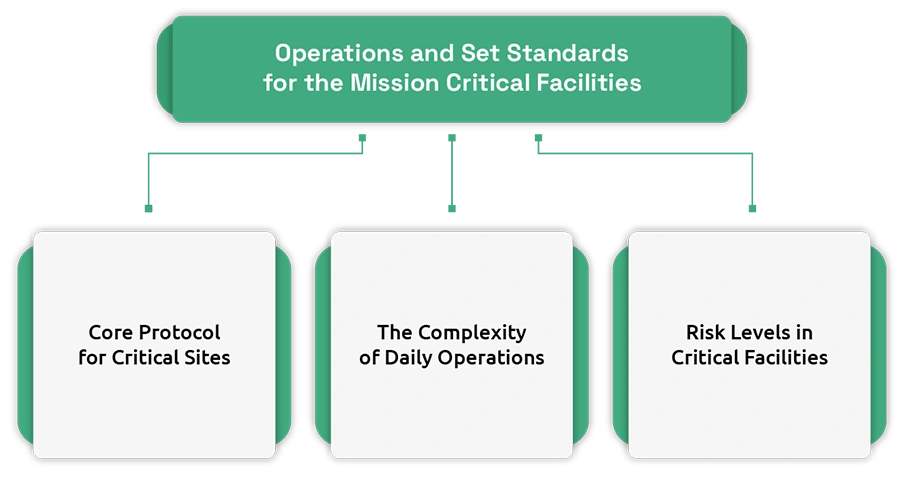
Operations and Set Standards for the Mission Critical Facilities
Safety needs differ based on the type of organization. For example, government institutions focus heavily on data privacy and try to protect their information at all costs. In contrast, universities may use their critical facilities to highlight their capabilities and improve their public image.
These factors are not the only parts of change management, but they are very important. Managing daily data center operations is often time-consuming and complicated because of advanced technology. This is why many companies choose to outsource these tasks, allowing them to focus on more important business priorities. Outsourcing helps critical facilities grow, develop, and operate more efficiently.
How Does Risk Management Improve Mission-Critical Operations?
Mission-critical operations operate in environments where even minor delay can affect important business operations. An efficient risk management strategy helps identify potential working issues before they impact performance. Regular system assessments, continuous monitoring, & planned planning enable organizations to respond quickly to unexpected events. Combined with clear working processes and skilled teams, risk management supports business continuity, minimizes downtime, & improves the long-term stability of critical network.
Conclusion
Mission-critical facilities require strong network, skilled teams, & effective risk management to maintain continuous operations. As businesses depend more on data-driven services, reliable data center performance has become essential for security and business continuity. One Union Solutions helps organizations manage critical infrastructure requirements with expert coordination, compliance support, & reliable global logistics solutions. Their approach helps businesses maintain operational stability & reduce risks in complex environments.
DID YOU KNOW?
India’s data center capacity increased from approximately 375 MW in 2020 to around 1,500 MW by 2025, reflecting the growing need for reliable, mission-critical infrastructure to support digital services and AI workloads
FAQS
What are mission-critical facilities?
They are essential systems, like data centers, that a business depends on. If they fail, core operations are affected.
How do data centers ensure continuous operations?
They use advanced tools like SCADA and DCIM to stay resilient, monitor systems, and recover quickly from disruptions.
Why is backup infrastructure important in mission-critical facilities?
Backup network helps reduce downtime by supporting power, cooling, network, & storage systems during failures or scheduled servicing.
What are the biggest risks to mission-critical operations?
Common risks include power downtime, equipment failures, network delay, cybersecurity risk, & human error.
How do standard operating procedures improve mission-critical performance?
SOPs & EOPs provide clear operating guidelines, helping teams respond quickly, minimize risks, & support continuous operations