Introduction
The trade relationship between India and the United States has always been changing, mainly in the automotive sector. Also, the recent increase to a 50% US duty on Indian auto parts has created a tariff complication that exporters, and importers are now struggling to guide. As global logistics become more interconnected understanding the effects of this tariff and how it affects Import export documentation, HS code classification, and the broader HTS Harmonized Tariff Schedule is more important than ever. Many organizations are now reconsidering their supply chain optimization plans to stay competitive while confirming agreement with Import duties and tariffs.
What the tariff is and why it was imposed on Indian Auto Parts
The 50% duty is largely rooted in long-standing trade imbalances and policy transitions following the clearance of India from the Generalized System of Preferences (GSP) program. Under GSP, many Indian products previously entered the US at reduced or zero tariffs, but after its termination, auto parts fell under standard HTS duty rates. The new tariff shows the US government’s objective to protect its local manufacturing sector and optimize competitive advantages. As a result, auto part exporters must now pay higher duties based on the precise HS code classification used for each shipment. This has also increased the importance of accurate Import/export documentation and a strong understanding of HTS rules to avoid penalties or delays at US Customs.

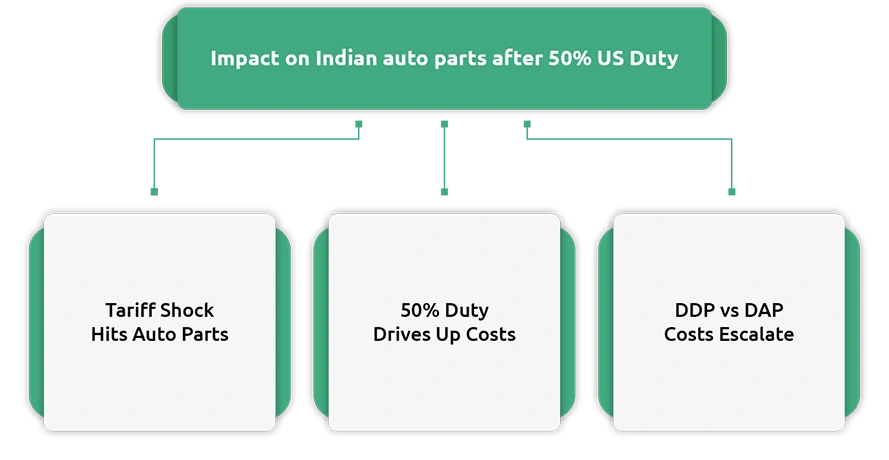
Impact on Indian auto parts after 50% US Duty
The impact of the tariff has been immediate and extensive. The cost of exporting auto components such as brake systems, engine parts, bearings, and electrical assemblies has risen sharply. Importers using Delivered Duty Paid service (DDP) or Delivered at Place (DAP, DAPs) terms now face higher landed costs as they must factor in the increased Import duties and tariffs when quoting clients or completing agreements. Many businesses now find themselves reworking International freight services plans and their supply chain optimization methods to maintain profitability.
Auto part suppliers may take a detour from the US market under the two-tier tariff.
The introduction of a two-tier tariff structure, where certain auto parts face higher duties compared to others, has pushed many Indian suppliers to consider reducing their dependence on the US market. Organizations that once exported huge volumes are now exploring alternative destinations where duties are more predictable, Also, some exporters are re-evaluating their definition and their relationships with US-based Importer of Record responsibilities partners to minimize approval risk. Without clear long-term tariff stability, businesses may change work toward markets providing better trade access, a predictable tariff system, and more flexible logistics solutions.
How does One Union Solutions help you import Auto Parts in the US?
One Union Solutions plays a crucial role in helping businesses guide this complicated tariff environment. Their expertise in IOR services and Importer of Record responsibilities confirms that all import/export documentation, HS code classification, and tariff issues are managed with accuracy. They work end-to-end logistics, from International freight services confirming your shipments remain compliant throughout the import cycle. Whether a business uses DAP, DDP, or other Incoterms, One Union Solutions helps optimize the complete process, providing Supply chain optimization insights, minimizing customs delays, and confirming that Import duties and tariffs are correctly calculated and paid.
Importance of Proper Tariff Planning in the Auto Parts Supply Chain
Rising duties on automotive components have made tariff planning an essential part of international trade strategy. Exporters shipping auto parts to the United States must carefully evaluate the HTS Harmonized Tariff Schedule, verify the correct HS code classification, and prepare accurate import/export documentation before goods leave the origin country. Proper planning helps businesses estimate Import duties and tariffs in advance, control landed costs, and avoid unexpected customs delays. It also allows companies to choose suitable Incoterms such as DDP or DAP, and adjust their supply chain optimization strategies to remain competitive in the US automotive market. By combining compliance knowledge with efficient International freight services, organizations can maintain smoother trade operations even when tariff policies change.
Conclusion
The 50% US duty on Indian auto parts has changed trade patterns and forced exporters and importers to reconsider plans, approval procedures, and logistics planning. While the tariff faces challenges, businesses can still succeed with proper guidance, correct HTS harmonized tariff Schedule categorization, and dependable partners such as One Union Solutions. By using changing policies, strengthening documentation accuracy, and improving supply chains, organizations can continue to grow even in a difficult tariff structure.
DID YOU KNOW?
According to the Automotive Component Manufacturers Association (ACMA), exports to the US were worth nearly $7 billion in 2024. Of this, $3.6 billion worth of spare parts and components for cars and light trucks will now be subject to a 25% tariff.
FAQs:
-
Why did the US impose a 50% duty on Indian auto parts?
The tariff increase is primarily linked to trade policy changes and India’s removal from the GSP program. Without GSP benefits, auto parts now fall under standard HTS duty rates, increasing the tariff burden on exporters.
-
Which auto parts are most affected by the 50% US duty?
Components such as brake systems, engine parts, electrical assemblies, bearings, and metal components are heavily impacted due to their higher HTS classifications and value.
- How does HS code classification influence the final duty rate?
Each auto part must be classified under the correct HS code. Even small errors can lead to miscalculated duties, reclassification at US Customs, and penalties, increasing the overall landed cost.
-
Can businesses reduce costs despite the high tariff?
Yes. Accurate documentation, correct HTS classification, optimized shipping terms (like DAP or DDP), and strategic logistics planning can help reduce delays, avoid penalties, and minimize unexpected expenses.
-
How does One Union Solutions help with importing auto parts into the US?
One Union Solutions assists with IOR services, documentation, HS code classification, customs compliance, international freight, shipment tracking, and last-mile delivery, ensuring smooth and fully compliant import operations.