Overview
The proper officer may carry out the audit of assessment of imported goods or export goods for legal compliance, and correct assessment of Customs duties will be verified by the Customs at the premises of importers and exporters. Bills of entry are selected for PCA under the Risk Management System for audit/verification of the correctness of the declaration of the bill of entry.
What Is a Customs Compliance Audit?
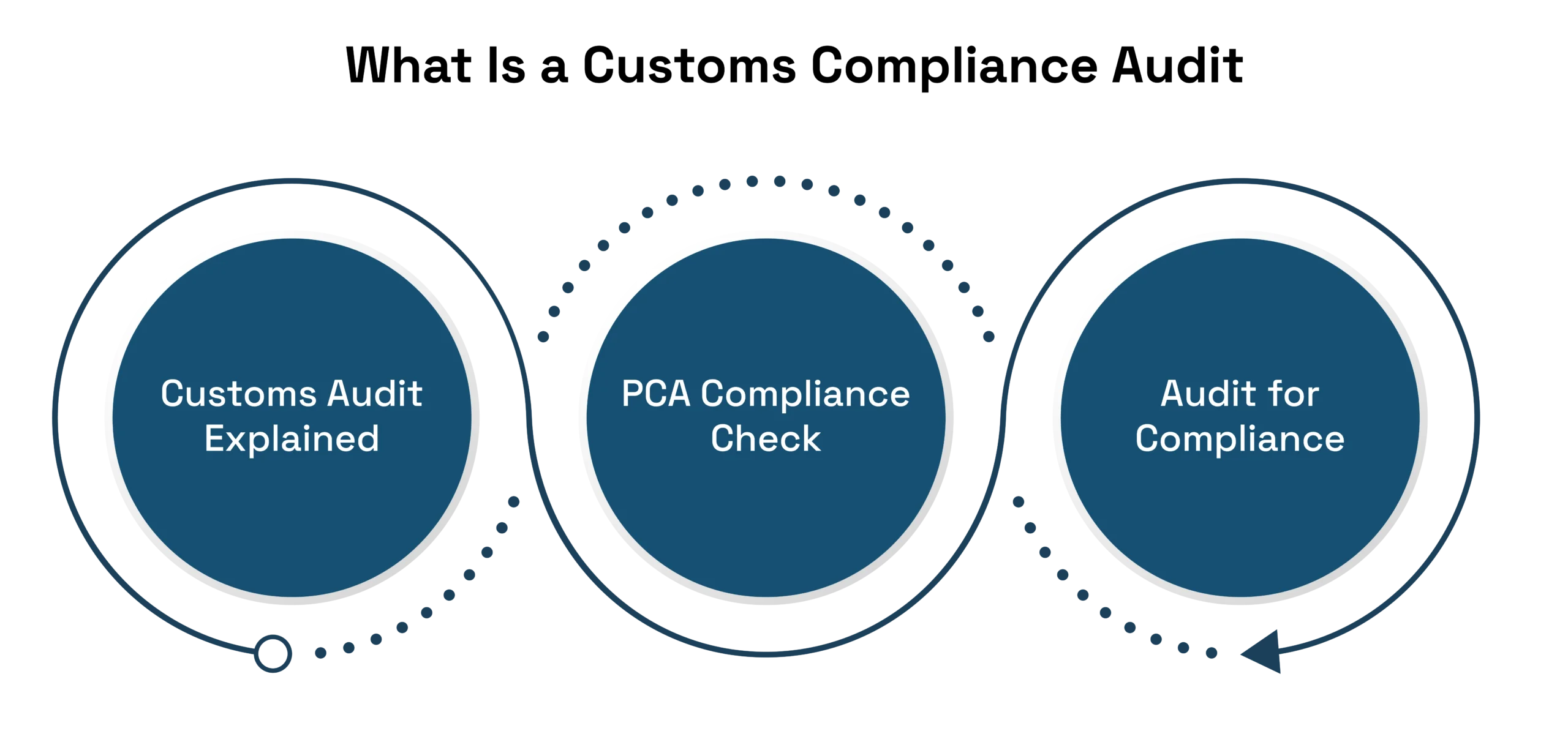
The Post-Clearance Audit (PCA) process can be defined as the structured examination of a business’ relevant commercial systems, sales contracts, financial and non-financial records, physical stock and other assets as a means to measure and improve compliance. The overall objectives of PCA is to assure that Customs declarations have been completed in compliance with Customs legal requirements as well as other requirements under any other law applicable in respect of import or export. The physical presence of Customs at the gateway to a country means checks can be conducted in real time before a decision is made to release a consignment of goods. Many administrations, therefore, nowadays concentrate their controls on the post-importation/exportation environment, whilst retaining selective and targeted checks at the frontier.
To verify that the value, origin, and classification of goods are declared correctly and the amount of revenue legally due has been identified and collected. To ensure goods liable to specific import/export controls are properly declared, including prohibitions and restrictions, licenses, quotas, etc., to ensure conditions relating to specific approvals and authorizations are being observed. Thus, PCA is a means to measure and improve the compliance of traders.
Why Should Businesses Prepare for a Customs Compliance Audit?
Customs will verify the accuracy of declarations and/or other returns submitted to Singapore Customs against the relevant trade documents provided by the auditee. Traders are also reminded that they must retain documents relating to import, export and transhipment activities for 5 years. Where applicable, compositions or other penalties may be imposed.
The duration of a post-clearance audit varies depending on the scope of the audit and the level of cooperation and completeness of information provided by the auditee. We will check whether the information declared is accurate by examining a sample of the goods, a series of cross-reference checks using the original supplier’s invoice or bill of lading and all of the supporting documentation for that particular declaration, and to confirm that traders are complying with their obligations regarding international trade activity for imports and exports. Businesses should establish proper internal systems to verify customs declarations, maintain accurate records, and ensure compliance with import and export regulations.
How to Prepare Your Business for a Customs Compliance Audit
It is essential to establish a comprehensive Internal Compliance Program (ICP) within the organization. The program should define clear policies and procedures for all customs-related activities. A thorough examination of all relevant documents is essential. This includes import/export declarations, sales agreements, invoices, packing lists, bills of lading, certificates of origin, payment proofs, training records, and internal correspondence related to trade activities. All files within the required retention period should be complete, well-organized, and easily accessible to demonstrate a clear audit trail.
Conduct a self-audit: It is highly recommended to conduct an internal mock review. During the customs audit, maintaining a cooperative and transparent approach is vital. Provide all requested information accurately and substantiate responses. If discrepancies are identified, acknowledge them promptly and present a corrective action plan with legal support to mitigate potential fines.

What Happens If a Business Fails a Customs Compliance Audit?
Customs may reject the declared value where it has reason to doubt its truth or accuracy. Differential duty and interest remain recoverable within the normal two-year limitation period, without confiscation or penalties. Customs enforcement proceedings are generally initiated by a show-cause notice issued by customs officers, including the Directorate of Revenue Intelligence. Importers are responsible for customs declarations, even where prepared by brokers or suppliers; customs brokers are responsible where they knowingly participated in or abetted the breach.
A system is in place for the monitoring and verification of exemptions, concessions, and duty waivers, including for enforcement action and loss recovery. Number of audits of bonded warehouses, duty- free store locations, and SEZ operators (if applicable), number of detected irregularities, and amount of recovered revenues, including penalties and fines.
Conclusion
Businesses can best take advantage of this opportunity if their internal processes are geared toward achieving better compliance with regulatory requirements. The better the compliance history of a business entity, the lower the chances of intervention at border points, which means cost and time savings for high-performance firms. Economic operators with a consistent track record of compliance, and no major errors or anomalies in their declarations, receive predictable treatment and faster clearance. Business enterprises should ensure in their internal processes that declarations are carefully prepared, reviewed and monitored by all managers dealing with international trade matters.
Did you know
Global goods trade is estimated to have reached approximately US$13.7 trillion in the first half of 2026, up 12.5 % from the same period in 2025.
FAQ
What is the first thing a business should check before a customs audit?
A business should first review its past import and export records, including invoices, customs declarations, HS codes, and duty payment details.
How can incorrect HS codes affect a customs audit?
Incorrect HS codes can lead to wrong duty payments, incorrect product classification, and customs penalties. Businesses should check whether their product codes match the actual goods.
Can customs authorities check old import shipments during an audit?
Yes. Customs authorities can review previous shipments and related records to check whether businesses followed the applicable customs rules.
What happens if the value on a commercial invoice does not match the customs declaration?
Customs authorities may ask for supporting documents to understand the difference. If the declared value is incorrect, the business may face additional duty payments or penalties, depending on the rules.
Why do customs auditors check the country of origin of goods?
They check the country of origin to confirm where the goods were made or produced. This helps verify whether the correct customs duty and any claimed trade benefits have been applied.