An importer of record is the entity or individual who is responsible for all entry documents required by CBP (Customs Border Protection) and for the product classification and payment of duties, as well as any other import obligations. In terms of the Customs Act, 1962 follow with the relevant rules and regulations, imported and export goods are subjected to certain legal and procedural formalities before being permitted clearance by Customs.
Goods imported into the country attract Customs duty and are also required to confirm to relevant legal requirements. Heavy Engineering and Machine Tools Sector consists of Capital Goods Industry.
Understanding Import Compliance for Industrial Machinery
The importer, either himself or through his authorized Customs Broker (CB), is required to file a declaration in electronic format called as Bill of Entry. Under self-assessment, it is the importer who will ensure that he declares the correct classification, applicable rate of duty, value, benefit of exemption notifications claimed, if any, etc.
The imported goods, which are interdicted for examination by the Risk Management System, are required to be examined for verification of correctness of description/declaration given in the Bill of Entry and related documents.
For export or import of specific goods or category of goods, which are subject to any restrictions/ policy conditions or require NOC or product specific compliances under any statute, the regulatory authority concerned may notify additional documents for purposes of export or import.
Major Import Compliance Challenges for Industrial Machinery in 2026
Along with the Bill of Entry the following documents are also generally required,Signed invoice, Packing list, Bill of Lading or Delivery Order/Airway Bill, GATT valuation declaration form duty filled in, Import license wherever necessary, and insurance documents the correctness of the information given therein has also to be certified by the importer in the form a declaration at the foot of the Bill of Entry and any mis-declaration/incorrect declaration has legal consequences.
Assessment of duty essentially involves proper classification of the imported goods as per the Customs Tariff Act, 1975 having due regard to its Rules of Interpretations, and determining the duty liability thereon.
All imported goods are required to be examined for verification of correctness of description given in the Bill of Entry. However, ordinarily only a part of the consignment is selected on random selection basis and examined.
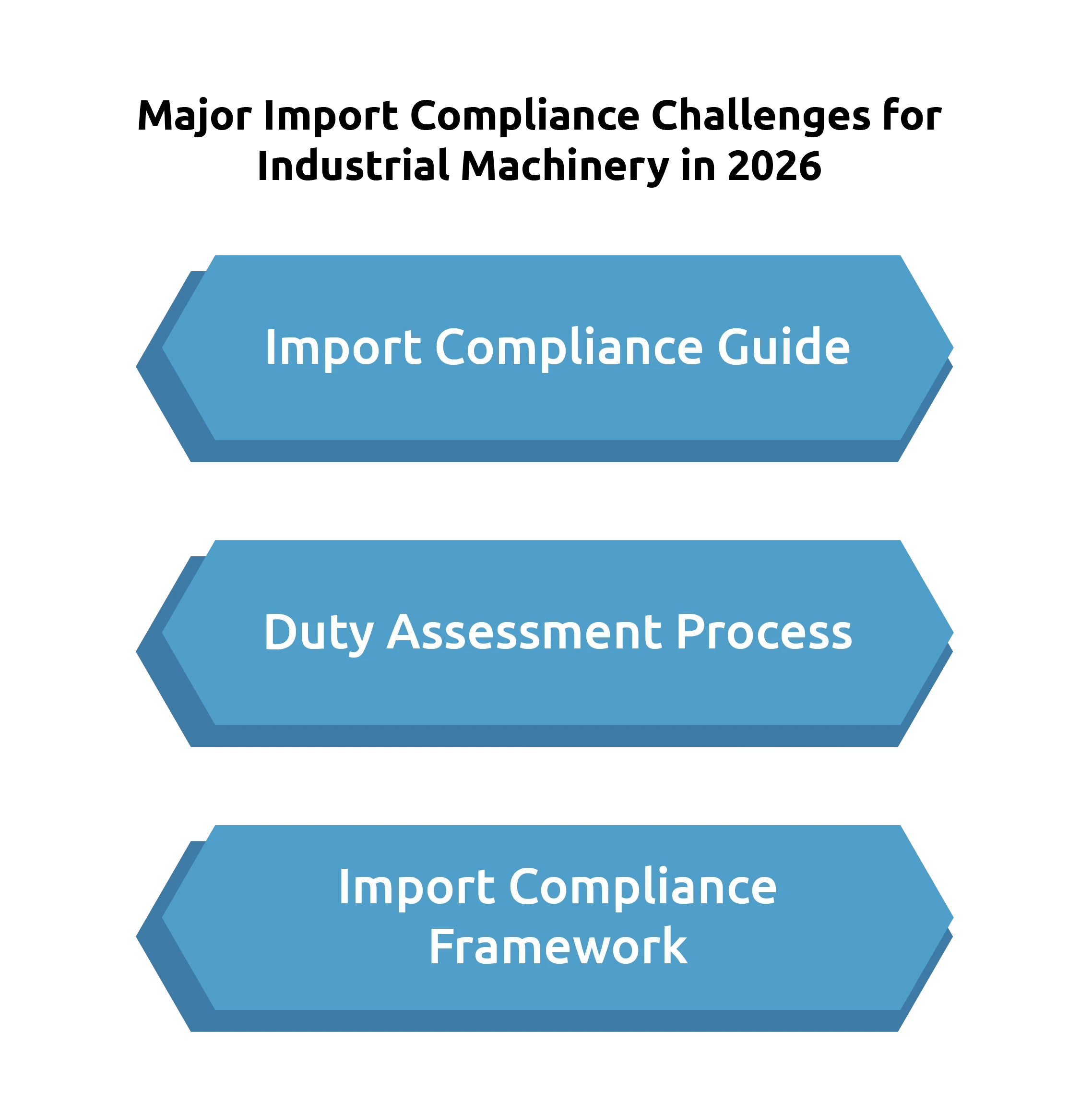
How Import Compliance Problems Affect Industrial Machinery Shipments
The Bill of Entry is subject to verification by the proper officer of Customs (under self-assessment scheme) and may be reassessed if declarations are found to be incorrect. Under self-assessment, it is the importer who will ensure that he declares the correct classification, applicable rate of duty, value, benefit of exemption notifications claimed, if any, etc. in respect of the imported goods while presenting Bill of Entry.
Before any goods imported and kept with the custodians as mentioned earlier can be cleared for home consumption in the country immediately – or for warehousing and customs clearances as and when needed etc., the importers have to comply with prescribed customs clearance formalities. A major part of Customs clearance work is handled on behalf of importers/exporters by CHAs or Customs House Agents – who are trained and experienced in Customs clearance work and are licensed by Customs for such work, subject to certain conditions as laid down in CHA Regulations.
Before any goods imported and kept with the custodians as mentioned earlier can be cleared for home consumption in the country immediately – or for warehousing and customs clearances as and when needed etc., the importers have to comply with prescribed customs clearance formalities. Missing or Incomplete Documentation the commercial invoice, shipping label, or description of goods may lack the detail required to determine what the item is, its exact value, or its country of origin.
Role of an Importer of Record (IOR) in Industrial Machinery Imports
Remember, even when using a broker, you, the importer of record, are ultimately responsible for the correctness of the entry documentation presented to CBP and all applicable duties, taxes and fees. Importers can request to follow rule from CBP for the proper HTSUS classification and rate of duty for their merchandise. Complete the entry, or substitute one or more reconfigured entries on an import activity record, by filing with the Customs Service the declared value, classification and rate of duty applicable to the merchandise. Importers shall place only compliant machinery or related products on the market. Importers shall ensure that the machinery or related product is accompanied by the instructions for use and the information.
The importer of any goods, other than goods intended for transit or transhipment, shall make entry thereof by presenting electronically on the customs automated system to the proper officer a bill of entry for home consumption or warehousing.
The importer who presents a bill of entry shall ensure the following, the accuracy and completeness of the information given therein; the authenticity and validity of any document supporting it, and compliance with the restriction or prohibition, if any, relating to the goods under this Act or under any other law for the time being in force.
Conclusion
Importing industrial machinery requires proper planning and knowledge of customs rules, duties, documents, and safety standards. Following import compliance rules helps businesses avoid extra costs and delays. Working with experienced import and logistics partners can make international machinery shipments easier and smoother.
Did you know
Engineering Goods exports increased by 20.91% from US$ 10.06 Billion in September 2025 to US$ 12.17 Billion in September 2026.
FAQ
Why is the HS code important when importing machinery?
An HS code helps customs authorities identify the type of machinery and decide the applicable import duties and taxes.
Are the rules for importing used machinery different from new machinery?
Yes. Some countries have extra rules for used machinery based on its age, condition, and type. Inspection reports or other documents may also be required.
Can industrial machinery be held at customs due to missing safety certificates?
Yes. If machinery needs safety certificates or technical approvals and these are missing, customs or other authorities may hold the shipment.
How do businesses calculate the total cost of importing industrial machinery?
They need to consider the machinery price, customs duties, import taxes, shipping charges, insurance, and other applicable fees.
Why do some industrial machines need export licenses?
Some machines can be used for both civilian and military purposes. These dual-use machines may need special export permission before shipping.