The path taken by international shipping is not always the same. Shipping firms may be forced to alter their customary routes due to conflicts, political unrest, trade restrictions, sanctions, and security issues. Delivery times, freight expenses, and supply chain hazards may all rise as a result of these modifications. Businesses are searching for alternate routes, ports, and transportation solutions to keep their products moving as international trade grows more unpredictable. Businesses may improve their planning and prevent unforeseen delays and expenses by knowing how these disturbances impact freight routing.
Why Geopolitical Events Affect Freight Routes
Geopolitical issues can change a freight route almost immediately. When carriers face safety concerns in a major corridor, they may avoid a particular sea lane, change port calls, or use a longer similar route.
One such example is the Red Sea. During the disruption, ships were often rerouted around the Cape of Good Hope rather than using the Suez Canal to travel between Asia and Europe. According to UNCTAD, this led to an increase in operating costs, vessel demand, and voyage distances. Ship tonnage passing through the Suez Canal was still about 70% lower in May 2025 than it was in 2023.
In 2026, things are changing. Maersk and Hapag-Lloyd stated in September that some services would be returning to the Suez and Red Sea region. Nonetheless, the businesses have stressed that broader network modifications are still contingent upon regional stability and are still keeping an eye on security situations in the region.
This shows why freight routing can no longer be treated as a fixed decision.
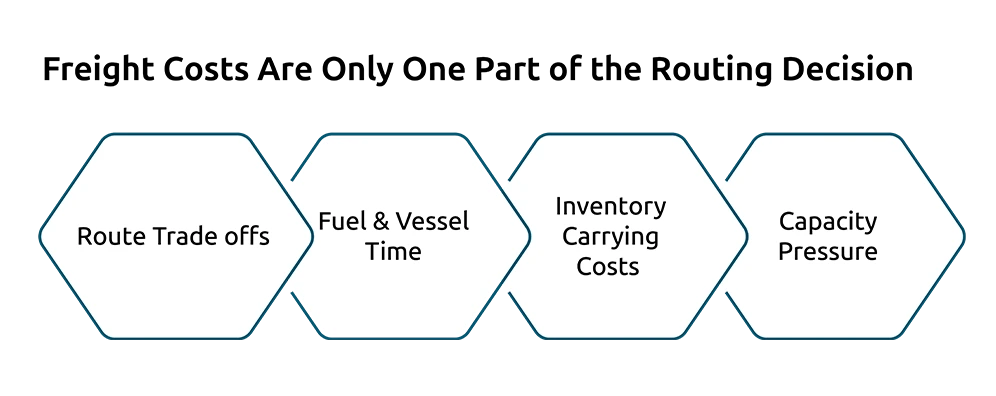
Freight Costs Are Only One Part of the Routing Decision
A longer route does not necessarily mean a poor decision. In some circumstances, paying more for a secure or more predictable route may minimize the risk of larger supply chain losses.
When ships take longer routes, organization can face higher fuel costs, additional vessel time, insurance costs, port charges, and inventory carrying costs. UNCTAD has also linked rerouting to increased freight-rate volatility and higher demand for shipping capacity.
a company shipping important data center equipment may need to compare a low-cost ocean route with a more costly alternative that offers greater schedule certainty. The cheapest freight option may become more costly in practice if a delay causes equipment shortages, installation delays, or missed project deadlines.
Trade Policies Are Also Changing Routing Decisions
Geopolitics has an impact on more than just actual shipping channels. Where goods are sourced, consolidated, imported, or stored can be affected by tariffs, sanctions, export restrictions, and shifting trade regulations.
UNCTAD has reported that changing tariffs & trade rules are developing trade flows and encouraging businesses to diversify their supply networks. Without of depending mainly on one market or channel, organizations are mainly considering many source regions & similarb trade connections.
Practical routing adjustments may result from this, such as using a new port of entry, transferring cargo via a different regional hub, switching a portion of the shipment to air freight, or keeping inventories closer to the destination.
Companies Are Transitioning to Multi-Route Planning
One of the biggest changes is the move from a single preferred route to a multi-route strategy.
Organizations are mainly preparing primary and similar routing options before a disruption occurs. Various ports, carriers, modes of transportation, customs routes, and warehouse locations may be included in these schemes.
For instance, a shipment from Asia to Europe might include an air freight option for urgent components, a conventional maritime route, and a Cape of Good Hope backup. The cargo value, urgency, available capacity, regulatory constraints, and the anticipated length of the disruption can all influence the best decision.
This approach gives logistics teams more flexibility when conditions change.

Technology Is Making Route Decisions More Data-Driven
Updated freight planning increasingly depends on real-time information. Businesses can monitor vessel movements, port congestion, changing sailing schedules, customs developments, weather conditions, & safety alerts before deciding whether to handle or change a route.
This is mainly important for high-value and time-sensitive equipment. A route that looks efficient when a purchase order is placed may no longer be suitable when the shipment is ready to move.
Better visibility helps companies make routing decisions earlier rather than reacting after cargo has already been delayed.
Conclusion
Geopolitical events are changing international freight routing from a simple transportation decision into a broader supply chain risk decision. The Red Sea experience has shown how quickly an important shipping corridor can affect shipping times, freight capacity, costs, & schedules. The gradual return of selected services through Suez in 2026 also demonstrates that routes can change again when operating conditions improve.
Businesses that make flexible routing plans can respond more effectively when geopolitical conditions change. In an increasingly uncertain global trade environment, route diversification, shipment visibility, and backup planning are becoming important parts of global logistics strategy.
Did you know?
Global shipping, which carries over 80% of world trade, is under immense pressure, facing fragile growth, rising costs and mounting uncertainty. After a modest 2.2% growth in 2024, maritime trade is expected to slow to just 0.5% in 2025, according to the Review of Maritime Transport 2025, published on 24 September by UN Trade and Development (UNCTAD).
FAQs
How do geopolitical disruptions affect freight costs?
They can increase fuel use, insurance, vessel operating costs, port charges, and freight rates when carriers take longer routes or when shipping capacity becomes constrained.
Why do companies use alternative shipping routes?
Alternative routes help businesses continue moving cargo when a major corridor becomes unsafe, congested, restricted, or commercially unreliable.
Can geopolitical issues affect air freight as well?
Yes. Airspace restrictions, sanctions, airport disruptions, and changes in trade flows can affect available flight paths, capacity, transit times, and operating costs.
How can companies prepare for route disruptions?
Businesses can maintain alternative ports and carriers, diversify transport modes, monitor geopolitical developments, and create contingency routing plans for critical shipments.
Are freight routing decisions becoming more complex?
Yes. Companies now need to consider transportation cost alongside security, customs compliance, schedule reliability, inventory requirements, trade policy, and potential disruption risks.