Introduction
AI servers, GPUs, and data center hardware are essential for modern AI infrastructure. Companies increasingly move this valuable equipment across borders, but global shipments require more than shipping. Customs declarations, classification, duties, taxes, & documentation must be handled correctly. An Importer of Record IOR helps businesses manage these import duties, especially when they have no local entity.
What Is an Importer of Record for AI Hardware?
An Importer of Record (IOR) is responsible for managing the import of AI servers, GPUs and data center hardware according to the destination country’s customs and import rules. This includes import documentation, customs declarations, duties, taxes and applicable requirements.
For AI infrastructure, an IOR can support shipments of GPU servers, storage systems, networking equipment, racks and other technology hardware. The IOR handles import responsibilities, while freight forwarders and customs brokers manage their respective logistics and clearance functions.
Why AI Servers and GPUs Need Careful Import Planning
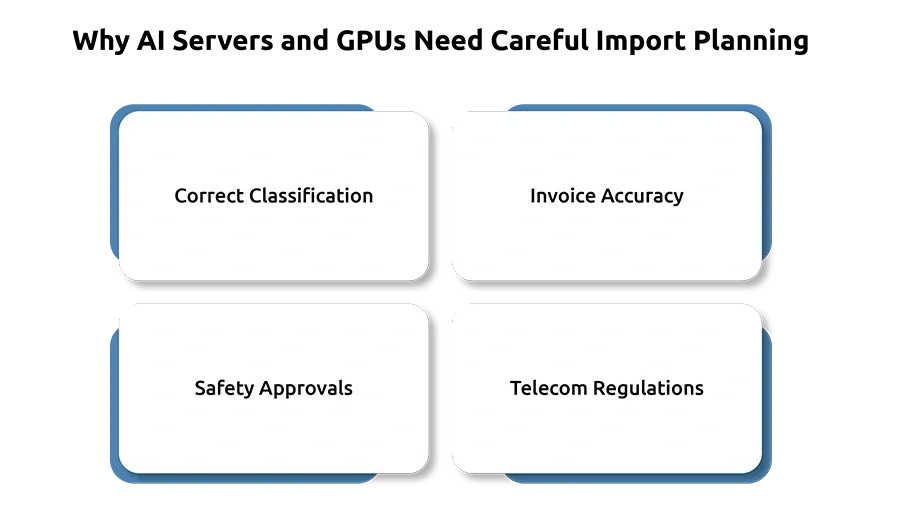
AI servers and GPUs are high-value equipment, so even a customs delay can affect an entire data center deployment. Correct product classification is important because it can impact duties, import requirements & customs documentation.
Commercial invoices must accurately state the equipment, quantity & value. Organizations should also check whether the hardware requires specific technical, safety or telecommunications approvals in the destination country.
Importing AI Hardware Without a Local Entity
Businesses may need to ship AI servers, GPUs or data center equipment to countries where they have no local entity. Establishing a company solely for a temporary or project-based import may not be practical.
Where local regulations permit, an IOR can take on the applicable import responsibilities and support customs processing. This can help companies manage international AI deployments, data center expansions and hardware replacement projects without creating a local importing structure.
Key Responsibilities of an IOR for Data Center Hardware
An IOR helps manage the import requirements for AI servers, GPUs and data center hardware. Key responsibilities can involves reviewing commercial documents, supporting customs declarations, manage duties or taxes, and working with customs brokers and authorities.
Accurate equipment descriptions are essential for customs processing. The IOR can also manage with suppliers, consignees and freight forwarders to keep shipment information consistent and complete.
IOR vs. Consignee: What Is the Difference?
The consignee or importer of record are not necessarily the same party.
The consignee is generally the party receiving the shipment, while the importer of record is the party responsible for the importation under the applicable customs framework. A company can therefore receive AI servers at its data center while another eligible party acts as the importer of record.
Understanding this distinction is important when planning international hardware deployments. The commercial arrangement, Incoterms, local regulations and responsibilities assigned to each party should be reviewed before shipment.
DAP and DDP: Where Does the IOR Fit?
Incoterms define duties between importer & exporter but do not cover every local import requirement. Under DAP, the buyer generally manage import clearance, duties and taxes. Under DDP, the seller takes greater responsibility for delivery and import obligations where permitted by local rules.
For AI servers and GPU shipments, businesses should confirm the IOR arrangement and import responsibilities before shipping.
Import Documents for AI Servers and GPUs
Correct documentation is important for smooth customs clearance of AI servers and GPUs. Typically documents involves the commercial invoice, packing list, shipping document or customs filing.
The invoice should clearly state the equipment, quantity & value, while the packing list should match the shipment. Product details may also be required for classification or compliance review.

Common Challenges When Importing Data Center Equipment
Importing AI servers and data center hardware can involve customs scrutiny, incorrect classification and documentation issues. Companies without a suitable local entity may also face difficulties managing the import process.
Duties and taxes can become complex when multiple parties are involved. Large deployments may also arrive in several consignments, requiring consistent documentation and coordination throughout the project.
How an IOR Supports AI and Data Center Deployments
An IOR helps technology companies manage the import process for AI servers, GPUs or data center hardware across international markets. This can include reviewing shipment details, supporting customs clearance, managing documentation & coordinating with logistics partners.
For companies operating across multiple countries, IOR support helps address local import requirements while providing a consistent approach to international hardware deployments.
When Should You Use an IOR for AI Hardware?
An IOR is useful when businesses need to import AI servers, GPUs or data center equipment into a country where they do not have a local entity. It can also support temporary projects, data center deployments, hardware replacements & network updates.
Before shipping, businesses should confirm the importer, required documents, duties, taxes or any applicable approvals. Early planning can help prevent customs delays or sudden import issues.
How One Union Solutions Can Help
One Union Solutions supports international imports of AI servers, GPUs, networking equipment and data center hardware. Its IOR support covers import documentation, customs requirements and shipment coordination.
For businesses without a local importing entity, One Union Solutions helps manage the import side of technology deployments and supports the movement of critical equipment across borders.
Conclusion
International AI hardware deployments require careful planning for customs, documentation, duties, taxes, and local regulations. An appropriate Importer of Record structure helps businesses manage these responsibilities when shipping across borders.
It is especially useful for companies without a local entity in the destination country.
With proper preparation, businesses can reduce customs issues and support smoother data center deployments.
Did You Know?
5 GW: In 2025, the U.S. and UAE announced an AI campus in Abu Dhabi planned to reach 5 GW of AI data-center capacity, highlighting the rapid expansion of international AI infrastructure.
People Also Ask
What is an importer of record for AI servers?
An importer of record is the party responsible for meeting the applicable import and customs obligations for AI servers entering a country. This can involves customs documentation, declarations, duties, taxes & other requirements depending on local regulations.
Can an IOR import GPUs without a local company?
An IOR arrangement may allow a business to import GPUs without establishing its own local entity, where local regulations permit such an arrangement. The particular requirements should be checked for the destination country & product.
Can a freight forwarder be the importer of record?
A freight forwarder & an importer of record perform different functions. A freight forwarder coordinates transportation, while the importer of record carries the applicable legal import responsibilities. Whether a particular logistics company can also act as IOR depends on its authorization and the destination country’s rules.
Is the consignee always the importer of record?
No. The consignee and importer of record can be different parties. The consignee may receive the equipment, while the IOR assumes the applicable import responsibilities.
Who is the importer of record on a DAP shipment?
Under DAP, the buyer generally handles import clearance and import obligations. However, the exact arrangement depends on the contract, local regulations and the parties involved in the shipment.