Businesses today develop IT network across borders more than ever. Servers, GPUs, storage systems, switches, routers, firewalls, workstations, & other data-center hardware may be manufactured in one country & shipped to another for installation.
Shipping IT hardware globally is not simply a freight or delivery task. Businesses must consider customs classification, import documentation, duties & taxes, importer needs, & product-specific laws.
The difficulties becomes even greater when a company wants to import IT equipment without a local entity in the destination country. An Importer of Record (IOR) can help provide the appropriate import structure where permitted by local regulations.
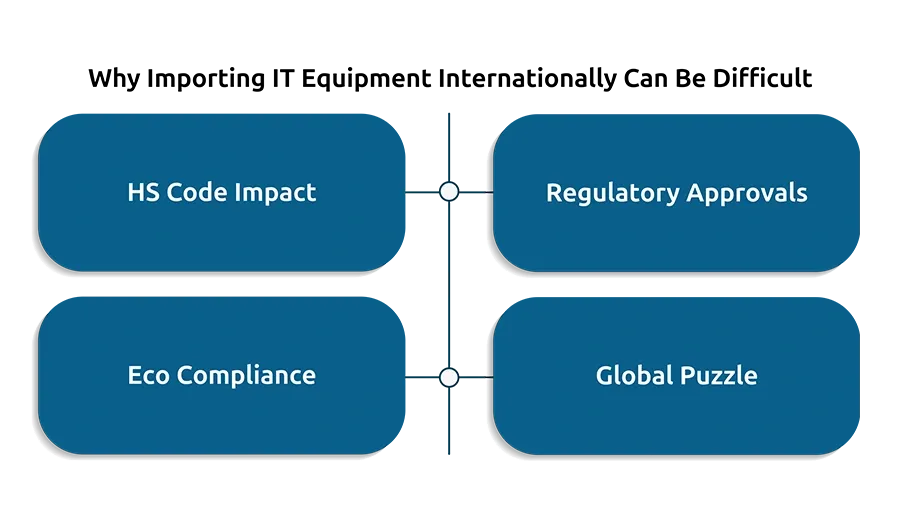
Why Importing IT Equipment Internationally Can Be Difficult
IT equipment can involve some customs & regulatory needs. A shipment containing servers & networking equipment, for example, may need different classifications & compliance checks.
The first consideration is usually customs classification. The correct HS classification can affect applicable duties, taxes, restrictions, & documentation. Businesses should classify equipment based on its actual characteristics & function rather than depending on generic descriptions or previous shipments.
Customs valuation is another important consideration, mainly for high-value IT equipment. Servers, GPU systems, & AI infrastructure can have significant declared values, making correct commercial & customs documentation essential.
Some equipment can also need additional regulatory approvals. Wireless access points, routers, radio-enabled devices, & telecom equipment may be subject to country-specific telecommunications or radio regulations. Electrical & electronic equipment can also face safety, conformity, environmental, or other product requirements.
What an IOR Does for IT Equipment
An Importer of Record for IT equipment is the party responsible for the import transaction and applicable customs obligations in the destination country.
The exact responsibilities depend on local laws and the commercial arrangement, but an IOR can support several parts of the import process.
First, the IOR helps determine who will legally act as the importer. This can be mainly important when a technology company has customers or infrastructure in a country but does not have a suitable local entity.
The IOR process can also include reviewing product data, customs classification, customs value, documentation, applicable duties & taxes, & product-specific needs.
Typical documentation may include commercial invoices, packing lists, transport documents, customs declarations, product specifications, certificates, permits, & origin information where required.
The IOR can also coordinate with customs brokers, freight forwarders & other parties involved in the clearance process.
However, using an IOR does not automatically remove customs duties or product regulations. Restricted products remain subject to applicable laws, & required approvals must still be obtained.
What Types of IT Equipment Can an IOR Support?
IOR services can apply to many categories of IT hardware, depending on the destination country’s rules.
Servers
This includes rack servers, blade servers, enterprise servers, high-performance computing systems, AI servers, & GPU servers. High-value server deployments benefit from careful classification, valuation, documentation, and pre-shipment planning.
Storage Systems
Businesses may import storage arrays, SAN and NAS systems, enterprise storage platforms, SSD/HDD systems, and backup appliances.
Networking Equipment
An IOR for networking equipment can support imports involving switches, routers, firewalls, network appliances, load balancers, and wireless access points.
Wireless and telecom-enabled equipment may require additional regulatory checks depending on the destination.
GPUs and AI Infrastructure
The development of artificial intelligence has developed global demand for GPUs, GPU servers, AI accelerators, & high-performance computing networks.
Companies importing these products should review not only customs requirements but also any applicable export-control or destination-specific restrictions based on the equipment, origin, destination, and end use.
Data-Center Hardware
International data-center deployments can also involve server racks, PDUs, KVM equipment, rack accessories, networking hardware, and replacement components.
Each product should be reviewed individually because different items can have different classification and regulatory requirements.
Importing IT Equipment Without a Local Entity
One of the main reasons businesses use an IOR is to support imports when they do not have a suitable local entity.
For example, a US technology company may need to deploy servers into a data center in another country but have no subsidiary there. The company still needs to determine who will legally import the equipment.
Where local law permits, an IOR can provide the required importing structure.
The basic model can be:
Technology Company → IOR → Customs → Data Center
This does not mean the IOR bypasses local regulations. The shipment must still satisfy applicable customs, tax, and product requirements.

Step-by-Step IT Equipment Import Process
A structured process can help companies avoid unnecessary customs problems.
- Identify the equipment: Collect manufacturer, model number, quantity, value, origin, & technical specifications.
- Confirm the destination: Identify the country of import, entry point, & final delivery location.
- Determine the importer: Confirm whether the company’s own entity can legally act as importer or whether an IOR is required.
- Review classification: Determine the appropriate HS classification for the equipment.
- Check regulatory requirements: Identify applicable telecom, wireless, electrical, conformity, environmental, or other product requirements.
- Prepare documentation: Ensure invoices, packing lists, transport documents, and product information are accurate & consistent.
- Complete customs clearance: Submit the required declaration & respond to any customs requests.
- Pay applicable charges: Settle customs duties, import VAT/GST, & other applicable government charges.
- Release and deliver: Once customs need are completed, ship the equipment to its final destination.
Common Customs and Compliance Problems
IT hardware imports can face issues when businesses use incorrect HS codes, incorrect product descriptions, inaccurate values, inconsistent invoices, missing permits, or an unsuitable importer.
Another common mistake is assuming that DDP automatically solves the importer requirement. DDP is an Incoterm governing certain delivery & cost responsibilities; it does not automatically make an overseas seller legally eligible to act as importer in every country.
The safest approach is to review the import requirements before shipment rather than waiting until the equipment reaches customs.
Conclusion
Transporting IT equipment globally needs more than shipping hardware from one country to another. Businesses need to consider the importer, customs classification, valuation, documentation, duties, taxes, & product-specific regulations before shipment.
For companies without a suitable local entity, an importer of record for IT equipment can provide an important import structure where legally permitted.
Did you know?
The Harmonized System (HS) is used by more than 200 countries and economies as the basis for classifying traded goods, covering more than 98% of merchandise in international trade. For IT hardware imports, accurate HS classification can influence customs duties, restrictions, and other import requirements.
FAQ
1. Can an IOR import high-value AI servers and GPUs?
Yes, an IOR can support eligible imports of AI servers, GPUs, and other high-value computing hardware. However, the shipment may require additional checks for customs classification, valuation, export controls, product regulations, and destination-specific import requirements.
2. Can I use an IOR if my company has no local entity?
In many markets, an IOR can provide an importing structure for companies without a local legal entity, where local regulations permit it. This allows businesses to manage eligible IT hardware imports without establishing a subsidiary solely for importing equipment.
3. Does an IOR guarantee that IT equipment will clear customs?
No. An IOR cannot guarantee customs clearance. The equipment must still comply with applicable customs, tax, documentation, licensing, and product-specific requirements. Proper pre-shipment compliance checks can help reduce avoidable delays.
4. What happens if networking equipment requires local approval?
If equipment such as routers, wireless access points, or telecom devices requires approval, that requirement generally needs to be addressed before or as part of the import process. Using an IOR does not automatically replace mandatory telecom, radio, safety, or conformity approvals.
5. Can one IOR support IT hardware deployments across multiple countries?
Yes, an IOR strategy can support eligible multi-country IT deployments, but each destination requires a separate compliance review. Customs classification, importer requirements, taxes, documentation, and product regulations can differ significantly between countries.