Companies are under increasing pressure to understand the environmental impact of their supply chains. Customers, investors, regulators, & business partners mainly want companies to report their greenhouse gas emissions. Logistics teams are looking beyond freight rates & delivery times. They are also asking how much carbon a shipment produces & whether a different transport option could minimize that impact.
What Is Carbon Reporting in Freight?
Carbon reporting is tracking & recording the greenhouse gases made by business tasks. In global logistics, this can added with emissions from ships, aircraft, trucks, trains, warehouses, & other parts of the shipping process. Businesses can consider things like how a shipment travels, how it is transported, how heavy it is, and what kind of vehicles, ships, and airplanes are used. Businesses can better assess the carbon footprint of moving goods from one location to another by using this data.
Why Carbon Data Is Becoming Important
Companies are facing huge expectations to understand & disclose their environmental impact. Regulatory needs are also improving the importance of emissions data.
This means logistics information can become part of wider corporate reporting. Procurement teams may need carbon information when evaluating suppliers, while finance & sustainability teams may use freight emissions data when preparing environmental reports. Accurate data can also help businesses identify where emissions are coming from.
Expedited air shipping may account for a significant share of a company’s logistics emissions. Instead of just seeking a cheaper airline service it may redesign inventory planning so more products can go through lower-emission transport modes.
Carbon Reporting Can Change Carrier Selection
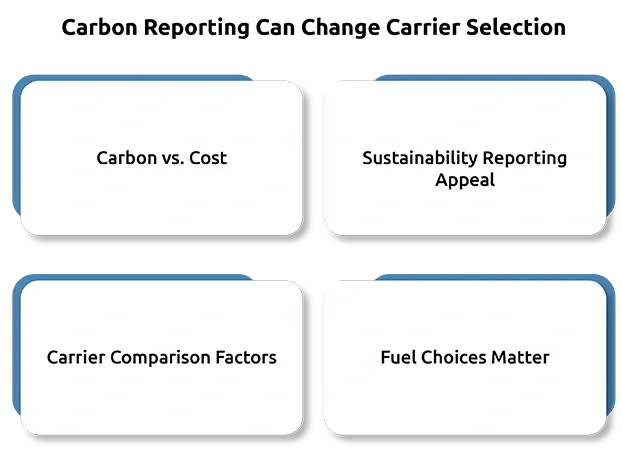
Freight rate is one of the traditional standards for companies to choose logistics providers. Another consideration is carbon performance. Businesses that require in-depth sustainability reporting are more likely to be attracted to a carrier with dependable emissions data. Companies can compare carriers on their transport networks, fuel efficiency, usage of alternative fuels, reporting capabilities, and emissions measurement methods.
Transport Mode Decisions Are Changing
One of the clearest ways that carbon reporting can influence freight is through the selection of mode of transport. Compare air, ocean, road & rail options based on commercial & environmental factors. Air freight is suitable for urgent, high-value, or time-sensitive goods. For larger shipments where delivery speed is not as critical, ocean freight could be a better option. Rail can provide another option on some global corridors.
Carbon reporting helps logistics teams see the environmental trade-offs alongside cost & transit time. This can encourage businesses to create different shipping policies. For example, urgent spare parts may continue to move by air, while standard inventory is consolidated & transported by ocean or rail.
Shipment Consolidation Can Reduce Emissions
Carbon reporting can also encourage companies to reconsider how frequently they ship.
Sending several small shipments separately can create more transport activity than consolidating them into fewer, fuller shipments.
A company that tracks emissions may identify frequent low-volume shipments as an area for improvement. Orders might be combined, container usage could be increased, or replenishment schedules could be modified.
Consolidation shouldn’t be viewed as a panacea, tho. Long-term inventory holding can raise storage expenses and lead to service issues. Finding the ideal balance between inventory needs, delivery obligations, freight expenses, and emissions is the aim.
Using Carbon Data in Freight Procurement and Shipping Policies
When choosing carriers, companies can consider carbon emissions data in addition to freight rates, delivery times, & service reliability. For example, when a delivery is not urgent, they can select reduced-emission solutions and set clear rules for using air freight. Decisions about freight pricing and supplier evaluations can also use carbon data. This helps businesses balance cost, delivery needs and international freight emissions when creating shipping policies.
Route Planning Becomes More Strategic
The shortest route is not always the most efficient, and the cheapest route is not always the one with the lowest emissions.
Companies may compare different shipping routes using emissions, cost, and delivery time because of freight carbon reporting. The cheapest or shortest path is not always the best one. Decisions about international freight may take consider of the form of transport, the distance, transfers, and the efficiency of the vehicle or vessel. This allows logistics teams to choose routes that balance freight emissions, cost and service needs.
Carbon Reporting Can Influence Supplier Decisions
Carbon reporting is also changing the conversation between companies and logistics suppliers. Companies may increasingly require freight forwarders, carriers, suppliers and logistics partners to share standard emissions data.
Contracts and supplier evaluations may be affected by this. A logistics provider may not be able to satisfy client requests for thorough sustainability reporting if they are unable to supply useful emissions data. Businesses must also ensure that the data they get is similar. Different providers may employ different assumptions, emission factors, system boundaries, and computation techniques. Inaccurate conclusions may result from merely comparing two emissions figures without understanding how they were determined.

How Freight Emissions Data Is Calculated and Compared
Details such cargo weight, distance, transport mode, and fuel or energy use are usually used to calculate freight emissions data. For example, freight carbon emissions may change depending on if the same cargo is shipped by air, sea, road, or rail. Businesses can use this data to compare shipping choices and make better choices about international freight.
However, carbon figures from different carriers may not be directly comparable. Providers can use different emission factors, calculation methods and reporting boundaries. Businesses should check how the figure was calculated before using it to compare carriers, routes or transport modes.
Better Data Leads to Better Freight Decisions
Rather than being a stand-alone sustainability effort, carbon reporting works best when it is incorporated into regular logistics planning. Traditional freight parameters such as cost, transit time, capacity, service dependability, customs performance, and inventory needs can be integrated with emissions data by organizations.
The objective is not necessarily to eliminate every high-emission shipment. Some goods mainly need urgent delivery. Businesses can identify where emissions can be reduced without damaging customer service or operational performance.
Conclusion
Carbon reporting is likely to become an important thing in global freight handling. As companies enhance their emissions data, logistics decisions can become clearer and more measurable. The next step is for transport to move from simply reporting emissions to using that information to improve supply chains. Companies that understand their freight emissions can find slow transport patterns, check similar modes, enhance shipment consolidation, work more easily with carriers, & make better-informed route decisions.
Did you know?
The EPA explains how transportation creates greenhouse gas emissions across trucks, ships, aircraft, and rail, and provides information on measuring and reducing transportation emissions.
FAQ
What is carbon reporting in international freight?
Carbon reporting is the process of tracking and recording greenhouse gases generated when goods are moved between countries.
How does carbon reporting affect freight decisions?
It helps companies compare transport modes, routes, carriers, and shipment methods based on both cost and environmental impact.
Can carbon reporting influence carrier selection?
Yes. Companies may consider a carrier’s emissions data, fuel efficiency, reporting methods, service quality, price, and delivery time.
Can changing the transport mode reduce freight emissions?
Yes. Depending on the shipment, moving goods by ocean or rail instead of air can reduce emissions when delivery speed is not critical.
How can companies reduce emissions from international freight?
Companies can reduce freight emissions by consolidating shipments, improving route planning, reducing unnecessary air freight, and choosing suitable transport modes.