Introduction
The logistics industry is developing quickly as supply chains become more difficult & connected. These days, companies work with logistics providers, warehouses, customs officials, and ships across many countries. A small problem such as a delayed delivery, missing documents, & port congestion can affect the supply chain. So, logistics exception handling is more important than before; companies need to find and fix issues before they cause more serious delays. In the past, a lot of businesses deployed AI co-pilots to help team members with reports, guidance, and alerts. While these tools made decision-making easier, manual review of data and action were still required. Agentic AI, in which autonomous AI agents can monitor processes, understand issues, make decisions within defined limits, and do routine activities with minimal human involvement, is becoming more and more popular among companies. Logistics teams can react to delays much more quickly due to this change.
The next stage of intelligent supply chain processes in logistics is agentic AI. Autonomous AI agents can identify these exceptions in real time, suggest the best plan of action, and even perform tasks like rerouted shipments, changing delivery plans, or notify consumers, rather than simply alerting teams about shipment delays, customs problems, or route delays. Agentic AI is helping companies in creating supply chains that are quicker, smarter, and more strong by reducing human effort and speeding up response time.
What Is Agentic AI in Logistics?
Agentic AI is a highly advanced type of AI that requires minimum human support to analyze a task, make decisions, and take action. By more effectively handling shipments, inventory, and deliveries, it allows autonomous processes in logistics. Supply chains use several forms of AI. Standardized AI uses set rules to perform out specific tasks. Reports and summary are generated by generative AI in response to user input. Agentic AI takes one step further by making decisions, processing data in real time, and carrying out tasks automatically. With autonomous AI, smart agents can respond fast to issues like route changes or shipment delays without continuous human support. In multi-agent systems, many AI agents work to handle stock levels, track shipments, and improve AI decision-making, helping companies in reducing delays and maintaining smooth logistical processes.
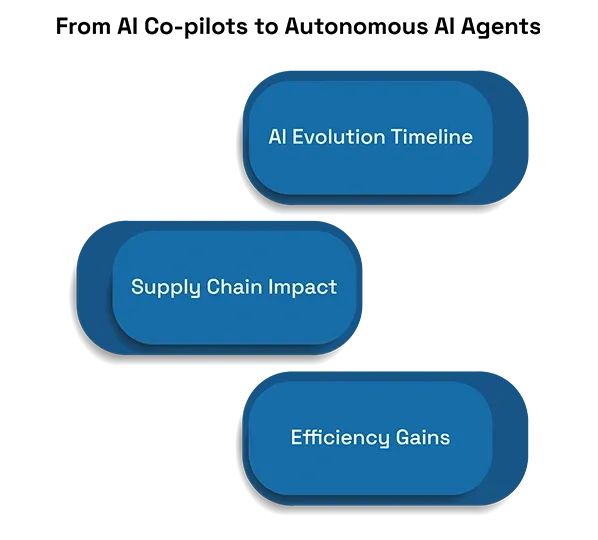
From AI Co-pilots to Autonomous AI Agents
AI co-pilots help staff by making guidance, response to requests, producing reports, & supplying useful data. They simplify routine tasks, but final decision-making and details reviews are still required. AI assistants’ main issue is the difficulty to finish tasks individually. They depend on human input at every stage, which may reduce efficiency in the case of shipment delays, inventory problems, & other logistical issues. Many companies are using Agentic AI as part of their business AI strategy in order to improve speed and efficiency. These AI team members are able to perform regular tasks through autonomous processes, review real-time data, and make decisions within defined limits. This reduces manual effort and supports faster problem-solving by teams.
Enterprise AI is changing from simple agents to autonomous AI agents that allow for faster and more reliable supply chain processes as AI automation keeps growing.
How Agentic AI Detects Logistics Exceptions in Real Time
Agentic AI tracks cargo, warehouses, shipments, and delivery updates in real time using AI tracking. It takes data from carrier platforms, warehouse software, ERP systems, and GPS to improve supply chain visibility. By identifying possible risks like delivery delays, traffic delays, & missing documents before becoming major problems, the review of this data helps predict logistics. Additionally, it provides warning signals for quick exception detecting, which helps companies to act more quickly and keep on-time delivery.
How Autonomous AI Agents Resolve Logistics Problems Automatically
Logistics issues can be quickly fixed by autonomous AI machines without require human support. They help with optimize routes when a shipment is delayed by identifying a different route or rerouting the package to avoid extra delays. Additionally, they can change customs documents, provide a new provider, reschedule shipments, contact logistics teams and customers, and handle warehouse processes. This helps companies maintain efficient and timely delivery processes, improves freight management, and allows automated decisions.
Agentic AI for Customs and Cross-Border Logistics
By handling regular customs tasks, agentic AI allows quicker and more efficient cross-border logistics. By reviewing export documents, verifying shipment details, & helping with the preparation of required customs documents, it supports customs automation. Additionally, it keep track on import and trade compliance rules to avoid mistakes and avoid delays at the border. Agentic AI allows more smooth global shipping and quicker customs clearance by increasing document correctness and controlling shipments’ compliance.

Conclusion
Agentic AI, which can make decisions and take out daily tasks manually, is replacing AI co-pilots in logistics industries that simply provide guidance. Businesses may identify logistics exceptions early, select the right solution, & respond more quickly with the help of autonomous AI agents. Additionally, they improve the efficiency of the supply chain, simplify trade compliance, reduce delays, & deliver better customer service. Agentic AI helps businesses in developing quicker, more smart, and more reliable logistics operations as supply chains get more difficult.
Did you know
The global AI copilot market size is valued at approximately 2.8 billion USD in 2025 and is forecast to exceed 20 billion USD by 2030 across all major regions.
FAQ
Can Agentic AI handle logistics exceptions automatically?
Yes, Agent AI can detect shipment problems, providing the best method of action, & manually handling processes rerouting shipments, updating timetables, & sending alerts following with business rules.
How does Agentic AI improve supply chain visibility?
Actual shipment, inventory, & delivery changes are tracked by agents AI. This helps companies in quickly identify problems & making more better decisions.
What are the benefits of using autonomous AI agents in logistics?
They reduce manual work, increase delivery speed, reduce delays, support compliance, & help logistics teams in finding more efficient ways to fix issues.
Can Agentic AI help with customs and cross-border shipping?
Yes. It can help prepare customs documents, monitor compliance rules, reduce documents mistakes, & support faster cross-border shipping.
What challenges should companies consider before implementing Agentic AI?
Companies should make sure they have good-quality data, secure systems, proper connection with existing software, and human oversight to handle AI effectively.