
The AI server & processor manufacturing industry is facing some supply chain issues, defined by shortages in advanced packaging, high-bandwidth memory, & specialized components, with pressures likely to stay through 2026. The growth in demand for generative AI & agentic AI systems has exceeded capacity, creating issues that spread lead times to over six months for main AI processors.
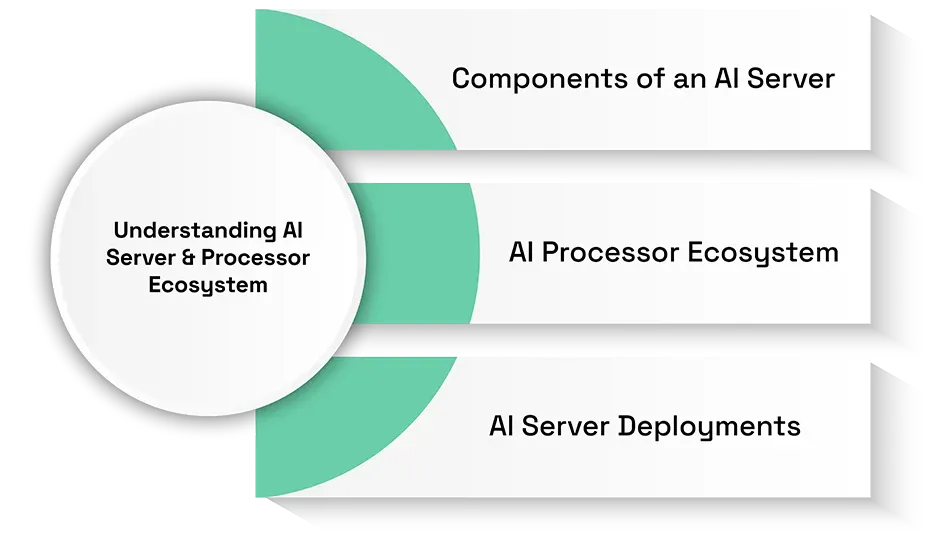
Understanding AI Server & Processor Ecosystem
AI servers and processors are specialized computing systems developed to manage the intense, parallel computational demands of artificial intelligence, mainly machine learning, deep learning, and generative AI. Unlike traditional servers used for sequential processing, AI servers provide high computing power, high-speed networking, & large memory capacities to manage difficult algorithms & huge datasets.
Components of an AI Server
AI servers are designed to maximize data throughput while minimizing delays, ensuring efficient execution of large-scale machine learning & generative AI workloads. At the core of these systems are specialized work such as GPUs, TPUs, & ASICs, which are mainly used for parallel processing, matrix computations, & high-speed data operations used for AI model training & inference. High-performance CPUs complement these accelerators by covering automation tasks, data preprocessing, & sequential computations that cannot be easily parallelized. CPUs & accelerators form a highly developed compute ecosystem.
Memory & storage also play an important role in system performance. High-bandwidth memory & large-capacity NVMe storage solutions help eliminate data risk by ensuring rapid data availability for processing units. Even the most advanced processors would not be fully used.
AI Processor Ecosystem
The AI hardware market is managed by a range of specialized chips developed to manage different types of artificial intelligence workloads efficiently. Graphics Processing Units, led by NVIDIA, have become the industry standard for both AI training & inference due to their strong parallel processing capabilities. Tensor Processing Units, developed by Google, are purpose-built to optimize TensorFlow-based workloads & deliver high efficiency for large-scale machine learning tasks. Application-Specific Integrated Circuits, created by companies such as AWS & Meta, are custom-managed to execute some AI models more easily than general-purpose GPUs. Field-Programmable Gate Arrays offer flexible hardware that is mainly useful for edge AI inference, where flexibility & usability is important.
AI Server Deployments
An AI network is developed based on some important needs, based on security, speed, & usability. Large cloud providers such as AWS, Google Cloud, & Microsoft Azure provide AI-as-a-Service, supporting organizations to use flexible & usable computing power for both training & predictive workloads without managing a physical network. On-site data centers are used by enterprises that need dedicated, high-performance, & highly secure AI clusters, especially for large-scale model training & sensitive data processing. Edge servers are important for real-time applications by processing data closer to its source, such as in manufacturing units & smart devices, minimizing delays & enabling faster decision-making at the point of data generation.
Challenges in the AI Hardware Manufacturing Supply Chain
The fast, developing growth of Artificial Intelligence has placed unique challenges on the hardware manufacturing supply chain, making it the main issue in majoring AI capabilities. The manufacturing process, which involves raw material securing, chip design, & packaging, is facing important issues, high costs, & adding lead times to over six months.
Here are the main supply chain challenges in AI server & processor manufacturing as of 2026:
- Advanced Packaging Constraints
A main issue in AI processor manufacturing is advanced packaging, mainly CoWoS technology. This highly complex packaging method is useful for developing high-bandwidth memory with GPUs to achieve the performance needed for modern AI workloads. Demand for these advanced packaged chips has developed rapidly, mainly driven by leading manufacturers such as TSMC. The available packaging capacity is struggling to keep pace with industry requirements, creating a major constraint in the production network. This shortage in advanced packaging capability is now causing delays in the delivery of finished AI processors, directly impacting the whole supply of AI hardware.
- High-Bandwidth Memory Scarcity
An important challenge in the AI hardware ecosystem is the growing mismatch between demand & supply of High Bandwidth Memory. The rapid development in demand for high-performance AI workloads has far exceeded the available supply of HBM, creating a critical constraint across the industry. This imbalance is further increased by the difficulty of HBM production, which needs highly specialized & advanced manufacturing processes. Since HBM is useful for managing modern GPUs used in AI training & inference, these production difficulties have resulted in constant shortages & supply chain pressure throughout the semiconductor ecosystem.
- Raw Material Shortages
The management of semiconductor chips mainly depends on specialized & often rare raw materials, making the supply chain highly important to risk. This connection creates risk, as any issue can have global effects across the global semiconductor industry. Such risks were plain when geopolitical tensions in the Middle East affected exports from Qatar, which were using cooling systems used in semiconductor development facilities, mainly in South Korea. These incidents underscore how material shortages & geopolitical insecurity can directly affect chip production & the greater AI hardware supply chain.

Conclusion
The AI server & processor manufacturing ecosystem is at a critical changing point, where remarkable demand is colliding with structural supply chain limitations. From advanced packaging constraints & high-bandwidth memory shortages to the concentration of critical raw materials & geopolitical issues, each stage of the semiconductor supply chain is under important pressure. These issues are not isolated issues but related challenges that collectively slow down the production & deployment of next-generation AI infrastructure.
Did you know?
The global semiconductor ecosystem is experiencing an unprecedented memory chip shortage with knock-on effects for the device manufacturers and end users that could persist well into 2027.
FAQ
1. What are the main supply chain challenges in AI server and processor manufacturing?
The key challenges include shortages of advanced packaging capacity (such as CoWoS), limited High Bandwidth Memory (HBM) supply, dependence on rare raw materials, geopolitical disruptions, and long manufacturing lead times in semiconductor production.
2. Why is advanced packaging such a major bottleneck in AI chip production?
Advanced packaging is essential for integrating GPUs with high-bandwidth memory to achieve high performance. However, limited global capacity especially for technologies like CoWoS cannot keep up with rapidly growing AI chip demand, causing production delays.
3. How does HBM shortage affect AI hardware supply chains?
High Bandwidth Memory (HBM) is critical for AI workloads, especially for GPUs used in training and inference. Limited production capacity and complex manufacturing processes lead to shortages, slowing down the delivery of AI processors and servers.
4. How do geopolitical issues impact the AI semiconductor supply chain?
Geopolitical tensions and trade restrictions can disrupt access to key materials, technologies, and logistics routes. This can delay production, increase costs, and create instability in global semiconductor supply networks.
5. Why are raw materials important in semiconductor manufacturing?
Semiconductor production relies on highly specialized materials like high-purity quartz. Since some of these are sourced from limited locations, any disruption in supply can significantly impact chip manufacturing and AI infrastructure development.