
Introduction
Global supply chains are becoming more important as businesses face developing risks from geopolitical tensions, climate events, growing demand, & supplier shortages. Past supply chain systems often depend on manual support & defensive decision-making, making it difficult for companies to respond mainly to surprising challenges. As industries push toward greater strength & operational efficiency, Agentic AI is being used as an effective technology capable of creating adaptive supply chains. Unlike common AI systems that mainly give insights or recommendations, Agentic AI can autonomously analyze situations, make decisions, & execute corrective actions in real time.
What Is Agentic AI?
Agentic AI is used to develop Artificial Intelligence systems that can independently make decisions, take actions, & make for changing situations with minimal human intervention. Unlike traditional AI models that mainly analyze data or give recommendations, Agentic AI operates with a goal-oriented approach, allowing it to solve problems autonomously in real time. These systems can observe their environment, enhance many outcomes, make strategic decisions, & mainly learn from new data & experiences.
Why Supply Chains Need Agentic AI
The Agentic AI in the supply chain is no longer a linear system; it’s an interconnected network of partners, platforms, data streams, & moving goods. A single issue can lead to many delays or lost revenue. Rigid, rule-based systems can’t adapt quickly enough.
Here’s where Agentic AI in supply chain operations becomes a game-changer. These intelligent agents can make decisions independently across functions such as:
Agentic AI is transforming many areas of supply chain management, with procurement, logistics, demand planning, inventory control, & supplier risk management. These intelligent AI agents mainly manage real-time conditions across the supply chain, communicate with connected systems, analyze issues, & take corrective actions whenever necessary without requiring constant human action.
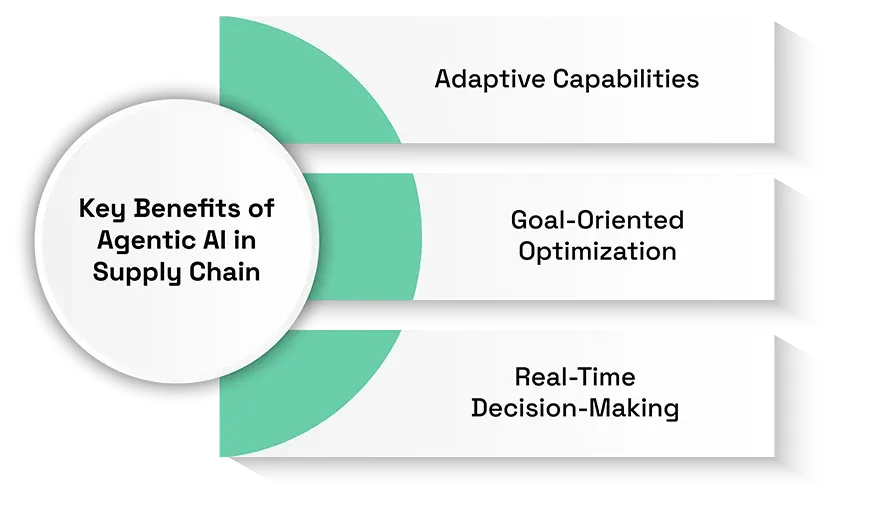
Key Benefits of Agentic AI in Supply Chain
1. Adaptive Capabilities
When unexpected events happen, such as weather delays, raw material shortages, or labor shortages, agentic AI agents can detect these issues, verify their impact, & mainly redirect shipments, adjust schedules, or switch suppliers.
2. Goal-Oriented Optimization
Unlike systems that react only to alerts, agentic AI in the supply chain is driven by long-term goals, such as minimizing costs or maximizing delivery on time. Agents analyze many trade-offs & mainly use decisions.
3. Real-Time Decision-Making
Real-time decision-making is one of the most important skills of Agentic AI in modern supply chains. These intelligent AI agents use live data collected from IoT sensors, stock management systems, ERP & TMS platforms, & supplier networks to continuously manage operations. Instead of waiting for human analysis or manual approval, Agentic AI can mainly detect fraud, measure main solutions, & take corrective action in real time. It involves rerouting shipments, adjusting inventory levels, or resolving supplier delays. These systems respond proactively to minimize operational risk & capture new opportunities quickly.
4. Collaborative Intelligence
Collaborative intelligence is a main feature of Agentic AI, where many AI agents work together to cover different supply chain functions while remaining connected across the broader operational network. Instead of functioning in isolated systems, these intelligent agents mainly share data, coordinate actions, & use decisions carefully. A demand planning agent may detect an upcoming development in product demand, leading a procurement agent to automatically secure additional stock while a logistics agent arranges early transportation capacity to avoid delays.
Main Challenges and Limitations
Data Quality: Agents need accurate, high-speed data from different sources. Much of this data is currently in groups, unstructured, or “messy,” hindering the AI’s ability to build a correct picture of operations.
Legacy System Integration: Many supply chains depend on old, rigid rule-based systems that are incompatible with autonomous AI agents. Improving these systems needs an important investment & customization.
Trust & Governance: A major issue is the doubt about turning over main logistics decisions to an autonomous system, necessitating strong “governed autonomy”.
Skills Gap & Change Management: There is a shortage of talent capable of covering these autonomous systems. 46% of executives identify talent shortages as the top issue for adoption.

Conclusion
As global supply chains become more linked & weak to delays, businesses are moving beyond past reactive systems toward autonomous, intelligent operations. Agentic AI is playing an important role in this transformation by enabling supply chains to detect problems early, make real-time decisions, & execute corrective actions with minimal human action. From predictive demand planning & automated logistics management to collaborative decision-making across many AI agents, these technologies are helping organizations build self-healing supply chains that are faster, smarter, & more usable.
Did you know?
By mid-2026, artificial intelligence (AI) will no longer be a concept that is discussed in executive suites around the world. AI will be the driving force behind the global economy and trade.
FAQ
1. What is a “self-healing” supply chain?
A self-healing supply chain uses autonomous agents to detect and resolve disruptions instantly, preventing issues from reaching the customer. It is a shift from manual firefighting to proactive, automated problem-solving.
2. What is the difference between Agentic AI and traditional supply chain AI?
Traditional AI provides analytics or recommendations for humans to act on. Agentic AI is an agent that takes action itself and coordinates with other agents to solve issues without waiting for human input.
3. What are the key KPIs for self-healing supply chains?
The leading KPI is the Mean Time to Resolve Disruptions, which drops from days to hours when using AI agents.
4. How does Agentic AI work with existing systems?
Agentic AI is deployed as an execution layer above legacy infrastructure via API integrations, enabling, for example, Oracle Fusion Cloud applications to automate end-to-end workflows.
5. How do I start building a self-healing supply chain?
Organizations are starting by enabling agents in high-value areas like production balancing, replenishment, and logistics optimization, starting with low-risk actions before broadening autonomy.