
Overview of Africa’s growing role in global trade
Africa is developing as one of the most changing & fast-growing import markets in the global trade ecosystem. With developing city development, developing industrial sectors, & increasing consumer demand, some African countries are mainly increasing their import volumes across needed goods, machinery, energy products, & customer material. The import patterns of top African buyers help exporters & businesses detect high-potential markets, vary trade opportunities, & adjust their strategies with developing country demand. This blog explores the leading African importing countries & the main products driving their import growth.
Top Imports of Africa
Africa has developed as an attractive market for export-oriented companies & manufacturers across the world, as demand for consumer & capital goods in Africa has been growing at a stable pace in the last few years. The growth of a rich middle class with disposable incomes in many African countries has largely contributed to the increased trade in Africa.
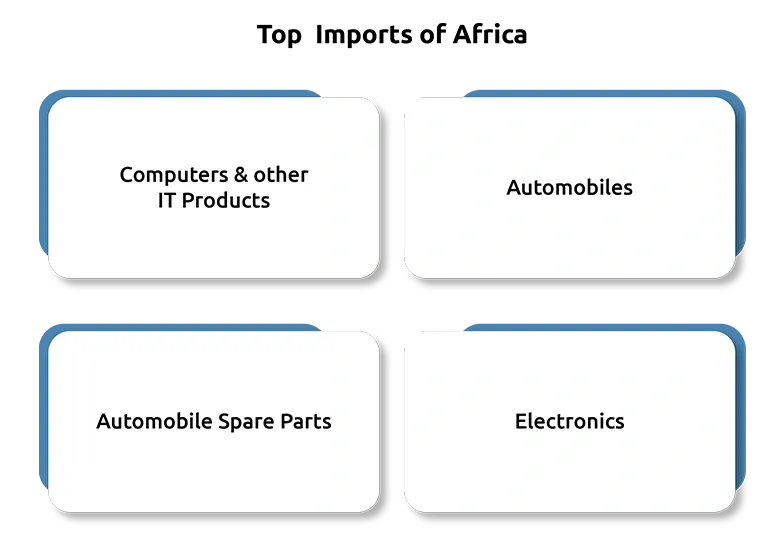
If you are targeting the African buyers in new & growing African markets, here is a list of 10 major African imports based on current African import & export statistics:
Automobiles
The automobile industry provides many profitable opportunities in this rapidly growing region. The high rate of economic growth & urbanization has led to a rise in income levels. This implies that more & more people are now able to purchase vehicles both for personal and commercial purposes as they move from low-income status & into the upwardly mobile middle class.
Computers & other IT Products
Africa has one of the highest rates of growth in the market for IT products worldwide. As a result, multi-national manufacturers have concentrated their efforts on the market, producing in great quantities items specifically targeting the African market.
South Africa’s computer market, for instance, is valued at more than $1 billion. One of the factors behind the growth in the sector is the fact that many organizations are changing from traditional desktops to the more personal and portable laptops & ultrabooks. The rapid pace at which innovations are being introduced to the sector & the inversely proportional price reductions have also boosted demand.
Automobile Spare Parts
Most of the African buyers are buying substantial quantities of automotive batteries, tyres, spare parts, ball bearings, water pumps, and a host of automobile spare parts from overseas markets for selling them at a profit in their own countries.
In addition to automobile spare parts, a major import to many African countries in recent years has been tyres, batteries, and lubricants.
Electronics
The African market has not yet been able to achieve self-sustenance in the electronics sector and depends on external players in the industry to fill its growing need for home appliances & electronics.
Electronic products from Asia have gained increasing popularity in the African markets thanks to their well-equipped production & assembly facilities as well as competitive pricing. Unlike European & American manufacturers, Asian manufacturers have easy access to electronic components & hence are able to provide lower prices.
Trade Partners of African Countries
Africa’s main trade partners as of 2026 are controlled by China, the European Union, India, the United Arab Emirates, & the United States. China is the largest partner, importing & exporting manufactured goods.
Top Trade Partners of African Countries
China: Africa’s largest trading partner, specializing in infrastructure financing and resource importation.
European Union: Main partners in Italy, France, Spain, & the Netherlands, focusing on manufactured machinery & imports from Africa.
India: A fast-growing partner, ranking among the top three for Africa, with dual trade arriving approximately $100 billion (2024–2025), focusing on technology products.
Three critical challenges to overcome for Trade in Africa
African import markets face many challenges, with poor network, limited access to finance, & difficult regulatory environments that develop trade costs 50% above the global average. Main issues include foreign exchange shortages, high volatility, & format red tape, which disrupt supply chains & increase the cost of goods for consumers.
Poor Infrastructure & Logistics
Africa’s network gap remains one of the biggest issues to trade efficiency. Many nations come from limited transport routes, limited rail connectivity, & inefficient port systems.
According to the African Development Bank, network gaps increase the cost of African trade by up to 30%, making African exports not cost-effective on the global stage.
Tariff & Non-Tariff Barriers
When tariffs have been mainly minimized, non-tariff issues such as difficult customs procedures & inconsistent border regulations still block trade.
Trucks often spend days or even weeks at border posts due to repetitive verification & paperwork.
Skills Gap & Human Capital Development
A major constraint in African trade is the lack of skilled professionals in trade logistics, supply chain management, & technology.

Conclusion
Africa’s import landscape is rapidly developing, driven by strong economic growth, urbanization, & rising consumer demand across main markets. Countries such as South Africa, Egypt, Nigeria, & Kenya continue to play an important role in transportation import volumes, while sectors like automobiles, electronics, IT products, & spare parts remain in high demand. At the same time, Africa’s growing middle class & industrial expansion are creating long-term opportunities for global exporters & manufacturers.
Did You Know?
Africa trade data, the total value of African imports reached $719 billion in 2024, a 2.4% increase from the previous year. At the top, African buyers and imports by country for the years 2024-25, with a key focus on African imports and African trade data.
FAQ
1. What is the most important product in Africa?
Vehicles & electronics are among the most heavily imported products across the continent, alongside wheat and other food items.
2. Which African country imports the most from China?
South Africa, Nigeria, Egypt, Liberia, and Algeria are the biggest buyers of Chinese goods.
3. What does Africa import from India?
Major imports include IT products, medical equipment, aviation materials, and commodities.
4. Why is Africa considered a high-potential import market for global exporters?
Africa is gaining importance due to rapid urbanization, a growing middle class, and increasing demand for infrastructure, technology, and consumer goods, making it a high-growth import destination.
5. Which country is no 1 in imports?
The United States is the world’s number one importer of goods, holding the top position with an import value of approximately $3.12 to $ 3.96 trillion in 2024