Insights
Trade agreements are evolving & updating the cross-border flow of diagnostic equipment by minimizing tariffs, harmonizing regulatory standards, & improving customs procedures, with recent agreements like the India-EU Free Trade Agreement set to minimize duties on up to 99% of medical & surgical devices. These agreements are important for the fast deployment of technologies like CT & MRI scanners, mainly by using regulatory delays for CE-marked devices.
What Are Trade Agreements in Healthcare Trade?
Trade agreements are treaties between two or more countries that include provisions addressing trade in goods and/or services. Trade agreements are tools of globalization & mainly seek to promote global wealth through trade liberalization. They can have important implications for the social, commercial, political, & ecological determinants of health as well as the delivery of health care.
International trade contributes significantly to increases in national wealth, which is a main factor in building strong health care systems. While trade agreements are designed to produce economic benefits & global wealth, it is fundamental to identify public health implications that may arise from these agreements.
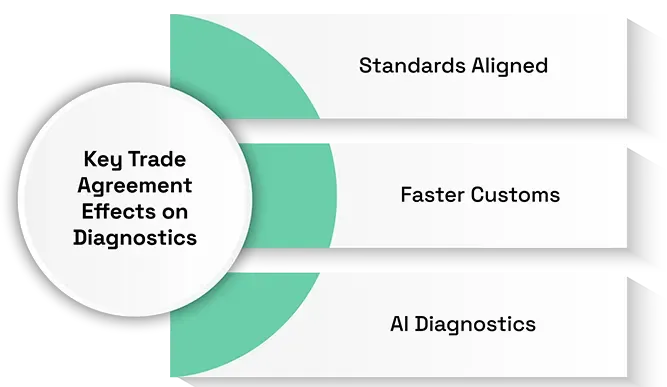
Key Trade Agreement Effects on Diagnostics:
Tariff Reduction: Agreements, such as the India-EU FTA, fastly lower import costs, with an impact of 10–25% savings on advanced medical technologies.
Regulatory Cooperation: Regional Trade Agreements increasingly include provisions for mutual recognition & quality, which prevent different standards from pausing trade in medical products. This eases the approval process for specialized diagnostics, such as CE-marked devices, in new markets.
Customs Simplification: Modern trade deals focus on cutting “red tape” to ensure faster, more predictable, & transparent border processes, which reduces inventory issues & improves supply chain efficiency.
Digital Trade Data Flows: Developing the free flow of general diagnostic data across borders is increasingly important for managing global logistics, supporting AI-driven diagnostic tools, & managing remote diagnostics.
Creative Property (IP) Protection: Agreements often add more rules that protect the IP of high-tech diagnostic machinery, encouraging development & investment in high-value manufacturing
Regional & Sector-Specific Examples:
India-EU FTA: This agreement represents a landmark shift, connecting a market of nearly two billion people, significantly boosting the importation of European diagnostics into India while improving market access for Indian manufacturers.
RCEP (Regional Comprehensive Economic Partnership): In the Asia-Pacific, RCEP has established a model for digital trade, aiming to harmonize regulatory standards to facilitate the flow of medical goods.
WTO Agreements: The WTO’s General Agreement on Trade in Services (GATS) regulates the cross-border movement of health services, impacting telemedicine & laboratory diagnostic services.
Challenges in Trade Agreements
Policy Challenges: The 2020 WTO Trade Policy Review of India noted that India makes extensive use of trade policy instruments such as tariffs, export restrictions, export taxes, anti-dumping duties, & import licensing. According to economist Arvind Panagariya, such tools create uncertainties & induce distortions in the international trading system.
Poor Utilisation of the existing FTAs: The reasons range from the cumbersome process of getting a certificate of origin and the related manual verification process to low awareness about FTAs in the domestic Indian industry.
Protectionist Fears: There are fears that FTAs will lead to an influx of cheaper goods from abroad & will prove detrimental to India’s domestic industry. These protectionist fears forced the Government to withdraw from RCEP.
New Issues: Developed countries have brought new issues like the labour standards, environment, & climate change within the ambit of trade and FTA negotiations. Inclusion of such issues will add additional costs & make Indian goods uncompetitive.

Conclusion
Trade agreements help update how diagnostic equipment moves globally. They make global trade faster, simpler, & easier. By using taxes on imports, aligning rules across countries, & making customs processes easier, these agreements help important medical technologies reach the places where they are needed most.
They also support new ideas & improvements by protecting creative property & allowing data to move more easily across borders. This is especially important today, as many modern diagnostic tools use digital systems & AI to work more easily.
Did you know?
Advanced economies announced more investment into one another—particularly to the United States—but decreased flows to China by nearly 70 percent.
FAQ
1. What is the impact of the India-EU FTA on medical devices?
The India-EU FTA, finalized in January 2026, is expected to cut tariffs to zero on 90% of medical equipment, boosting imports of high-end European diagnostic tools into India while allowing Indian firms access to the EU market.
2. How do trade agreements affect the price of diagnostic equipment?
Trade deals reduce import duties and tariffs (often from 10–50% to zero), directly lowering the landed cost of advanced imaging and laboratory diagnostic equipment, making them more affordable for healthcare providers.
3. What are the non-tariff barriers being addressed in new trade deals?
Key non-tariff barriers include strict and lengthy regulatory approvals, inconsistent product standards, and restrictive import licensing. New deals often include “Mutual Recognition Agreements” (MRAs) to accept international standards, such as ISO, to speed up certification.
4. How do trade agreements impact the ‘Make in India’ initiative for medical devices?
While import-heavy, the deals aim to attract investment and technology transfer, encouraging foreign companies to move from simple exporting to local assembly, service infrastructure, and eventual manufacturing.
5. What diagnostic products are most affected by the new India-US trade framework?
The interim deal focuses on high-value segments, including diagnostic reagent kits, linear ultrasound devices, and software-based diagnostics, aiming to reduce the cost of these technologies for Indian hospitals.