

Overview
The global automotive industry has depended on an interconnected production chain that works in multiple countries. Trade uncertainty has new risks for organizations that depend heavily on global trade and cross-border manufacturing businesses. Also, many automakers are mostly focusing on localization plans to create more flexibility and acceptable supply chains. Localization in the automotive industry refers to producing vehicles, tools, and services near the market rather than depending massively on imports. Also, organizations must carefully manage international trade terms and correct documentation processes. Regulations related to systems such as Generalized System of Preferences (GSP), HS code categorizations, and the HTS Harmonized Tariff Schedule rules change how organizations structure their trade operations. Businesses frequently depend on services such as exporter of record services, Importer of record services, and International freight services to confirm regulatory approval while shipping goods across borders. While localization looks to reduce dependency on difficult cross-border systems, global trade remains a necessary part of the automotive ecosystem.
The Role of Localization of the Supply Chain in the South African Automotive Industry
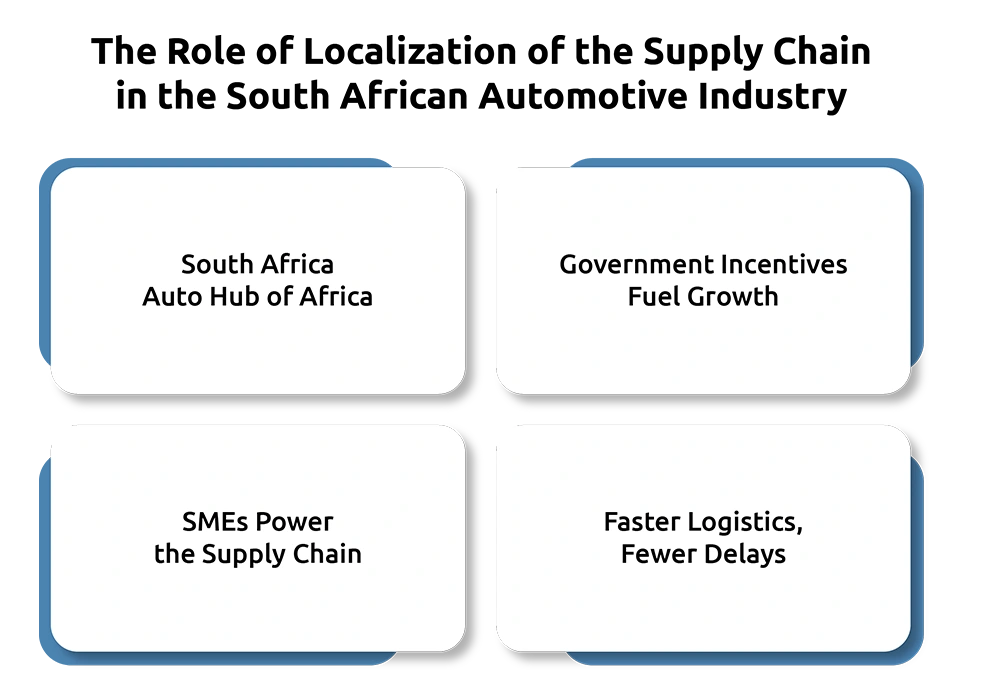
South Africa provides a strong localization plan that can support the development of the automotive sector. The country has positioned itself as one of the leading vehicle manufacturing hubs in Africa, developing production systems for many global automakers. Localization guidelines have encouraged manufacturers to increase the use of locally produced components and improve local supplier chains.
Government Support and Industrial Policies
Government schemes have played a critical role in growing localization in South Africa’s automotive sector. Incentive programs encourage automakers to trade components locally and invest in local production simplification. These schemes look to reduce dependence on imports, improving industrial capabilities.
Supplier Development and Regional Integration
Localization also increases the development of small and medium-sized suppliers that support vehicle assembly trades. As local supplier trades grow, manufacturers can reduce logistics delays and improve work across production stages. Also, with strong localization efforts, organizations must manage global trade issues. Approval processes such as customs clearance, Incoterms, and working with global partners are necessary when moving tools or vehicles across borders with service providers.
Can Trade Policy Uncertainty Simplify Auto Industrial Chain Localization?
Trade policy uncertainty has become a major factor in the localization of automotive supply chains. When governments introduce new tariffs, export restrictions, or regulatory requirements, organizations may see unexpected costs and working problems. By manufacturing vehicles and tools locally, organizations can reduce their risk of tariffs and regulatory delays. Localization allows automakers to avoid cross-border and simplify production processes.
Major Supply Chain Adaptation in the industry
Organizations are also reevaluating their trade strategies to create greater dependence into their supply chains. Also, depending on a single global supplier chain, automakers are varying production across multiple regions. This strategy helps reduce risks related to trade issues, logistics delays, or some policy changes. Advanced digital tools, including the best trade compliance software for import export rules, help manufacturers track regulatory problems and have effective trades.

How Localization Strategies Improves Auto Industry Amid Trade Uncertainty
Localization plans provide many advantages that help the automotive industry to navigate uncertain global trade. Manufacturing tools closer to the assembly industry reduces logistics time and reduces disruptions caused by global shipping delays. Regional manufacturing networks also allow faster response times when demand changes.
Improving Supplier Relationships
Local supplier partnerships encourage work between automakers and component manufacturers. Working with localized manufacturing, organizations must have correct documentation and regulatory approval. Most of the organizations frequently ask questions such as whether a freight forwarder can be an exporter of record or whether a customs broker can handle both import and export documentation for approval. Understanding these roles helps manufacturers work the global trade systems more effectively while confirming approval with global regulations.
Conclusion
Trade uncertainty is changing how the global automotive device manufacturers and manages its supply chain. Localization strategies have become an important response for manufacturers looking for greater stability, efficiency, and flexibility. The experience of South Africa shows how targeted policies and industry collaboration can support successful localization efforts. While global trade will continue to play an important role in the automotive sector, organizations that work with strong local manufacturers will be good to guide future uncertainties in global trade.
DID YOU KNOW?
The Middle East and Central Asia doubled their share of global foreign direct investment projects from 6% in 2003 to 14% in 2024, and the Eurozone strengthened its position from 18% to 21%.
FAQs:
1. What is localization in the automotive industry?
Localization in the automotive industry refers to producing vehicles, components, and services closer to the target market instead of relying heavily on imports. This strategy helps manufacturers reduce supply chain risks, logistics costs, and trade barriers.
2. Why are automotive companies focusing on supply chain localization?
Automotive companies are focusing on localization to reduce risks caused by trade policy uncertainty, tariffs, and cross-border disruptions. Local production also improves supply chain efficiency and reduces dependency on global suppliers.
3. How does trade uncertainty affect the automotive supply chain?
Trade uncertainty can increase tariffs, introduce new regulatory requirements, and cause delays in cross-border trade. These challenges force manufacturers to rethink sourcing strategies and invest in regional production systems.
4. What are the benefits of localization in the automotive industry?
Localization can improve supply chain stability, reduce logistics costs, shorten production lead times, and strengthen relationships with local suppliers. It also helps companies respond quickly to market demand changes.
5. How does South Africa support automotive localization?
South Africa supports localization through government incentive programs, industrial policies, and supplier development initiatives that encourage the use of locally manufactured components in vehicle production.