Insight
As international trade continues to develop, businesses are mainly seeking ways to minimize costs, enhance market access, & updated supply chain usability. Free Trade Agreements (FTAs) have developed as powerful tools that help importers & exporters overcome trade issues by lowering tariffs, simplifying customs procedures, & creating more predictable trading environments. From aviation & automotive manufacturing to IT infrastructure & medical equipment, companies across industries are using FTAs to improve competitiveness & accelerate global growth. Understanding how these agreements work, added with their compliance need & strategic advantages, is essential for businesses looking to maximize profitability & succeed in today’s interconnected global marketplace.
Free Trade Agreements
A free trade agreement allows several countries to lower or eliminate trade barriers, such as import taxes. These agreements aim to help make global trade fair & open to various competitors. Some FTAs also cover non-tariff factors such as quotas, the need for certain licenses, & rules or standards in different areas.
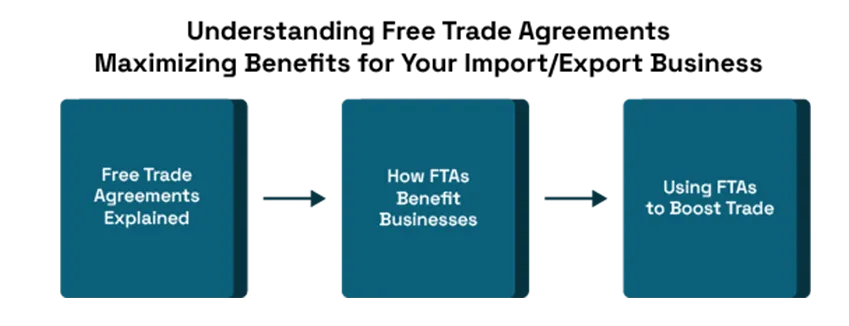
Free Trade Agreements simplify the movement of goods across borders by reducing tariffs, easing customs clearance requirements, and offering predictable trade rules. For importers and exporters, this means lower operational costs, fewer delays during in transit processes, and smoother access to new markets.
What are rules of origin in FTAs?
Rules of origin determine where a product is made and whether it qualifies for reduced tariffs under a trade agreement. They set specific criteria that a product must meet, such as being fully produced in a country or having a certain level of local content.
These rules help prevent misuse of trade agreements, where goods from non-member countries are routed through member countries to get benefits. Businesses must provide proper documents, like certificates of origin, to prove compliance. Following these rules correctly helps companies reduce costs, avoid penalties, and ensure smooth customs clearance in international trade.
Key Benefits of Free Trade Agreements
FTAs present several advantages to businesses, such as:
Lower Tariffs and Taxes: Reducing or eliminating tariffs is one of the biggest advantages of FTAs, as it lowers the cost of exportation and importation of goods. Reduced tariffs in sectors such as aviation and automobile equipment, where the cost of goods is generally high, could mean significant savings and more competitive prices.
Increased Market Access: FTAs provide greater market access by liberalising foreign markets that may have been hard or too expensive. Through reducing trade barriers, FTAs open doors for businesses to access new markets & grow their global presence.
Regulatory Compliance: FTAs frequently contain rules that harmonize national regulations and certifications. This provides more convenient access for enterprises to conform their products to international standards, particularly in industries such as IT equipment and medical devices, where safe and high-quality products are essential.
Maximizing Supply Chain Performance Under FTAs
Leveraging FTAs helps businesses improve end-to-end supply chain efficiency by minimizing duty costs and simplifying documentation across borders. Companies working with an importer of record (IOR) or exporter of record (EOR) gain additional support in navigating customs paperwork, harmonized system (HS) codes, and global trade compliance requirements. This ensures safer, more reliable movement of aviation parts, IT hardware, MRO supplies, and medical equipment. By integrating efficient warehousing services, optimized freight forwarding services, and accurate classification through HTS codes, companies can maintain uninterrupted supply chains and reduce risks during international shipping. FTAs paired with smart logistics planning create a competitive edge in today’s global trade environment.
How FTAs Benefit Different Sectors
Aviation Equipment
The aviation industry is recognized for having many rules and being very expensive. FTAs can assist aviation equipment companies by making the purchase of raw materials and components more affordable. Through FTAs, companies find exporting aviation products to different countries simpler, more accessible, and more cost-effective.
Automobile Equipment
FTAs assist the auto industry in both lowering manufacturing costs and getting into new markets. Once tariffs are removed, companies can import parts for cars at a lower price and give those savings to customers. Through FTAs, automobile companies can sell their products to new markets and become more competitive.
IT/Data Center Equipment
FTA agreements help companies grow and provide the global market with the IT and data center equipment it requires in the fast-changing technology field. FTAs allow companies to get supplies such as servers and networking equipment worldwide. In addition, many FTAs ensure that technology companies’ intellectual property is safe, making it simpler to create new inventions and expand their activities overseas.
Medical Equipment
The medical equipment sector will see gains because FTAs make importing medical devices and equipment into different countries much less expensive. When FTAs lower tariffs and rules, it becomes easier for this sector to provide medical solutions to larger markets. FTAs make it simpler for companies to get certified and ensure their safety measures in countries they have not operated in before.
Conclusion
Industries that benefit from free trade agreements gain an increased market and lower operating costs. Companies can export to other countries without tariffs or trade restrictions with less effort and expense. Yet, to enjoy all these benefits, companies must know all the details about each deal and ensure they follow all the related rules.
At One Union Solutions, we guide businesses through the challenges of free trade agreements to help them use trade opportunities globally without breaking any rules.
Did You Know,
The World Trade Organization reports that around 50% of worldwide trade happens under free trade agreements.
FAQs
1. How can businesses determine whether their products qualify for FTA benefits?
Businesses must review the specific rules of origin outlined in the applicable Free Trade Agreement. This typically involves verifying where the product was manufactured, assessing local content requirements, and ensuring the correct Harmonized System (HS) classification is used. Proper documentation, including certificates of origin, is often required to claim preferential tariff treatment.
2. What documents are commonly required to claim benefits under a Free Trade Agreement?
The required documents vary by agreement but generally include a certificate of origin, commercial invoice, packing list, bill of lading or airway bill, and customs declarations. Maintaining accurate records is essential to demonstrate compliance during customs inspections or audits.
3. Can Free Trade Agreements help reduce supply chain costs beyond tariff savings?
Yes. In addition to lowering or eliminating customs duties, FTAs often streamline customs procedures, reduce administrative delays, improve border clearance efficiency, and create more predictable trade regulations. These benefits can significantly lower overall logistics and operational costs.
4. What role do HS codes play in utilizing Free Trade Agreements?
HS codes are used to classify products in international trade and determine applicable tariff rates and FTA eligibility. Incorrect classification can lead to denied benefits, customs penalties, shipment delays, or unexpected duty charges. Accurate product classification is critical for maximizing FTA advantages.
5. How do Free Trade Agreements benefit technology and data center equipment suppliers?
FTAs can reduce import duties on servers, networking equipment, storage systems, and other IT infrastructure components. They also facilitate smoother cross-border trade, helping technology companies optimize procurement costs and expand into international markets more efficiently.