What Are Terms of Trade (TOT)?
Terms of Trade show the difference between a country’s export fees and its import fees. When a country can sell its exports at higher values compared to the cost of its imports, its Terms of Trade improve, showing stronger economic performance. Also, a decrease in Terms of Trade suggests a greater discharge of resources to acquire imports. Terms of Trade play an important role in changing global trade, simplifying and supporting the actions for industries combined in cross-border trade, from freight forwarding services to regulatory import management.
A favorable Terms of Trade strengthens a country’s purchasing power and supports long-term economic stability. It also enables businesses to invest more confidently in international expansion and supply chain development. For exporters and importers, understanding Terms of Trade helps in pricing strategies and contract negotiations. As a result, effective trade policies and compliance frameworks become essential for sustaining competitive global trade operations.
Understanding the Economic Effects of Terms of Trade
An improvement in TOT frequently means a country has more buying power, allowing it to buy more global goods with some exports. This positively affects investment, wages, and consumption. On the other hand, a decreasing TOT can strain a country’s foreign reserves and weaken trade competitiveness. Economic impacts also depend on trade compliance expertise, since effective handling of international export regulations and export customs brokerage confirms that businesses optimize their trade flows. Governments and businesses frequently use trade programs such as the Generalized System of Preferences (GSP) to benefit from tariff reductions, which further influences a country’s Terms of Trade.

How to calculate a country’s terms of trade?
The calculation of TOT is straightforward:
TOT = Export Price Index divided by Import Price Index multiplied by 100
For example, if a country’s exports become more expensive relative to imports, the TOT rises, showing a more favorable position in global trade. To achieve accurate calculations, businesses often rely on categorization systems such as the HS Code and the HTS Harmonized Tariff Schedule. These coding systems confirm that goods are correctly used under Incoterms such as DAP, Delivery Duty Paid, and DAPs when various shipping hubs are considered. Knowing these trade terms is critical for forwarders, exporters, and importers to estimate fees and compliance correctly.
How Can One Union Solutions Help to Improve Terms of Trade?
How One Union Solutions Strengthens Terms of Trade Through Smarter Global Logistics
One Union Solutions helps businesses improve their Terms of Trade by integrating freight forwarding services, importer of record (IOR) support, and DDP shipping into a single, compliant global supply chain framework. Our expertise in customs clearance, HS/HTS classification, and trade compliance ensures that imported and exported equipment is processed smoothly, reducing landed costs and boosting export competitiveness. With specialized capabilities in warehouse services, in-transit logistics, and MRO supply chain operations, we enhance cost-efficiency across borders while supporting industries such as IT, aviation, automotive, and medical technology. By applying supply-chain best practices and compliance-driven strategies, we help organizations unlock better TOT positions and achieve sustainable international growth.
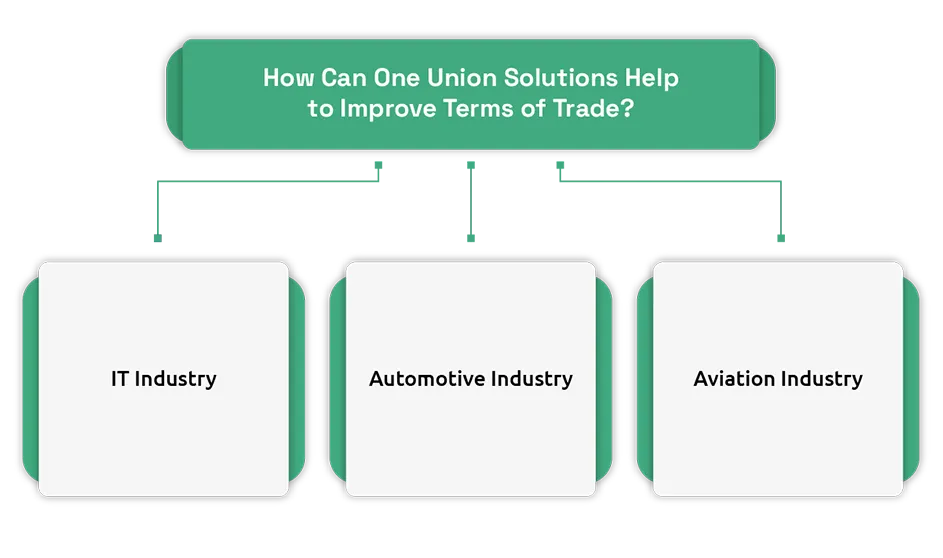
Terms of Trade: IT, automotive, aviation, and medical industries.
Different industries experience unique impacts from TOT shifts:
IT Industry: Hardware exports frequently depend on favorable tariff structures under programs like the generalized system of preferences. TOT improvement allows tech companies to import raw materials at competitive rates while exporting high-value goods.
Automotive Industry: With complex supply chains, car manufacturers depend on accurate HS codes, HTS harmonized tariff schedule classification, and trusted forwarders for efficient freight forwarding services. TOT improvements reduce the import costs of parts while increasing export margins.
Aviation Industry: The sector depends heavily on global sourcing of equipment under strong international export regulations. Using delivery duty paid (DDP shipping) and DAP terms, organizations simplify logistics while improving competitiveness.
Medical Industry: Compliance-driven by export customs brokerage and trade logistics, and compliance is critical. Access to global supply chains through importer of record services confirms the timely movement of sensitive equipment, while favorable TOT improves the affordability and accessibility of healthcare imports and exports.
How Supply Chain Visibility Supports Better Terms of Trade
Stronger Terms of Trade depend on how efficiently goods move across borders, making global supply chain visibility essential for modern industries. With advancements like AI-powered demand forecasting tools and improved warehouse management services, businesses can reduce delays, optimize inventory, and minimise excess freight costs. This becomes especially valuable for sectors relying on sensitive or high-value equipment—including telecom, IT hardware, and automotive components—where accurate HS Code identification and compliance with Incoterms 2025 directly influence import costs. By integrating smarter visibility tools with trusted freight forwarders and compliant warehouse solutions, companies can enhance predictability, reduce exposure to tariff barriers, and strengthen their overall trade position.
Conclusion
Terms of Trade (TOT) work as a importer indicator of a nation’s economic health, directly influencing purchasing power, trade competitiveness, and industrial growth. Whether in IT, automotive, aviation, or medical sectors, favorable TOT outcomes allow businesses to balance import costs with stronger export earnings. By using tools such as HS codes, Incoterms, and tariff reduction programs such as the Generalized System of Preferences, organizations can increase agreement and improve their trade flows. At One Union Solutions, we bring unmatched expertise in importer and exporter of record services, freight forwarding, and global trade, simplifying and helping businesses strengthen their TOT position while unlocking new opportunities in global trade.
DID YOU KNOW?
Today, there are approximately two million types of medical devices on the global market, classified into more than 7,000 device categories.
FAQs:
Q1: Why are Terms of Trade important for a country’s economy?
Terms of Trade measure the relationship between export prices and import prices, helping assess a country’s trade strength, income levels, and global competitiveness.
Q2: How does a favorable Terms of Trade impact national growth?
When export prices rise faster than import prices, countries earn more from trade, supporting higher government revenue, stronger currency stability, and increased economic investment.
Q3: What economic risks arise from unfavorable Terms of Trade?
Unfavorable Terms of Trade can increase import dependency, weaken trade balances, pressure foreign exchange reserves, and raise production costs for domestic industries.
Q4: How do customs duties and trade policies influence Terms of Trade?
Customs tariffs, free trade agreements, and duty-relief programs alter import and export pricing structures, directly affecting the balance between trade earnings and costs.
Q5: How do logistics terms and customs classification affect Terms of Trade?
Incoterms, accurate HS code classification, and correct tariff application shape landed costs and export revenues, playing a key role in maintaining balanced and sustainable trade conditions.