Overview
Global trade dynamics in 2026 have been significantly impacted by geopolitical disruptions, with one of the most notable developments being the sharp rise in South Korea’s import-export prices. Triggered by instability in the Gulf region, energy costs and raw material prices have surged, pushing Korea’s trade metrics to levels not seen since the Asian financial crisis.
As a highly trade-dependent economy, South Korea plays a critical role in global supply chains, particularly in sectors like semiconductors, automotive manufacturing, and advanced electronics. Any fluctuation in its import-export pricing structure has ripple effects across international markets, impacting industries such as IT, aviation, medical equipment, and automotive. For businesses engaged in cross-border trade, understanding these changes is essential for maintaining operational stability and cost efficiency.
Korea’s Import-Export
South Korea is really connected to the rest of the world when it comes to buying and selling things. The country of South Korea needs to import and export things like semiconductors, automobiles and industrial machinery. South Korea relies on importing and exporting these high value goods.
The Gulf shock has caused a problem. This has made production costs go up for all kinds of industries. Because of this the prices of things that Korea exports have also gone up. Korean goods are now more expensive when people in other countries import them. It is also affecting how well Korea can compete with other countries in trade. The Gulf shock is really affecting goods and trade.
For import-export businesses these changes show that it is really important to be able to adapt. In areas like aviation and automotive import-export businesses are affected a lot because they get parts from different countries. They also have to make sure that everything runs smoothly when moving products from one place to another.
Regulatory compliance and doing the paperwork is really important. When companies try to save money they also have to make sure that all the transactions they do with countries meet the new rules that are always changing. This way regulatory compliance and these transactions can happen without any problems. Businesses must do this to avoid disruptions, to their compliance and transactions.
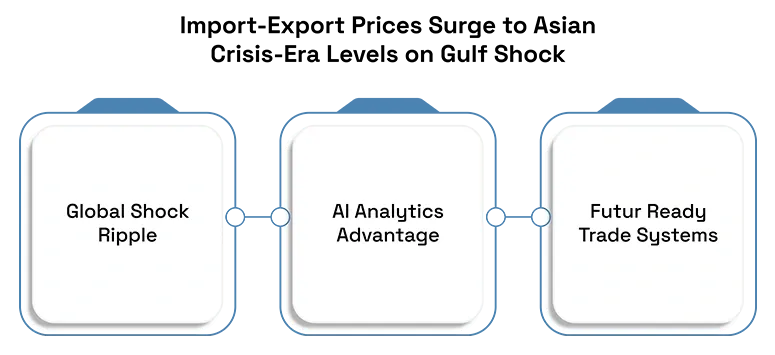
Import-Export Prices Surge to Asian Crisis-Era Levels on Gulf Shock
Korea is seeing a change in the prices of import – exports. This is because of problems outside of Korea and issues with Korea’s economy. For a country like South Korea that imports a lot of things from other countries this means it now costs more to make things in many areas of the economy. Korea’s import prices are going up. This is a problem for South Korea.
This situation mirrors the volatility seen during the Asian financial crisis, where external economic shocks led to sharp fluctuations in trade balances and currency values. In 2026, although the economic environment is more resilient, the scale of the price surge is drawing comparisons to that period.
For people who do business around the world this shows that planning ahead is really important. Companies need to find places to get the things they need to get better at guessing what will happen and use AI Analytics for further good. Using computer systems for trade can help companies deal with complicated rules and avoid problems that come with prices that keep changing. Global trade stakeholders, like these companies, need to focus on this to do well.
Navigating Volatility: Strategies for Global Trade Stability
Businesses need to be ready for what’s coming. They have to think and come up with plans to deal with the risks that come with prices going up and down. One thing they can do is try to get the things they need from more than one place. This means they will not be relying much on one area for import or export. This is called diversification of the resources. It can help with price volatility. Diversification can help with this problem.
Another important strategy is enhancing visibility across the supply chain. Real-time data and analytics enable businesses to respond quickly to changes in pricing, demand, and regulatory requirements. This is particularly relevant for industries like medical equipment and IT, where timely delivery and compliance are crucial.
Cost management also becomes a priority. Companies must evaluate transportation routes, optimize shipment planning, and implement efficient inventory practices to reduce overall expenses. While rising prices cannot always be avoided, their impact can be minimized through better planning and execution.
Collaboration with experienced trade partners is equally important. By working with professionals who understand international trade regulations and documentation processes, businesses can ensure smoother operations even during periods of uncertainty.

Conclusion
The big jump in Korea’s import and export prices is now as high as it was during the crisis. This shows that what happens in one part of the world can affect parts. For example something like the Gulf shock can have an impact on economies and industries all around the world. Korea’s import and export prices are an example of this.
For businesses that work in the IT sector, the aviation sector, and the automotive sector this situation is a big deal. When costs go up and things get unpredictable that makes it hard to plan. At the same time the IT sector and the other sectors have to think of new ideas, try new things and make their supply chains better.
Companies can deal with these problems by keeping up to date and using the tools. Companies like these need to stay informed about what’s going on. This is important because global trade is changing all the time in 2026. If companies want to be successful in the run they have to be able to adapt to new conditions. Global trade will keep changing so companies must be able to change with it to achieve long-term success, with trade.
DID YOU KNOW
South Korea’s import prices jumped at the steepest pace in nearly three decades as the outbreak of a full-blown war in the Gulf triggered a sharp surge in energy prices and the U.S. dollar against the Korean won
FAQs
1.Why have Korea’s import-export prices surged in 2026?
The surge is mainly due to rising energy costs triggered by instability in the Gulf region, increasing overall import and production expenses.
2.How does this price surge affect global trade?
Higher export prices from Korea impact global supply chains, making goods more expensive and influencing demand across markets.
3. Which industries are most affected by this situation?
Key sectors like IT, automotive, aviation, and medical equipment are heavily impacted due to their reliance on Korean exports.
4. What challenges do import-export businesses face?
Businesses face rising costs, supply chain disruptions, and the need to manage pricing and sourcing strategies more effectively.
5. How can companies manage such trade volatility?
They can diversify suppliers, improve supply chain visibility, and adopt better planning tools to handle cost fluctuations efficiently.