Insight
Export laws have been instrumental in the aviation business in determining how businesses run their international trade. Both on an aviation equipment level and on the level of technology or software, it is important to know the difference between the International Traffic in Arms Regulations (ITAR) and the Export Administration Regulations (EAR). These two policies determine the exportation of some commodities and services out of the United States, particularly the aviation industry. Let us look at these laws in more detail and their implication for international trade and due compliance by aviation enterprises.
Understanding whether a product falls under ITAR or EAR helps businesses avoid compliance risks and costly penalties. These regulations also influence licensing requirements, approved destinations, and end-user restrictions. Proper classification ensures smooth exports and protects national security interests. For aviation companies, staying informed about these laws is essential for safe and compliant global operations.
What are ITAR and EAR?
The U.S. government has established two significant regulatory systems that control the export of sensitive materials and technologies- ITAR and EAR. However, they differ in the types of items and technologies they target since both aim to control the export of goods to foreign states.
ITAR (International Traffic in Arms Regulations) mainly focuses on the export of military type equipment, which also includes flight equipment that is aviation-related but military in form. The emphasis is enforced by the Directorate of Defense Trade Controls ( DDTC) in the U.S. Department of State. The ITAR handles the export of defense articles/services to foreign persons to safeguard national security interests.
On the other hand, EAR (Export Administration Regulations) is in place through the U.S. Department of Commerce and handles the export of dual-use goods. These products can be used by the civilian and military population, i.e., a civilian transport aircraft and some technologies used in the aviation industry. EAR controls the export of goods depending on their sensitivity and the destination of the products.

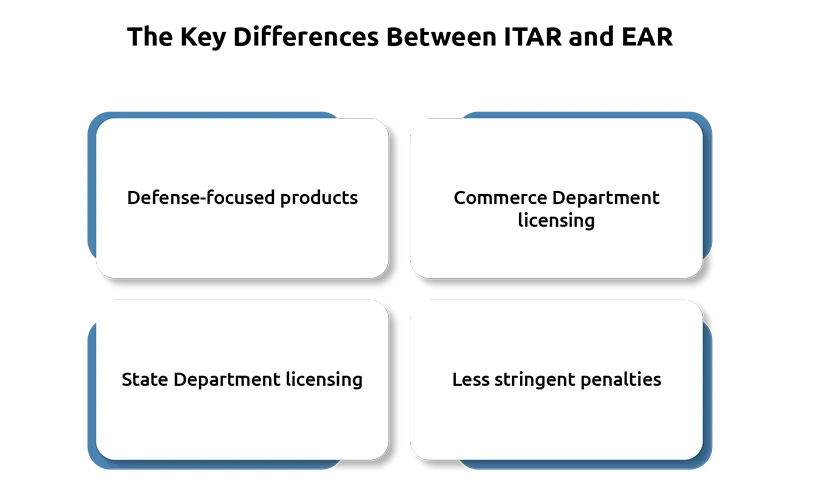
The Key Differences Between ITAR and EAR
It is important to know the differences between ITAR and EAR, in case businesses deal with the export of aviation equipment. Items and services covered under ITAR are mainly of a defense nature, and this can include military aircraft, avionics, and technology that is meant to be used by the military. On the contrary, EAR targets dual-use products with both civilian and military applications, such as commercial airliners, navigation equipment, and some aerospace technologies. The goods going under each of these frameworks are placed in different categories of control lists. The ITAR-controlled items are placed on the United States Munitions List (USML), and the EAR-controlled items on the Commerce Control List (CCL), which contains products that can possibly be used in military directions.
In terms of approval and licensing, ITAR-controlled goods need to be licensed by the U.S. Department of State, and approval is stricter. EAR-controlled items, conversely, need a license from the U.S. Department of Commerce and its normally less stringent license procedure. The consequences of both violating ITAR and EAR are grave, including fines, prohibition of exportations, and imprisonment. Nonetheless, ITAR breaches are more likely to be heavy hitters because of the sensitive status of the military-centered exports.
Why ITAR and EAR Compliance Matter in Aviation
Any aviation company involved in international trade should comply with these regulations to adhere to U.S. law; otherwise, an intentional violation of ITAR and EAR may lead to high fines, exclusion of export rights, and serious reputational losses. Compliance will ensure that the law is followed and that trust is maintained with foreign customers and partners.
Furthermore, a vast majority of foreign governments demand that firms prove that they are not violating the U.S. export control laws to be allowed to trade in different countries. Non-compliance with such requirements may also deny companies the ability to exploit the profitable foreign markets.
How Compliance Enhances Aviation Export Logistics
Exporting aviation parts—whether commercial avionics or dual-use components—demands more than technical knowledge; it requires an integrated logistics strategy that supports global trade compliance. Companies handling cross-border shipments must align their processes with ITAR and EAR while also managing warehousing services, DDP shipping requirements, and multimodal transport arrangements. The right compliance framework reduces delays, improves transparency in the supply chain, and ensures that every shipment—from initial classification to final delivery—passes regional controls and partner-country regulations. For aviation exporters working in international ecommerce shipping or complex B2B supply chains, adopting strong documentation practices and working with reliable freight forwarders helps eliminate risks and supports long-term global expansion.
The Impact of ITAR and EAR on the Aviation Equipment Exporters
Export Licensing: The aviation companies must acquire the desired export licenses to export products to other countries. What kind of license is needed will be based on whether the product falls into ITAR or EAR classification. In the case of ITAR-controlled goods, a more thorough license application is needed.
Destination restrictions: ITAR and EAR both put limits on exporting products to specific countries or entities. For example, exporting ITAR-controlled goods is prohibited to nations where the U.S has imposed an arms embargo. In the same sense, EAR limitations are enforced on the grounds of national security and stability in the region.
Compliance Costs: ITAR and EAR compliance may become expensive due to the time to navigate. Companies involved in exporting aviation equipment must spend their money on hiring legal and compliance professionals to ensure that their products can pass the expected regulatory inspections.
Export Documentation: The documentation must be in great detail on all transactions that take place, which involves controlling items by exporters. This also covers a document based on licensing, customer checking, and where the products finally go.
Market Insights: Aviation Equipment Export Trends
The global aviation export sector continues to grow steadily as demand increases across Asia, Europe, and the Middle East. According to recent U.S. trade data, aerospace and aircraft exports exceeded $150 billion in 2024, demonstrating how vital this industry is for international commerce. However, expanding into foreign markets now requires stronger compliance practices, especially as governments tighten controls on sensitive items using systems like the Harmonized System Code (HS Code) and HTS classifications. Aviation exporters must also coordinate closely with freight forwarding services, customs clearance teams, and Importer of Record (IOR) partners to ensure that equipment moving in transit meets both ITAR and EAR screening criteria. This combination of regulatory oversight and logistics coordination increasingly shapes which countries U.S. aviation suppliers can access and how efficiently shipments reach global markets.
Conclusion
Knowledge of the differences between ITAR and EAR is significant for companies in the aviation industry. Exporting aircraft equipment is a highly regulated area requiring much attention to detail. We, at One Union Solutions, are in the business of ensuring companies comply with such laws so they can journey around the globe in compliance.
Did You Know,
The U.S. government regulates the export of almost 30,000 goods through ITAR and the EAR, enabling its government to prevent the inappropriation of sensitive technologies while encouraging legitimate international business.
FAQs
What is the main difference between ITAR and EAR?
ITAR controls the export of military and defense-related items, while EAR regulates dual-use products that can be used for both commercial and military purposes.
Does every aviation equipment export require a license?
Not all exports need a license, but items covered under ITAR or certain EAR categories do require export authorization.
How can I tell if my product falls under ITAR or EAR?
Businesses can check official control lists such as the U.S. Munitions List (USML) for ITAR and the Commerce Control List (CCL) for EAR to determine product classification.
What happens if ITAR or EAR rules are violated?
Violations can lead to heavy fines, export bans, and even criminal charges. ITAR violations usually carry stricter penalties.
Can aviation equipment be exported to all countries?
No, exports to certain countries are restricted or prohibited due to national security concerns, sanctions, or trade agreements.