
Overview
Export controls play a vital role in regulating the shipments of valuable goods across international trade borders. Administration use export control guidelines to secure national security, support global laws, and stop unauthorized access to restricted goods in global trade. The USA has two main regulatory rules for export controls, such as the Export Administration Regulations and the International Traffic in Arms Regulations. Organizations’ requirements in manufacturing, technology development, or global trade must use effective ITAR/EAR approval systems to confirm regulatory approval. A systematic approval approach helps reduce legal risk, avoid penalties, and maintain integrity in global markets.
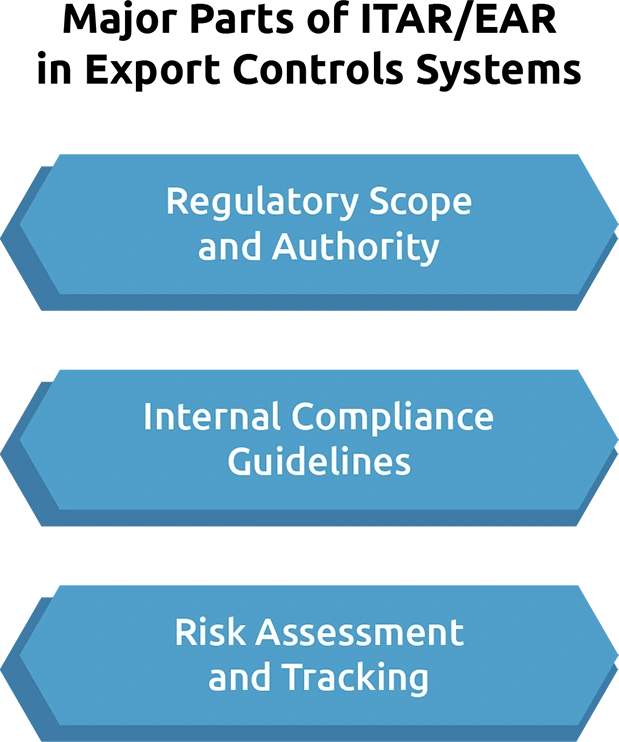
Major Parts of ITAR/EAR in Export Controls Systems
Regulatory Scope and Authority
ITAR and EAR are regulated by different U.S. government agencies and apply to clear categories of restricted goods. Compliance systems must clearly identify which regulation governs specific products, data, or operations of trade. This variance is based on the fact that the problems, licensing requirements, and working systems differ hugely in the supply chain.
Internal Compliance Guidelines
An effective export controls compliance system mainly includes internal policies, employee training, screening procedures, and an audit system. These systems help organizations track exports, re-exports, and transfers while having correct records. Strong governance systems confirm responsibilities at every stage on supply chain.
Risk Assessment and Tracking
Continuous risk analysis is necessary for ITAR/EAR regulations. Export control systems should evaluate possible risks related to customers and destinations. Tracking tools allow organizations to adapt to regulatory changes and growing execution trades.
Understanding Export Administration Regulations in Export Controls
What Is EAR?
The Export Administration Regulations are used by the U.S. Department of Commerce’s Bureau of Industry and Security in global trade. EAR mainly governs used goods, meaning goods and technologies that have both civilian and possible military applications, as well as some reused goods.
How EAR Classification Works
Under EAR, goods are categorized based on their technical specifications and assigned control levels. The categorization process determines whether a license is required and what restrictions apply on that goods. Many commercial goods fall under EAR regulation, making proper categorizations a major component of agreements.
Approval Problems Under EAR
Organizations used to EAR must conform to licensing requirements, end-use controls, and documentation problems. EAR approval systems frequently improve due to effort and documentation to show good efforts to follow regulatory expectations.
Understanding International Traffic in Arms Regulations in Export Controls
What Is ITAR?
The International Traffic in Arms Regulations are used by the U.S. Department of State’s Directorate of Defense Trade Controls in global trade. ITAR controls defense articles, defense services, and related technical data shown on the U.S. Munitions List portal.
Strict Control Environment
ITAR imposes stricter controls compared to EAR. Even non-physical transfers, such as sharing technical data with foreign nationals, can constitute an export under ITAR. As a result, regulatory systems must address both physical and online delivery of controlled information for customs clearance.
Registration and Licensing Requirements
Organizations working with Importer of record Service and exporter of record services for ITAR are required to register with DDTC and obtain licenses or approvals before exporting regulated goods. Strong agreement systems confirm that these requirements are met consistently and clearly with International shipping terms.

What Are the Major Differences Between ITAR and EAR in Export Controls?
Administration and Product Coverage
The main difference between ITAR and EAR depends on administration. ITAR applies to defense-related goods and services, while EAR covers reused and commercial goods. Determining administration is frequently the first step in export control regulation.
Level of Restriction
ITAR is more restrictive, with limited exceptions and stronger execution standards. EAR provides more flexibility through license exceptions, depending on the nature of the goods and destination.
Regulations Impact on Organizations
Organizations dealing with ITAR goods face a higher agreement load, including increased security measures and stronger access controls. EAR approval, while still accurate, allows for more working flexibility when managed correctly.
Conclusion
ITAR/EAR regulating systems are necessary for organizations working in regulated international environments. By understanding the growth, requirements, and differences between EAR and ITAR, businesses can develop systematic guidelines and systems that support regulated work. Effective export control systems not only reduce regulatory risks but also grow long-term organizational dependence in a highly regulated global trade.
DID YOU KNOW?
A large portion of those settlements, $24 million for Boeing and $100 million for RTX, has been suspended on the condition that the funds will be used to strengthen compliance measures.
FAQs:
1. What are ITAR and EAR in export controls?
ITAR and EAR are U.S. export control regulations that govern the export of defense-related and dual-use goods, technologies, and data to protect national security and global compliance.
2. Who regulates ITAR and EAR?
ITAR is regulated by the U.S. Department of State through the Directorate of Defense Trade Controls (DDTC), while EAR is administered by the U.S. Department of Commerce’s Bureau of Industry and Security (BIS).
3. What is the main difference between ITAR and EAR?
ITAR applies to defense articles and services listed on the U.S. Munitions List, whereas EAR covers dual-use and commercial items under the Commerce Control List.
4. Why are ITAR/EAR compliance systems important?
Compliance systems help organizations manage approvals, track exports, reduce regulatory risks, avoid penalties, and maintain lawful international trade operations.
5. Do all exports require an ITAR or EAR license?
No. License requirements depend on the product classification, destination, end-user, and end-use. Some EAR-controlled items may qualify for license exceptions, while ITAR items generally require strict approvals.