Insight
In this blog, the author explores the new position of autonomous freight and the ways it is likely to transform delivery systems. It concentrates on such industries as aviation, IT/data centers, healthcare, and automobile equipment and investigates the possibility of enhancing logistics efficiency and reliability with the help of this technology. We discuss the meaning of autonomous freight, its advantages, issues, technological forces, actual applications, and future influence. In the meantime, we point out how intelligent supply chain management, freight forwarding service, and tailor-made logistics solutions converge in this new age.
What Is Autonomous Freight?
Autonomous freight is a term that is used to refer to the application of self-driving trucks and vehicles that transport goods, which are not operated directly by humans. These cars are equipped with modern sensors, Artificial Intelligence, and connectivity to guide them through the streets, traffic, and routes to optimize the routes. The vehicles communicate with air freight and cargo forwarding services to manage shipments in a coordinated manner. Automated freight is developed to operate long days and minimize mistakes and setups to ensure the timely and safe transport of delicate equipment.

The Advantages of Autonomous Freight in the Logistics Industry
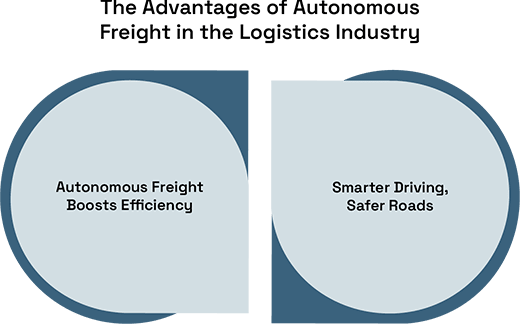
This technology enhances efficiency in transport through the minimization of errors and maximization of vehicle uptime. The utilization of human drivers reduces labor expenses. The enhanced road safety is due to the accurate vehicle control and the advanced systems of detection. In high-value equipment industries, autonomous freight has a more predictable delivery time, with fewer interruptions. The business is enhanced with an international freight forwarding service that enhances the transparency and responsiveness of the supply chain.
Potential Problems, Issues, and Remedies in the Autonomous Freight Adoption
The implementation of autonomous freight has a number of difficulties. There are no clear regulatory frameworks created by governments yet, and this makes the mass adoption slow. In technical terms, it is still challenging to develop AI technologies that are able to reliably work in complex traffic situations. The public’s concerns about the safety of truck drivers and their potential job loss influence acceptance. As a solution to these issues, the training programs are being made to assist drivers in shifting to new technology management positions. Pilot projects are a compromise between innovation and solid safety standards that contribute to the development of regulatory confidence and trust among the population.
How Technology Companies and Startups Can Advance Autonomous Freight Solutions
The technology firms are at the forefront in creating self-driving freight vehicles and, in most cases, partner with logistics companies to develop solutions to what is needed in the real world. Innovations that are brought by startups include AI-assisted route planning and improved environmental awareness to enhance the safety and efficiency of vehicles. This partnership is changing the aspect of freight forwarding and supply chain management through the automation of complicated logistics activities. The autonomous trucks, when integrated with warehouse management systems and customs clearance support, are used to streamline the operation and enhance the visibility of the supply chain.
An overview of existing Pilot Programs and Practical Uses of Autonomous Freight
Worldwide, pilot programs explore the use of autonomous trucks for transporting sensitive equipment like IT systems, medical devices, and aircraft parts. These programs usually imply the combination of bonded warehouse and advanced warehouse management system activities to ensure proper management of the inventory. Initial performance has demonstrated a reduction in transport time and an enhancement in shipment tracking accuracy. The experience of these pilots informs the continued development of the technology and assists in the development of the required regulatory policies, which is a step forward towards full commercial utilization.
The Future Outlook: Does Autonomous Freight Change Global Supply Chains?
Analysts claim that autonomous freight will expand greatly within the next ten years. Such a shift will facilitate the process of complex tariff and customs by improving the import and export registration and the process of adherence. Together with enhanced supply chain operations through the use of autonomous technologies, equipment transportation over the globe will be more cost-efficient and sustainable. The effect will be huge, and it will provide more credible delivery services to the high-value industries requiring aviation, medical, IT, and auto equipment logistics.
Conclusion
Autonomous freight will transform the logistics of such important fields as aviation, healthcare, IT, and automobile equipment. We combine the most recent technology and expertise in trade compliance with a deep understanding of the logistics specialization to assist firms in adapting to this new age at One Union Solutions. Our total freight forwarding and supply chain management services are aimed to be seamless and sustainable, to enable the safe, timely, and efficient transportation of the required equipment. Through the combination of autonomous freight solutions and our tailored delivery plans and compliance service with customs, we allow you to future-proof your supply chain to meet emerging market needs and regulatory requirements. Collaborate with us, feel better operational stability, and place businesses at the center of logistics innovation.
FAQs
What equipment industries can be most useful in the case of autonomous freight?
Sensitivity and time-criticality are beneficial to aviation, IT/data centers, healthcare, and automobile equipment.
What are the regulatory issues that affect the adoption of autonomous freight?
The process of policy-making for safe operation and integration is continuous.
Is it possible to have autonomous freight to work in tandem with freight forwarding services?
Yes, it helps increase the efficiency of transport and communication between supply chains.
What is the benefit of autonomous freight in supply chain management?
It is reliable and predictable in its operations, as well as transparent.
When will autonomous freight become a common practice?
The extensive implementation is forecasted within a decade with the technological changes and regulations.