Introduction
Artificial Intelligence (AI) has grown as a change across every industry, and the supply chain is no exception. In today’s global trade environment, businesses are no longer depending only on manual forecasting or reactive logistics management. Also, AI-related systems are showing how organizations manage demand, production, inventory, and transportation. By combining AI automation and live analytics, AI allows global supply chain services to work with greater clarity, speed, and efficiency than ever before.
What Is AI in Supply Chain?
AI in the supply chain refers to the use of technologies such as machine learning, predictive analytics, natural language processing, and robotic process automation to increase decision-making and simplify work. These technologies analyze huge amounts of supply chain data from procurement to complete delivery to predict trends, reduce risks, and improve overall performance. Modern organizations depend on AI not just to automate routine tasks but also to create data-driven plans for international export regulations, DDP shipping methods, and customs clearance support. AI tools into organizations’ systems, businesses can make smarter decisions across procurement, warehousing, and global trade agreements.

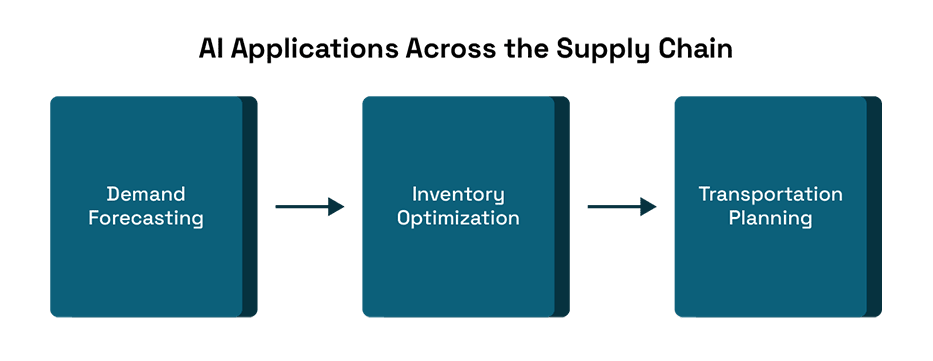
AI Applications Across the Supply Chain
AI impacts multiple stages of the supply chain. Here are a few core applications transforming traditional workflows:
Demand Forecasting
Machine learning methods analyze historical sales, seasonal data, and market behavior to show future demand with high accuracy. This helps companies reduce overstocking and stockouts.
Inventory Optimization
Intelligent systems track storage levels in real-time, automatically adjusting replenishment cycles and order quantities to maintain working balance.
Transportation Planning
Using AI route improvement reduces shipping time and fuel use by analyzing live traffic, weather, and delivery issues.
Predictive Maintenance
In automotive supply chains, predictive AI methods track machinery to projections possible issues and ensure on-time maintenance.
Risk Management and Compliance
AI systems help identify disruptions in international logistics networks and confirm full agreement with Incoterms and global trade systems.
Supplier Evaluation
AI algorithms assess supplier dependability, lead time performance, and quality metrics to optimize sourcing strategies.
Warehouse Automation
Robotics and computer vision technologies improve warehouse efficiency through AI picking, packaging, and order tracking systems.
Customer Experience
Through chatbots and intelligent tracking systems, AI increases customer communication and provides live shipment updates.
Decision Intelligence
AI combines live data from various sources to create a single decision-making dashboard, allowing managers to respond to issues directly.
How AI Improves Global Supply Chain Management
An AI supply chain allows companies to more easily handle goods from one location to another. AI checks data, predicts future demand, & helps companies in planning more effectively. It also helps improve global supply chain processes by reducing delays & increasing shipment tracking. Logistics systems simplifies many daily activities, saving time & reducing human mistakes. Businesses that simplify their supply chain can control inventory, improve delivery speed, & reduce operations costs. This allows businesses to serve customers more efficiently & maintain goods moving smoothly across global markets.
9 Benefits of AI in Supply Chain
- Real-Time Visibility: AI provides end-to-end visibility across the complete logistics chain, from production to delivery.
- Faster Decision-Making: Intelligent analytics grows decision-making in complex scenarios such as customs clearance and trade documentation.
- Enhanced Forecasting Accuracy: Reduces uncertainty and optimizes production planning based on predictive insights.
- Improved Risk Mitigation: AI shows and reduces risks in global trade ways and seller relationships.
- Affordability: Automated workflows reduce manual issues, minimize official fees, and improve storage allocation.
- Sustainability: AI promotes energy-efficient logistics and warehouse management methods.
- Flexibility: Helps organizations adapt quickly to changes in demand or issues in global trade.
- Data-Driven Approval: Simplifies trade regulations, such as the HS Code and HTS harmonized tariff schedule.
- Increases work between importers, exporters, and customs officials through central, automated systems.
How One Union Solutions Supports Global Supply Chain Management
One Union Solutions supports businesses managing cross-border shipments of IT equipment, medical devices, automotive components, and aviation parts. Depending on the shipment and destination, services can include Importer of Record (IOR), Exporter of Record (EOR), DDP shipping, customs coordination, and trade documentation support.
These services help businesses manage import requirements, customs documentation, duties and taxes, and shipment coordination across international markets. The appropriate setup depends on the equipment, destination country, parties involved, and applicable import and export requirements.
Conclusion
AI is no longer just a modern concept; it’s the foundation of the modern supply chain. Organizations that combine AI into their logistics and trade ecosystems can unlock higher efficiency and profitability. With partners such as One Union Solutions, businesses gain not only access to advanced automation but also the expertise to guide the difficult global chain confidently. As global trade continues to grow, AI stands as the major to smarter, data-driven supply chains, allowing smooth work and sustainable growth globally.
DID YOU KNOW?
By 2025, 45% of organizations are likely to experience improvement in their software supply chains, triple the number compared to 2021.
FAQs:
How does AI improve inventory management?
AI studies sales and demand patterns to help businesses keep the right amount of stock and avoid shortages or extra inventory.
How does AI improve supply chain visibility?
AI integrates data from multiple sources to provide real-time visibility, helping companies track shipments, monitor inventory, and respond quickly to disruptions.
What are the main benefits of AI in logistics?
AI improves forecasting accuracy, reduces risks, optimizes transport routes, enhances warehouse efficiency, and promotes sustainability across the logistics chain.
How can AI help with customs and trade documentation?
AI can help analyze large amounts of trade data, identify missing information, and support faster document processing. This can help businesses manage customs documentation and cross-border shipment information more efficiently.
Why is AI important for the future of global trade?
AI enables smarter, faster, and more sustainable supply chains by automating workflows, reducing manual errors, and ensuring compliance with international trade standards like HS Code and Incoterms.