Overview
The rapid rise of direct-to-consumer (D2C) brands has transformed the way businesses sell and deliver products. Instead of using old ways to get products to customers companies now sell directly to customers making getting products to them a big part of how they work. Now companies like Shipway are helping to change how shipping direct to customers works. Shipway and similar platforms are important in this way of shipping products directly to customers.
D2C shipping is no longer just about moving products from warehouses to customers—it is about speed, visibility, cost control, and customer experience. This is happening in a industries like IT, Aviation, Automobile and healthcare and equipment sectors. For these companies finding ways to get things to people is very important. Good shipping solutions are a plus for companies like these. Companies in the aviation sector also need shipping solutions.
D2C Shipping Exposure
D2C shipping has gained significant exposure in recent years due to the growth of online influence. Businesses want to be able to track where their inventory is all the time and they want to be able to export things without any problems. This means that companies have to make sure their shipping runs smoothly and they do not spend more. One of the things about shipping things directly to customers is dealing with many different delivery companies handling things that people send back and making sure that people get their things on time with D2C shipping. D2C shipping is really tough because companies have to manage all these things and still make D2C shipping work. Businesses must also ensure smooth coordination between order processing and fulfillment to avoid delays and errors.
This is where shipping automation platforms come in. This makes it easy to compare prices choose the delivery partners and handle shipments better with shipping automation platforms. The platforms allow businesses to manage all shipments in one place. This saves time. Makes shipping more efficient. Additionally, features like automated notifications and tracking updates enhance the overall customer experience.
For companies involved in import-export operations, especially in high-value sectors like aviation and medical equipment, the need for reliable last-mile delivery solutions is equally critical. Even though they mainly deal with trade the final delivery to customers or partners still relies on good direct-to-customer shipping systems. This is where D2C shipping comes in. It helps them deliver their products efficiently.
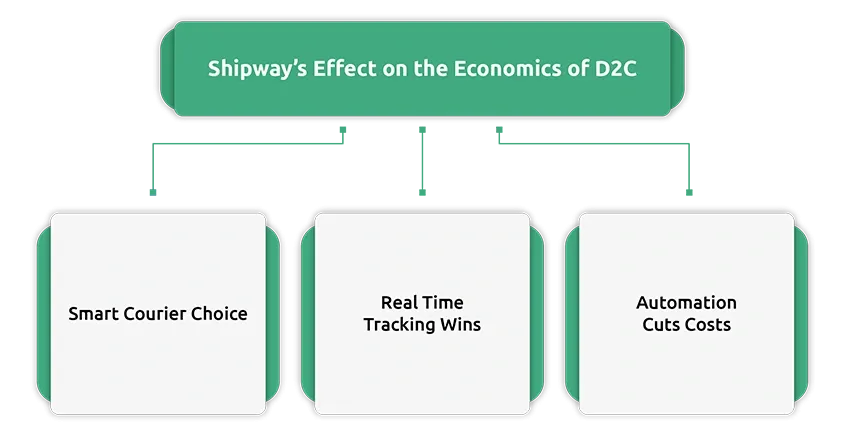
Shipway’s Effect on the Economics of D2C
Shipway has made a difference in the economics of shipping things directly to customers. They have done this by using automation and being clear about costs. This has made the whole process work better. One of the things Shipway has done is help cut down on shipping costs. They do this by using a system to pick the best courier service and compare prices. This means that businesses can select the option that saves them the money without slowing down the delivery of their products. Shipway is really good, at helping businesses with shipping especially when it comes to D2C shipping.
The return management process is really important for D2C businesses. If they are not handled properly they can quickly reduce the amount of money that D2C businesses make. Shipway makes this process a lot easier by handling returns, which means that people do not have to do as much work and it also reduces the costs that are associated with returns. Shipway and its return management process are very helpful for D2C businesses.
The platform also enhances customer communication by providing real-time tracking updates and notifications. This reduces customer queries and improves satisfaction, which indirectly lowers operational costs related to customer support.
Furthermore, Shipway enables businesses to scale without significantly increasing their logistics overhead. It also helps to keep all the work in one place. This means Shipway can help companies deal with a lot of orders without needing to get a lot more resources. This is particularly beneficial for industries like automotive and IT hardware, where order complexity and value are high.
Data-Driven Shipping and Customer Experience Optimization
This advantage is that it uses information to understand what is going on. For example companies like Shipway give us information about how deliveries are being made how good the courier services are and what customers are doing. This information helps businesses make choices and constantly improve the way they ship things. Direct, to customer shipping is getting better because of this.
For example, companies can identify which courier partners perform best in specific regions, enabling better route planning and faster deliveries. They can also analyze return patterns to address underlying issues such as product quality or incorrect descriptions.
In addition, seamless integration with eCommerce platforms ensures that order processing, shipping, and tracking are aligned. This level of synchronization is essential for maintaining consistency and reliability in D2C operations. For import-export businesses expanding into domestic markets, adopting such data-driven approaches can bridge the gap between global supply chains and local delivery networks. It ensures that the efficiency achieved in international operations is carried forward to last-mile delivery.

Conclusion
The economics of D2C shipping are being fundamentally reshaped by technology-driven platforms like Shipway. This means businesses can keep up with all the companies in the market and sell their things to people. D2C shipping is getting a lot better because of this. Companies that do D2C shipping are very happy with the results they are getting from using Shipway and other technology companies. D2C shipping is really important, for businesses that want to sell things to people.
For companies operating across IT, aviation, medical, and automotive sectors, the integration of advanced shipping platforms into their operations is no longer optional—it is a necessity. As D2C models continue to grow, businesses that invest in automation, data insights, and efficient delivery systems will be better positioned to succeed.
In 2026 and beyond, the focus will not just be on delivering products, but on delivering value through smarter, faster, and more cost-effective shipping solutions.
DID YOU KNOW
“For most D2C brands, logistics already eats up 8–12% of order value, meaning even small inefficiencies, scaled across millions of orders, quickly turn into significant losses. ”
FAQs
-
How is D2C shipping different from traditional retail shipping?
D2C shipping eliminates intermediaries, allowing brands to deliver directly to customers with more control over speed, cost, and experience.
-
What makes platforms like Shipway important for D2C brands?
They centralize courier management, automate processes, and provide real-time insights to improve delivery efficiency and reduce costs.
-
How can D2C businesses reduce shipping costs effectively?
By using automated rate comparison, optimizing courier selection, and minimizing return-related expenses.
-
Why is return management critical in D2C shipping?
Returns directly impact profitability, so efficient handling helps reduce losses and improve customer satisfaction.
-
How does data analytics improve D2C shipping performance?
It helps businesses track delivery trends, optimize routes, and make informed decisions to enhance overall shipping efficiency.