In today’s interconnected economy, global trade management professionals at multinational companies increasingly feel the speed of technological change as they work to keep their enterprises operating through a changing geopolitical landscape.
The technological transformation in this century is rapid, impacting every element of global supply chain operations & global trade compliance. For many companies, adopting global trade compliance automation is no longer optional, it’s useful for staying updated.
The role of technology in modern global trade compliance
In a recent survey of global trade compliance professionals, all respondents said their organizations had grown or intended to develop a software solution for global trade compliance automation. Clearly, companies expect a return on their investment.
The survey found that the top reason for GTM technology adoption is to gain greater visibility into business transactions & cross-border operations. GTM systems can collect & consolidate data from many countries & sources to give a single collected view of global trade compliance & related supply chain activities.
Understanding Trade Compliance Penalties
Trade compliance penalties are legal & financial sanctions enforced by government bodies such as customs & regulatory agencies against businesses that violate import/export controls, sanctions, & trade remedy orders. These penalties aim to recover improper gains, cover administrative costs, & secure against future violations. Violations are categorized into many escalating tiers of consequences, ranging from minor administrative fees to severe criminal charges.
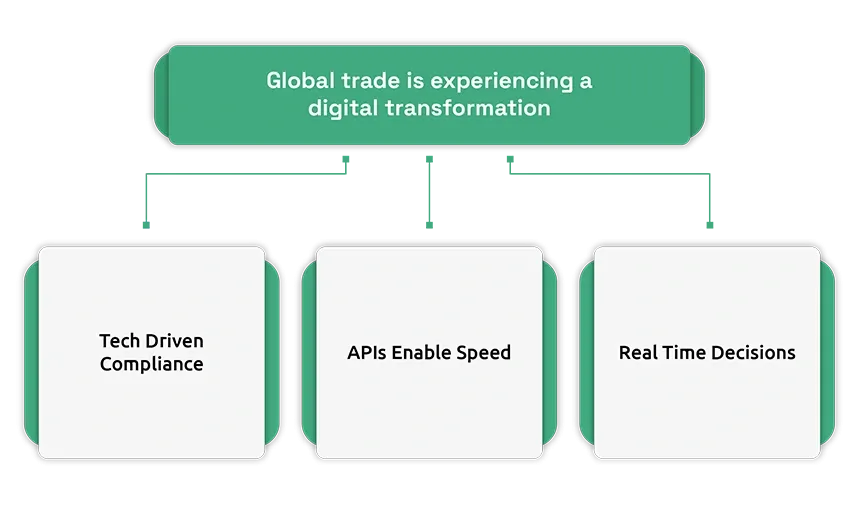
Global trade is experiencing a digital transformation
Global trade compliance specialists understand that as technology accelerates the pace of change, staying ahead of the disruption requires, well, more technology. Today, developing global trade management technologies is growing traditional data processing software & stand-alone solutions, & redefining how companies manage global trade activity & stay compliant. Application programming interfaces enable companies to access real-time data needed to analyze global trade issues and make informed, time-critical decisions.
Big data delivers predictive analytics & scenario planning to help trade professionals assess the effect of issues such as tariff increases, regulatory changes, & new or changing trade agreements.
The World Trade Organization recently reported that blockchain technology can impact a diverse set of GTM-related applications, including trade finance, customs & certification processes, transportation & logistics, insurance, risks, intellectual property, and government procurement.”
The digital transformation of trade management is accelerating; companies that fail to keep up risk falling behind.
AI in global trade: Revolutionizing product classification
AI is particularly suited to make one of the most complex and time-consuming areas of trade compliance, product classification, faster, more efficient, and more accurate.
Many companies grapple with correct classifications, either relying on manual searches of the Harmonized Tariff Schedule (HTS) or struggling with disparate databases across geographies. Others use technology solutions that claim to fully automate the classification process, but yield results based mostly on probability and guesswork, and produce unacceptably high error rates.
Classification assistance software rooted in the principles of AI can streamline the classification process, ensure accuracy, and generate a customs-ready audit trail. As a result, global trade professionals can avoid accidental under- or overpayment of duties, work more efficiently, and improve compliance performance.
By combining secure generative AI with authoritative content, aligning to your organization’s specific data & terminology, delivering immediate, confidence-ranked HS & ECCN code recommendations, automating a traditionally past process & supporting audit-ready compliance. This ability empowers compliance professionals to minimize manual tasks & targets on strategic, high-value decisions.

Conclusion
As global trade regulations become more critical & digital, automation is quickly changing how businesses manage compliance & minimize penalty risks. Technologies such as AI, APIs, predictive analytics, blockchain, & automated classification systems are helping organizations improve visibility, update documentation, improve product classification accuracy, & respond more easily to changing global trade regulations. Minimizing human errors & developing audit capability, automation enables companies to minimize costly compliance issues & improve operational efficiency across global supply chains. As digital transformation continues to develop, businesses that invest in intelligent trade compliance solutions will be better positioned to manage regulatory compliance, minimize financial risks, & remain updated in the developing global trade landscape.
Did You Know?
40% of organizations now use generative AI for trade compliance, up from 22% last year.
FAQs
1. How does automation help reduce trade compliance penalties?
Automation reduces compliance penalties by minimizing manual errors, improving documentation accuracy, monitoring regulatory changes in real time, and streamlining customs and trade compliance processes.
2. What types of trade compliance tasks can be automated?
Businesses can automate product classification, sanctions screening, customs documentation, duty calculations, audit trails, regulatory monitoring, and restricted-party checks.
3. Why is AI important in global trade compliance?
AI helps businesses analyze large volumes of trade data, identify compliance risks, improve HS code classification accuracy, and predict potential violations before they occur.
4. Can automation improve customs clearance efficiency?
Yes. Automated compliance systems accelerate document verification, reduce processing delays, improve data accuracy, and help shipments move through customs more efficiently.
5. What are the main benefits of automated trade compliance systems?
Key benefits include reduced compliance penalties, lower operational costs, improved regulatory visibility, stronger audit readiness, enhanced supply chain efficiency, and better risk management.