Executive Summary
Delivering medical defibrillators across the Caribbean was challenging for a number of reasons, including the fact that each island has its own set of rules about what can be brought in. Each island in the Caribbean has its own set of customs laws and import requirements. This makes for a complicated web of rules that must be carefully followed. Because of the different regulatory environments, highly customized logistics strategies were needed. This made the delivery process much more difficult and often caused delays.
In addition, the fact that the Caribbean’s islands are spread out over a lot of oceanic space added another level of complexity. Because medical equipment like defibrillators are so important and delays could have terrible effects, it was necessary to be very careful and flexible when coordinating shipments by both air and sea. Different islands had different levels of infrastructure development, which made things even harder. Some islands didn’t have the right facilities for quick and easy customs clearance or immediate distribution of medical supplies. It was very hard to get around all of these complicated regulatory and physical barriers, which made it harder to make sure that defibrillator devices that can save lives in medical emergencies would be delivered quickly and reliably. The problems with logistics not only messed up the schedules of deliveries but also put the effectiveness of healthcare responses across the Caribbean at great risk.

The Challenge
Procuring medical supplies, supplies, especially, throughout the Caribbean posed considerable administrative and legal obstacles. There are many islands in the Caribbean region, and each one has its distinct import regulations and logistical limitations. These factors frequently caused delays, higher expenses, and inefficient operations. The critical nature of their cargo—defibrillators are vital for saving lives in emergency medical situations—made these difficulties for medical equipment suppliers even more difficult. The main challenges were figuring out the complex customs procedures, dealing with the various import taxes and duties, and organizing transportation throughout a disjointed supply chain that included both air and sea freight.
The Solution
Using a strategic and all-encompassing approach designed to address the logistical and regulatory challenges unique to the Caribbean, One Union Solutions took on the complex problem of defibrillator delivery. First, we thoroughly examined the unique import laws and procedures for medical devices on each island, making sure that all local laws and procedures were understood and followed. To successfully traverse regulatory environments, required thorough documentation, certifications, and ongoing communication with local health and customs authorities.
Taking into account the Caribbean’s physical dispersion and limited infrastructure, One Union Solutions developed a model to optimize logistics by identifying the most efficient routes and modes of transportation. They strategically used air and sea freight taking into account factors like cost, destination-specific characteristics, and urgency. They also formed partnerships with local entities to establish local distribution hubs, which greatly improved last-mile delivery efficiency and response time to emergency medical needs.
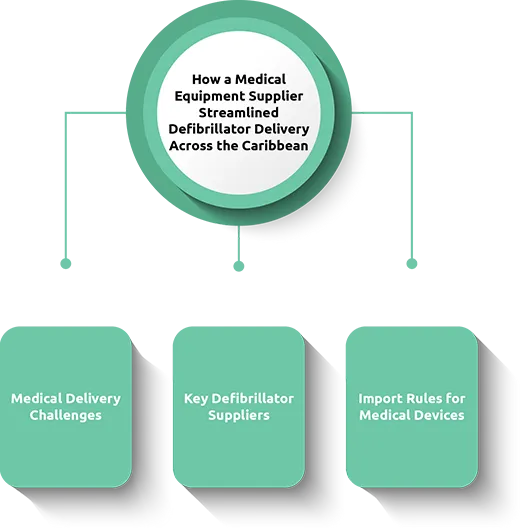
Advanced tracking and logistics management technologies were integrated to further streamline the process, enabling proactive shipment management and end-to-end visibility. To handle documentation electronically and reduce delays caused by administrative errors, technological integration was essential. To speed up the customs procedure upon arrival, One Union Solutions also put in place customs pre-clearance arrangements, submitting required paperwork and obtaining preliminary approvals.
The business also placed a strong emphasis on capacity building by educating employees of healthcare facilities and local partners on how to properly handle and maintain defibrillators, ensuring their longevity and efficient use. This multifaceted strategy improved the overall effectiveness and dependability of healthcare emergency responses throughout the Caribbean by overcoming the immediate challenges of delivering vital medical equipment and establishing a strong framework for future medical deliveries.
Conclusion:
Delivering medical defibrillators across the Caribbean presented major logistical issues due to varying import regulations, infrastructure limitations, and difficult customs processes. We simplified this process by using its expertise in supply chain management, warehousing and warehousing and distribution services. By confirming agreement with each island’s import laws, improving air and sea freight routes, and pre-arranging customs clearance, the company minimized delays and import-related costs, such as import duties and tariffs. This major approach confirmed timely, dependable delivery of urgent medical equipment across the Caribbean.
FAQs:
How did One Union Solutions handle varying import duties and tariffs across Caribbean islands?
One Union Solutions conducted detailed compliance checks for each destination, ensuring proper classification under local import duties and tariffs to avoid unexpected costs or delays.
What role did warehousing and distribution services play in the project?
Local warehousing and distribution services were established to enhance last-mile delivery efficiency, ensuring rapid deployment of defibrillators to healthcare centers.
How did supply chain management warehousing help overcome logistical barriers?
Through optimized supply chain management warehousing, One Union Solutions coordinated inventory, storage, and transportation, reducing handling times and improving delivery precision.
How were customs and documentation challenges managed?
The company implemented customs pre-clearance and electronic documentation systems, streamlining the approval process and ensuring full regulatory compliance.
What lasting impact did this project have on Caribbean healthcare logistics?
It created a scalable logistics framework, enhancing medical supply reliability and setting a new benchmark for efficient healthcare distribution across the region.