
Introduction
As global trade size rises, businesses continue to face pressure from high logistics fees, changing import duties and tariffs, and the constant demand for quick and affordable deliveries. Organizations increasingly turn to third-party providers that specialize in modern freight plans. One such important strategy is freight consolidation, a method that helps businesses overcome challenges related to customs clearance, warehousing solutions for import and export goods, and even Delivered Duty Paid service when required. Combining varied shipments into a combined shipment, 3PLs deliver huge savings without compromising delivery speed or dependability.
What is Freight Consolidation?
It is a practice of merging many small shipments, frequently from different suppliers or different purchase orders, into a single, larger load. This allows organizations to access lower logistics rates normally reserved for high-volume shippers. Instead of paying premium charges for fragmented loads, businesses reduce expenses while simplifying Import export documentation, improving International freight services planning, and strengthening predictability in their overall transportation and warehousing activities. When executed effectively, consolidation helps reduce delays that commonly occur during customs clearance or cross-border transit.

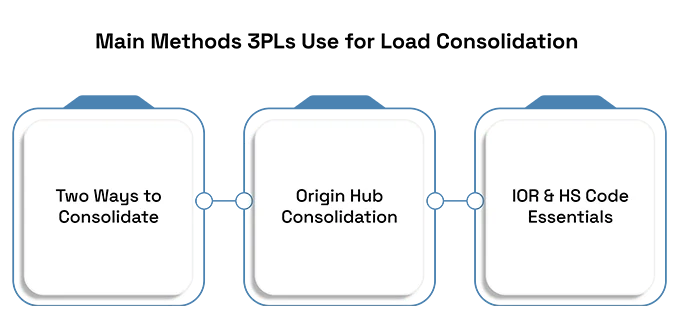
Main Methods 3PLs Use for Load Consolidation
3PLs mainly apply two major approaches to consolidation, depending on the cargo and buyer requirements. One approach involves consolidating multiple small shipments at an origin hub before forwarding them as a single freight shipment. This method is particularly beneficial for clients using IOR services, where consistent agreement and HS Code classification accuracy remain necessary. The second approach focuses on destination-based bundling, where goods arriving from different regions are sorted, combined, and prepared for final distribution. This method frequently supports last-mile delivery services and Delivered Duty Paid service solutions for international importers who want smooth door delivery without managing multiple carriers.
Step-by-Step Process of Load Consolidation
The consolidation process begins when a 3PL receives shipment details such as weight, volume, HS Code, or HTS Harmonized Tariff Schedule categorization, and preferred Incoterms. Once documentation is verified, cargo is moved into the Transportation and warehousing hub works to handle both small goods and containerized loads. After goods arrive at the hub, the 3PL classifies them according to destination, delivery timelines, and method of transport. Those heading toward the same final destination are grouped. The provider then prepares Import export documentation, arranges International freight services, and confirms all steps work with Supply chain management standards. The consolidated load is shipped as a single unit, which mostly lowers per-unit cost and supports Real-time shipment tracking throughout the movement.
How 3PL Consolidation Cuts Your Freight Spend
3PL consolidation immediately reduces shipping costs by eliminating the inefficiencies of moving partially filled containers or trucks. Instead of paying multiple carrier charges, clients settle one optimized freight bill, making the process significantly more cost-effective. By consistently using consolidation, organizations reduce warehousing requirements, avoid unnecessary storage fees, and maintain better control over import duties and tariffs. Also, because 3PLs depend on experienced Supply chain optimization techniques, consolidation minimizes delays that mainly arise from fragmented shipment cycles. For businesses depending on DAP or DDP delivery structures, consolidation further lowers administrative expenses by simplifying shipment and improving approval accuracy.
Benefits of Freight Consolidation
The biggest advantage is cost savings, but consolidation also improves speed, predictability, and improved service dependability. Businesses gain stronger visibility through Real-time shipment tracking, allowing more trust in planning and scheduling. Consolidation also increases workflow efficiency within Transportation and warehousing systems by reducing the issue of scattered small loads. Companies benefit from fewer discrepancies, faster customs clearance, and smoother integration within the supply chain management system. When combined with professional Warehousing solutions for import and export goods, the result is a more synchronized and competitively efficient shipping method.
Conclusion
3PL consolidation services have become indispensable for businesses looking to reduce freight costs without compromising speed or accuracy. By combining shipments, improving documentation quality, simplifying customs clearance, and using advanced Supply chain optimization plans, 3PL providers deliver measurable savings and continuous performance across global trades. For organizations seeking smarter, more predictable work, freight consolidation is no longer optional; it is necessary.
DID YOU KNOW?
The logistics provider manages 37 million shipments annually and has been operating in Mexico for 35 years.
FAQs:
-
What is freight consolidation in logistics?
Freight consolidation is the process of combining multiple small shipments into one larger load, helping businesses reduce transportation costs and improve shipping efficiency.
-
How does 3PL consolidation reduce freight costs?
3PLs merge fragmented shipments into a single freight unit, allowing businesses to pay one optimized shipping fee instead of multiple carrier charges, resulting in significant cost savings.
-
Does freight consolidation delay shipment delivery?
Not usually. In fact, consolidation often improves delivery timelines by reducing customs delays, preventing scattered shipments, and streamlining end-to-end logistics.
-
What types of businesses benefit from consolidation services?
Companies importing or exporting goods, handling multiple suppliers, shipping small loads frequently, or relying on DDP, DAP, or IOR services benefit the most.
-
Is freight consolidation suitable for international shipping?
Yes. Consolidation is widely used in global trade to reduce import duties, simplify documentation, improve customs clearance, and enhance overall international freight planning.