
Overview
In today’s strongly regulated global trade environment, export compliance audits are no longer casual checks; they are a core part of regulatory processes. Governments across the world are improving error of cross-border shipments to stop unauthorized exports, confirm exact categorizations of goods, and verify accurate duty payments. In case a company is managing advanced technology, dual-use goods, or electronic products, regulators expect strong conformity to export laws and documentation standards.
Export compliance audits: what regulators actually look for is a topic that every exporter must understand in the supply chain. From verifying the correct HS code categorizations under the HTS Harmonized Tariff Schedule to checking Incoterms such as DAP, regulators used whether businesses are meeting international shipping terms correctly in global trade.
What Is An Export Compliance Audit?
An export compliance audit is a systematic inspection of a company’s export processes, documentation, and internal controls to confirm approval with local and international trade regulations. These audits may be conducted internally, by third-party experts, or by government authorities.
Key Elements Reviewed During an Audit
Regulators typically explore:
Classification and Documentation
Authorities verify that each product is allocated the correct HS code and work with the HTS Harmonized Tariff Schedule requirements. Miscategorizations can affect duty fees, trade agreements, and eligibility under programs such as the generalized system of preferences (GSP) process.
Licensing and Export Controls
Auditors review restricted or controlled goods that were exported with permits. They check screening procedures against restricted party lists and confirm that export control documentation is properly maintained throughout the process.

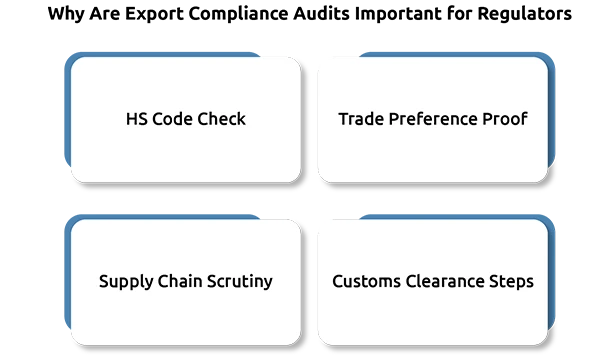
Why Are Export Compliance Audits Important for Regulators?
Regulators conduct export compliance audits to protect national security, improve trade laws, and have advantage in global trades. These audits help authorities identify problems, stop fraud, and confirm organizations meet their problems as exporters.
Confirming Accurate Trade Classification
Incorrect HS code declarations can result in underpayment of duties or misuse of preferential trade programs. Regulators check whether goods qualify for benefits such as the generalized system of preferences (GSP) and documentation supports those claims in trade.
Tracking Cross-Border Trade Responsibilities
Authorities also verify the responsibilities of the exporter of record services and the importer of record Service arrangements. Clear identification of legal responsibility is necessary in cross-border trade. Regulators want to confirm that proper documentation supports each shipment and that no unauthorized provider is working as the suppliers.
Improving Supply Chain Problem
With increasing global trade difficulty, regulators pay attention to logistics systems and International freight services. They analyze whether shipments follow declared routes and whether Customs Broker filings are accurate. Effective supply chain optimization must work with regulatory approval standards.
Customs clearance processes are scrutinized to confirm correct valuation and tariff application. Any inconsistencies in declared value, origin, or tariff categorizations may lead to deeper investigations.
Trust One Union Solutions To Help You With Your Compliance Audits
Navigating export compliance requirements can be difficult, mainly when working across multiple administrations. One Union Solutions supports businesses with systematic agreement strategies that reduce risk and increase working efficiency.
You will get complete Trade Support
From exporter of record services to importer of record Service solutions, businesses can confirm that responsibilities are clearly defined and properly documented during supply procedure. Accurate HS code categorizations, usage to the HTS Harmonized Tariff Schedule, and correct application of Incoterms such as DAP and DAPs are necessary components of complete work.
Integrated Logistics and Documentation
Through International freight services and coordinated logistics planning, companies can simplify cross-border trade while maintaining regulatory processes. Proper Inventory and order management systems help maintain accurate records, which are critical during audits.
Dependable Customs Handling
Working with experienced Customs Broker experts improves accuracy in Customs clearance filings. Combined with Premium delivery service solutions, businesses can meet delivery schedules without compromising approval standards.
Conclusion
Export compliance audits are not simply regulatory problems; they are necessary safeguards in international trade. Regulators check product categorizations, licensing, documentation accuracy and Incoterms usage to confirm lawful and clear trade work. Implementing structured approval programs, maintaining correct documentation, and using expert trade support services, organizations can reduce risks and have operational continuity in the supply chain.
DID YOU KNOW?
According to an official statement by the Minister of Electronics and IT, India exported electronics worth US$ 47 billion in fiscal year 2025.
FAQs:
1. What is an export compliance audit?
An export compliance audit is a systematic review of a company’s export procedures, documentation, and internal controls to confirm approval with national and international trade regulations.
2. Why do regulators conduct export compliance audits?
Regulators conduct audits to prevent unauthorized exports, confirm correct HS code categorization, verify duty payments, confirm export licensing, and protect national security.
3. What documents are reviewed during an export compliance audit?
Authorities typically review trade invoices, shipping documents, export licenses, HTS codes, Incoterms usage, restricted party screening records, and customs clearance filings.
4. How do HS codes and the HTS Harmonized Tariff Schedule affect audits?
Correct HS code classification under the HTS determines duty rates, trade agreement eligibility, and programs like the generalized system of preferences (GSP). Errors may show penalties or investigations.
5. How can businesses prepare for an export compliance audit?
Companies should maintain accurate documentation, implement internal compliance programs, conduct regular internal audits, verify exporter and importer of record responsibilities, and work with experienced customs brokers and trade compliance experts.