The global world is shifting to renewable energy sources, which is rocket-fueling the need for Electric Vehicle charging devices. Globalization of electric vehicles (EVs) has widened export markets for companies involved in the EV charging industry. However, this opportunity is accompanied by a challenge of working in various regulatory regimes in different countries. Discuss the increasing export destinations of the equipment being produced by the companies on EV charging and the regulations they must acquaint themselves with so that conducting business in such foreign markets is smooth sailing.
Globalisation of Electric Vehicle Charging
The world market of EVs is growing greatly due to environmental concerns, governmental activities, and the improvements and development of the battery industry. Consequently, there has been an increase in the need for a dependable and effective EV charging infrastructure. The International Energy Agency (IEA) information shows that the world will have more than 10 million electric vehicles in stock in 2020, which will rapidly increase. The increase in electrically powered automobiles has directly led to the demand for EV charging stations and supplies.
Summarily, most nations are focusing on the creation of EV infrastructure as part of this transition. As an illustration, the European Union, China, and the United States have all introduced ambitious programs to introduce EV charging stops on a massive scale. These countries are not only rolling out public chargers. Still, they are also encouraging the private sector to invest in workplace and home charging infrastructure, building new markets for EV charging hardware exporters.
Key Export Markets for EV Charging Equipment
The prospects of China, Europe, India, and the United States have emerged as the potential markets of EV charging infrastructure with specific growth opportunities. Norway, the Netherlands, and even Germany can be called some of the most prominent nations in implementing EVs in Europe, since the use of charging stations is high because of the high goals of the European Union to control carbon emissions and increase the utilization of electric vehicles. The extensive use of electric vehicles in China has turned it into an enormous market for EV charging equipment, where the current government is still enforcing EV policies, including subsidies to manufacturers and incentives to buyers, and is eager to expand its charging networks.
The encouragement of charging solutions in the United States through the federal and state-based incentives alongside the plan of the Biden administration to install half a million charging stations has prompted the inconceivable growth of the EV industry, thus, the rise of the demand for charging solutions. Meanwhile, India is emerging as a significantly expanding economy in the EV sector. The state government is promoting the use of EVs by providing tax rebates and even building a large number of charging stations across the country, which is more than 2,000, providing immense opportunities to exporters in the green energy industry.
Licensing Regulatory Regimes of EV Charging Equipment Exports
Companies entering foreign markets should also learn about the regulatory environments in those countries regarding EV charging equipment. Market regulations differ from country to country and must be adhered to to have a successful market entrance and avoid delays. The safety, performance, and compatibility standards vary in each market (e.g., CE marking in the EU, UL in the U.S., and CCC in China). There are also rigid environmental standards in countries with charging stations in Europe; the charging stations must comply with energy adequacy and sustainability standards.
Governments tend to deliver such incentives as tax credits and grants to promote the deployment of EV charging stations, which one can use to collaborate with local firms. Nonetheless, the cost of doing business differs depending on the amount of taxes and duties imposed in the country, and some countries end up taxing imported goods heavily compared to locally produced ones. The exporters must consider these factors carefully to stay competitive and have easy market access.
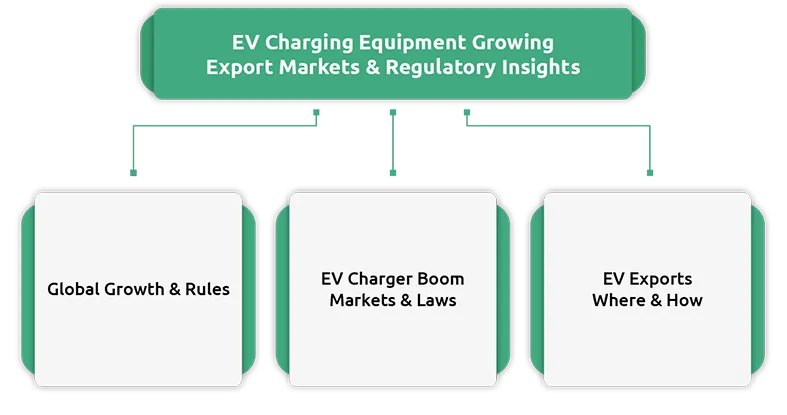
Market Insights
It is estimated by the International Energy Agency (IEA) that the market for EVs and charging equipment around the globe will expand significantly over the next couple of years. EVs are estimated to comprise 30 per cent of car sales globally by 2030. The requirement to adjust EV charging infrastructure will remain on the incline as governments all over the globe are placing more rigid demands on emissions. The EV charging equipment industry’s growth is a huge opportunity. Still, it also comes with the challenge of operating in even more complicated regulatory territories.
This rapid growth is driving strong demand for reliable and scalable charging solutions across both developed and emerging markets. Manufacturers and exporters must focus on meeting regional safety, quality, and compliance standards to stay competitive. Strategic partnerships and local market knowledge will be essential to manage regulatory differences smoothly. Companies that adapt early will be better positioned to capture long-term growth in the global EV ecosystem.
Conclusion
The export markets of EV charging equipment are growing by leaps and bounds as the manufacturers are gaining momentum now that EVs are increasing globally. Nevertheless, to excel in such markets, the firms should be ready to learn how to operate in the regulatory environment, such as certification procedures, ecological regulations, government incentives, and import tariffs. In One Union Solutions, our goal is to make sure that the companies need not worry about their expansion to these increasing markets, and how they will be able to navigate all the necessary policies and regulations that are set to maximize their access to reach their expansions, and then in the EV market.
Did You Know,
The EV charging infrastructure market is projected to exceed $50 billion by 2025 worldwide. The growing phase can be attributed to rising EV adoption and the global sustainability mission.
FAQs
Which are the best export markets for EV charging equipment?
The European Union, China, the United States, and India are among the top export markets. These regions are seeing rapid growth in electric vehicles and strong expansion of charging infrastructure.
What certifications are required to export EV charging equipment?
Certification requirements vary by country. Common examples include CE marking for the European Union, UL certification for the United States, and China Compulsory Certification (CCC) for China.
What role do government incentives play in the EV charging equipment market?
Government incentives such as tax rebates, subsidies, and grants help lower installation costs and encourage the adoption of EV charging stations, boosting demand for charging equipment.
How can EV charging equipment be made more environmentally friendly?
Manufacturers should follow local environmental standards by designing energy-efficient equipment and using eco-friendly and safe materials.
How do import responsibilities affect EV charging equipment exports?
Import duties and taxes differ by country and can impact overall pricing. These costs must be considered carefully when setting prices for international markets.