
Introduction
China’s trade data for November shows renewed momentum in the country’s global economic arrangement, with exports growing 5.9% and imports increasing 1.9%. These results come at a time when global trade remains unpredictable, and businesses across borders continue to adapt to changing Incoterms, evolving import duties and tariffs, and emerging logistics requirements. China’s slow growth shows how exporters and importers are managing difficult import-export documentation, using new agreement standards such as HS codes, the HTS Harmonized Tariff Schedule, and making broader use of modern tools such as real-time shipment tracking to improve efficiency.
China’s exports grow 5.9% in November despite a 29% drop in US shipments
China’s export expansion demonstrates its ability to stabilize international trade relationships despite challenges. Even with a huge 29% decline in shipments to the United States, exporters maintained overall growth by varying trades and optimizing processes. Many exporters depend on better route planning, updated DAP and DDP delivery terms, and stronger coordination of international freight services to confirm goods reach destinations on time. As global buyers increasingly demand clarity in supply arrangements, the role of the Exporter of Record becomes more necessary. Organizations handling this responsibility confirm agreement with global market requirements while guiding tariff categorizations under the relevant HS code system. These efforts collectively helped China maintain export stability despite U.S. market weaknesses.

China’s exports are on strong sales to non-US markets
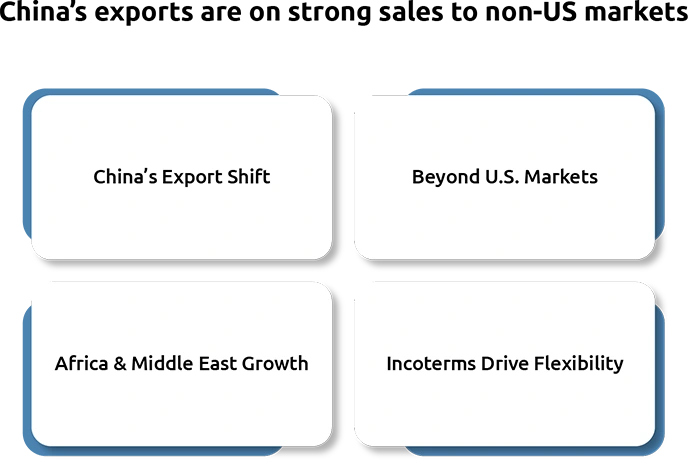
The stronger-than-expected export growth is largely attributed to growing demand from non-U.S. markets, where buying patterns remain resilient. Many partner nations benefit from the Generalized System of Preferences (GSP) provided by various countries, which supports more competitive pricing for Chinese goods. As exporters change focus to Southeast Asia, Africa, and the Middle East, coordination of last-mile delivery services, updated Incoterms arrangements, and effective cargo handling have become necessary. Supply networks increasingly depend on advanced supply chain optimization methods that allow organizations to adjust routes, documentation, and tariff planning quickly. These supportive systems make it easier for Chinese exporters to strengthen their presence in developing markets while reducing dependence on traditional destinations.
Despite the trade war, China’s exports to the US saw a double-digit decline, down 29% in November
China’s exports to the U.S. continued to experience double-digit declines as a result of ongoing tariff tensions and difficult trade guidelines. The trade environment requires exporters to remain cautious, specifically with changes in import duties and tariffs, documentation rules, and classification updates under the HTS Harmonized Tariff Schedule. To sustain competitiveness, many exporters and freight operators have changed to flexible delivery terms such as Delivered Duty Paid service, which simplifies clearance for U.S. buyers but places additional responsibility on exporters. In such cases, having a well-defined Exporter of Record definition becomes necessary for confirming agreement. Even with these adjustments, the downturn in U.S. shipments shows the required for China to continue expanding into markets where demand is more stable.
China Imports Rise for 6th Month straightly
China’s imports are rising for the sixth consecutive month, which suggests a stable incoming of raw materials, IT goods, and automotive components. The steady inflow shows better work with domestic production cycles and improvements in IOR services, where an Importer of Record manages regulatory approval and oversees documentation and customs processes. These services are necessary when working with detailed requirements combined with HS code classifications, valuation checks, and logistics under specific Incoterms such as DAP or DDP. As organizations simplify procurement, increased supply chain optimization and clear shipment visibility help to ensure consistency in export flows. The overall trend highlights the important role of the logistics system as China strengthens its internal and external trade connectivity.
Conclusion
China’s November trade performance shows a major adaptation to global market change, stronger dependence on varied export destinations, and improved management of the logistics system. With exports up 5.9% and imports rising 1.9%, the country shows both external dependence and internal stability. The effective use of Incoterms, advanced real-time tracking systems, and better work of international freight services have supported these results. As businesses manage difficult documentation, manage Importer and Exporter of Record responsibilities, and adjust to changing import duties and tariffs, China continues to position itself as a central player in global trade. This balanced growth shows that with effective supply chain optimization, the country can guide unwanted while supporting global market partnerships.
DID YOU KNOW?
China’s imports rose 1.9% year-on-year to $218.7 billion in November 2025, up from 1.0% in the previous month and marking the sixth consecutive month of growth.
FAQs:
- Why did China’s exports grow 5.9% in November despite reduced U.S. shipments?
China increased trade with Southeast Asia, Africa, and the Middle East, supported by better logistics planning, DAP/DDP Incoterms, and optimized supply chains.
- What role do HS codes and the HTS Harmonized Tariff Schedule play in China’s trade?
HS and HTS codes ensure correct product classification, enabling accurate tariff calculations, lower compliance risk, and smoother customs clearance.
- How do IOR (Importer of Record) and EOR (Exporter of Record) services support global trade?
IOR/EOR services manage compliance, handle Import-Export documentation, oversee customs filings, and ensure shipments meet local regulations.
- How does real-time shipment tracking help exporters and importers?
Real-time tracking improves visibility, reduces delays, assists with last-mile delivery management, and supports supply chain optimization.
- What factors contributed to China’s rising imports for the sixth consecutive month?
Growth was driven by demand for raw materials, electronics, automotive items, and efficient processing of logistics, HS code classification, and DAP/DDP imports.