Introduction
Customs inspection may increase the cost of logistics and cause shipments to be delay. In the past, companies might only become aware of inspection during the process of clearing customs. Artificial intelligence (AI) is now able to analyse shipment data, product details, customs declarations, and previous records before to the shipment’s transport. It can find unusual information and possible customs risk early. This can help businesses identify problems with documents, HS codes, or product information before shipping. AI can help predict which shipments may need closer checks, but it cannot guarantee an inspection. Its main value is early risk prediction and better shipment preparation. This allows businesses to prepare better and reduce avoidable customs delays.
What Does a Customs Inspection Mean?
A customs inspection checks that the products follow with import regulations and meet the customs record. Customs may review documents or examine the actual cargo. Information including the product details, value, origin, and HS code are verified by a customs document review. The goods actual are checked in hand during a customs inspection to make sure they match documents. Customs uses customs risk assessment to decide which shipments need more attention. Factors can include the HS code, country of origin, shipment value, transport type, and the trader’s compliance history.
This means not every shipment needs a detailed cargo examination. While reduce-risk goods can get through the customs clearance process more quickly, higher-risk shipments may be at risk to more checks.
Can AI Really Predict a Customs Inspection?
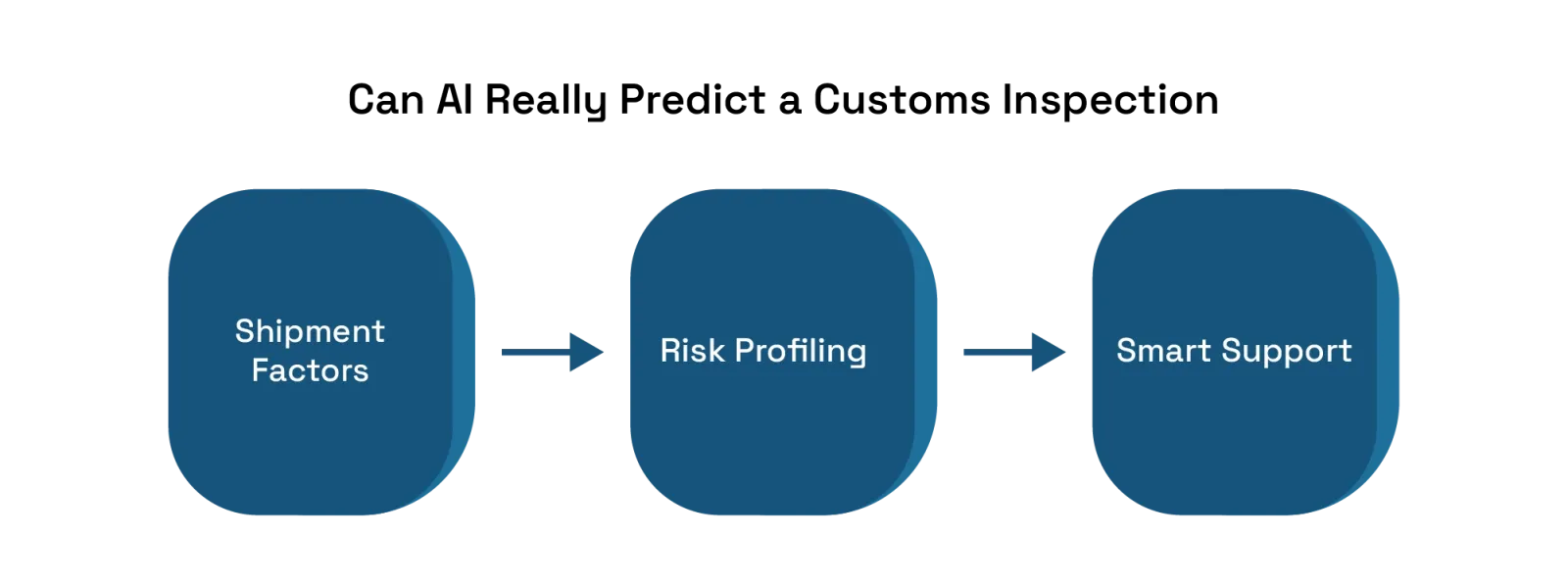
AI cannot predict with reliability if a shipment will be checked by customs. AI customs inspection prediction, on the other hand, makes use both current & previous shipment data to identify trends that might show a higher or lower risk. HS codes, product descriptions, place of origin, declared value, volume, shipment route, customs documents, shipment data, & importer or exporter record can all be checked by AI. Additionally, it can detect past compliance problems or delayed shipments. AI risk analysis, shipment risk factor, and predictive customs analytics can all profit from this data. These results can be used by customs teams to profile customs risks and identify which shipments require further review. To put it simply, predictive analysis in customs helps in detecting possible risks before to the shipment reaching at the border. An AI result, however, does not verify an inspection. It supports intelligent customs inspection and better preparation.
How AI Predicts Customs Inspection Risk Before Shipment
AI can identify unexpected trends, such as changes in quantity, value, or importer record, by comparing data from a new cargo with that of previous shipments. This helps create a shipment risk profile. AI can check HS codes, product descriptions, and product details to find possible classification errors. It can also compare previous classification decisions and tariff information. Invoices, packing lists, documents of origin, bills of lading, import licenses, and customs declarations belong to the customs documents that AI may check. Information that is incorrect or missing might be detected. AI can also compare the invoice, packing list, manifest, customs declaration, and product data. These checks support customs risk assessment and predictive customs analytics by identifying shipments that may need closer review.
Lastly, in order to identify unexpected trends before the shipment is shipped, AI can check the country of origin, trade route, supplier, importer, product type, & shipping timing.
How AI Changes Customs Clearance From Reactive to Predictive
Traditional customs clearance usually finds problems after the shipment has already started. This can cause extra checks, delays, and higher costs. With AI, businesses can check shipment data earlier and find possible issues before the goods move. AI can review documents, product details, and other shipment information to identify risks. Then, before delivery, companies can correct these problems. This allows a more smooth customs clearance process and improves proactive customs compliance.
What AI Cannot Predict About a Customs Inspection
Because AI can help with customs risk review, it is difficult to predict the final result of a customs review. Random inspections, choices made by customs officers, shifting compliance goals, sudden rule changes, and unexpected document requests might not be planned. AI also cannot know what customs officers may find during a physical customs inspection. AI also cannot know what customs officers may find during a physical customs inspection.
So, it is better to use AI customs inspection report as a risk estimate rather than a guaranty. Customs officials still have the final say on how to conduct a customs check, but AI can help businesses prepare and identify possible risks.

Conclusion – AI Can Predict Risk, Not Guarantee Inspection
AI is changing the way customs risk assessment is done. It can check large amounts of shipment data and find unusual patterns, document errors, and classification risks before the cargo moves. This helps businesses prepare for possible customs inspection and avoid some common problems.
However, AI cannot guarantee whether customs will inspect a shipment. For difficult problems and final decisions, human customs officials are still important. Customs clearance may become more data-driven, predictive, & AI-assisted in the future, helping companies identify customs issues.
Did You Know
CBP collected $264 billion in customs duties in calendar year 2025, up from $79 billion in 2024. That more than three-fold increase is driven primarily by the layered tariff environment
FAQ
What shipment data does AI use for customs risk prediction?
AI is able of reviewing various types of shipping data, like HS codes, product details, declared value, country of origin, shipment records, and customs documents.
Can AI predict customs inspection based on the country of origin?
AI can use country of origin as one part of a wider risk assessment, but it cannot use this information alone to predict an inspection.
Can AI reduce customs clearance delays?
AI can help find document errors, classification issues, and data mismatches before shipping. Fixing these problems early may help reduce avoidable delays during customs clearance.
Will AI replace customs experts in inspection decisions?
No. AI can support predictive customs analytics, but human customs professionals are still important for complex cases, unusual shipments, and final decisions.
Can AI predict customs checks caused by incorrect product descriptions?
AI can flag product descriptions that do not appear to match other shipment information. This can help businesses correct the description before customs clearance.