Overview
Engineering companies and automated production plants are overly dependent on robots and automated equipment. Companies then import industrial robots, robotic arms, sensors, control systems and automated machinery to aid production. However, when the same equipment crosses the borders, it is not spared from paperwork, requirement by the importing country and border inspections.
Goods imported into the country attract Customs duty and are also required to confirm to relevant legal requirements. Thus, unless the imported goods are not meant for Customs clearance at the port/airport of arrival such as those intended for transit by the same cargo/aircraft or transshipment to another Customs station or to any place outside India, detailed Customs clearance formalities have to be followed by the importers.
Machinery Safety Regulation Updates in India and Europe
Before placing machinery or a related product on the market or putting it into service, manufacturers shall draw up the technical documentation set out in Annex IV, Part A and carry out the relevant conformity assessment procedure.
In exercise of the powers conferred by section 16 of the Bureau of Indian Standards Act, 2016 (11 of 2016), the Central Government, being of the opinion that it is necessary to do so in the public interest, hereby withdraws the notification of the Government of India in the Ministry of Heavy Industries issued vide number S.O. 3649(E), dated the 28th August, 2024, published in the Gazette of India, Extraordinary, Part II, Section 3, Sub-section (ii), relating to the Machinery & Electrical Equipment Safety Omnibus Technical Regulation Order, 2024, with immediate effect.
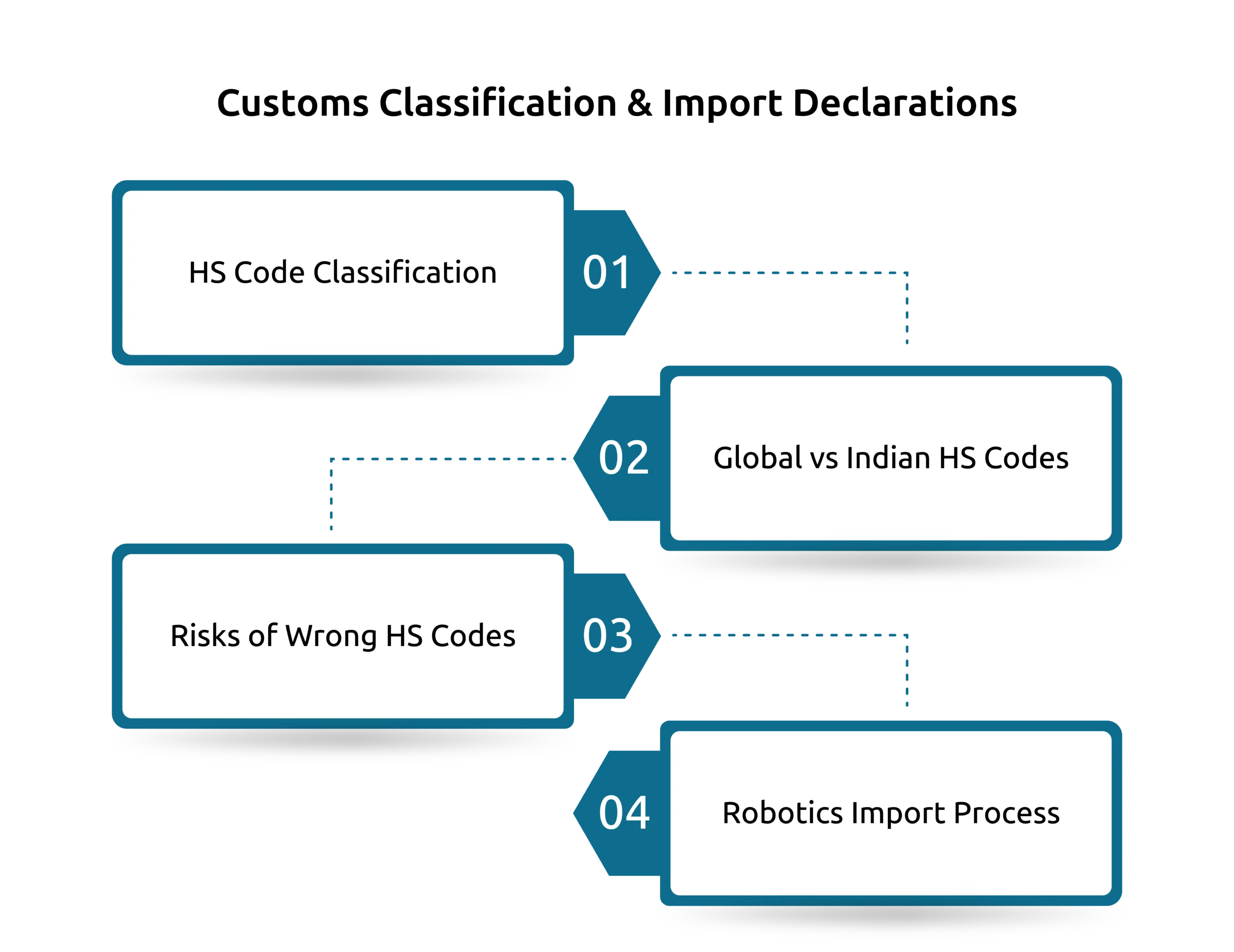
Customs Classification & Import Declarations
Robotics & automation equipment have to be listed under the correct HS Code before import. According to the World Customs companies, industrial robots that can perform different tasks using different tools may fall under HS Code.
Globally, HS system goes by the name WCO system, but each country has its code for importing purpose. In India, the imports are covered by an 8-digit code.
Wrong code usage could result in payment of wrong duties, extra checks,or anything extra with the import requirements.
Before importing robotics & automation equipment into india, businesses must obtain an Importer-Exporter Code (IEC) from the Directorate General if Foreign Trade,unless they fall under an exempt category.
The ICE application process is completely online.Importers must also follow india’s customs and foreign trade rules.Certain restricted goods may required additional licences or government permission.
Product Safety Standards & Certification Requirements
Before importing robotics equipment into India,organizations should checks whether the product falls under any applicable quality control order.BIS certification is generally voluntary, but it becomes compulsory fo product covered by a notified QCO.Product cover such order must meet the similar Indian standards & carry the required BIS Standards & carry the required BIS standards marks.
Robotics & automation equipment must meet the safety standards that apply in the importing country. In india,the Bureau of Indian Standards BIS has published safety standards for industrial robots systems and collaborative robots.These standards cover the safety of robots and their use in industrial workplaces.
Import Documentation And Technical Records
The documents required for machinery imports may vary depending on the type of equipment, its intended use and the applicable import requirements.
In the non-EDI system, along with the bill of entry filed by the importer or his representative the following documents are also generally required: –
- Signed invoice
- Packing list
- Bill of Lading or Delivery Order/Airway Bill
- License wherever necessary
- Import license
- Industrial License, if required
- DEEC Book/DEPB in original
- Catalogue, technical write-up, Literature in case of machineries, spares or chemicals as may be applicable
- Separately split up value of spares, components machineries
- Certificate of Origin, if preferential rate of duty is claimed
While filing the bill of entry and giving various particulars as prescribed therein the correctness of the information given has also to be certified by the importer in the form a declaration at the foot of the bill of entry and any mis-declaration/incorrect declaration has legal consequences, and due precautions should be taken by importer while signing these declarations.
Country of Origin and Trade Restrictions
Rules of origin are used to determine the origin of goods. There may be several ways to define rules of origin.
The specific provisions, developed from principles established by national legislation or international agreements applied by a country to determine the origin of goods
Rules of Origin shall be defined as those laws, regulations and administrative determinations of general application applied by any Member to determine the country of origin of goods.Preferential Rules of Origin shall be defined as those laws, regulations and administrative determinations of general application applied by any Member to determine whether goods qualify for preferential treatment under contractual or autonomous trade regimes leading to the granting of tariff preferences
Trade restrictions may apply depending on the machinery, its country of origin and the import regulations of the destination country. These limitations may includes anti-dumping duties, import controls, sanctions or limitations on specific products. Importers should check the applicable trade measures & confirm whether the machinery is aprroval for import before placing an order.
Environmental Requirements and Import Controls
It aims to prevent the risks posed to human health and the environment related to the management of EEE.It does this by restricting the use of certain hazardous substances in EEE that can be substituted with safer alternatives. These restricted substances include heavy metals, flame retardants or plasticisers. All products with an electrical and electronic component, unless specifically excluded, have to follow with these restrictions.Importers should check whether their electrical & electronic equipment falls within the scope of these requirements before shipping it to the destination country.
Conclusion
Cross-border shipping of robotics & automation equipment having correct planning.Companies should verify HS codes, country of origin,technical documents,safety requirements & relevant import rules before shipping.
Checking theses requirements in advanced & handling with production companies,freight forwarders & customs agent can help reduce documentation error & avoid extra delays.
Did You Know?
According to the International Federation of Robotics, factories worldwide installed more than 600,000 industrial robots in 2025, taking the global operational stock beyond 5 million units
FAQ’s
Why does automation adoption differ by region?
Demand for automation is a function of labor costs and labor availability. High wages in old industrial centers result in labor shortage and thus substitution by robots. Growing industrial centers use them to scale up production.
Why do industrial robots need specialised shipping methods?
The robots that get moved around end up getting shocked, vibrated, wetted, etc., on their sensitive electronics & sensors. They are loaded specially to protect them.
Can organization import used robotics equipment into India?
Yes. But there could be some import conditions for the used machinery. Companies should refer to the existing DGFT policy before shipment.
Do you have special robotics equipment to handle moves?
Yes. Robotics equipment may need special lifting and secure loading as well as protective packaging. During shipping electronics and sensors must be protected against moisture, shock, and vibration.
What factors affect customs duty on imported robotics equipment?
Customs duty rely on the HS code, declared value & country of origin. The relevant tariff rate may also depend on the destination country’s import rules.