Medical devices are being shipped across borders to support hospitals, diagnostic centers, laboratories, clinics, research facilities, & healthcare projects. Transporting medical devices is more difficult than shipping standard commercial products from one country to another. Importers may need to manage customs needs, product registrations, technical documentation, labeling rules, permits, duties, taxes, & local regulatory approvals.
This is where an Importer of Record (IOR) can play an important role. An IOR helps businesses manage the legal & administrative responsibilities related to importing medical equipment into a foreign market, mainly when the company does not have a local legal entity.
What Is an Importer of Record for Medical Equipment?
An Importer of Record is the service responsible for ensuring that an imported shipment complies with the destination country’s customs & import laws.
For medical equipment, the role can extend beyond customs clearance. Depending on the country & product, the importer may need to ensure that the equipment meets applicable medical-device regulations, registration needs, labeling standards, & documentation risks.
An IOR can therefore act as the local importing service while helping the manufacturer, distributor, healthcare organization, or technology company move equipment through the import process.
Why Medical Equipment Imports Are More Complex
Medical equipment can be subject to many layers of laws. A product’s classification, intended use, technical characteristics, & risk level can influence the need that apply to its importation.
For example, equipment such as diagnostic machines, patient-monitoring devices, laboratory instruments, imaging systems, surgical equipment, & certain electronic medical devices may require different approvals depending on the destination market.
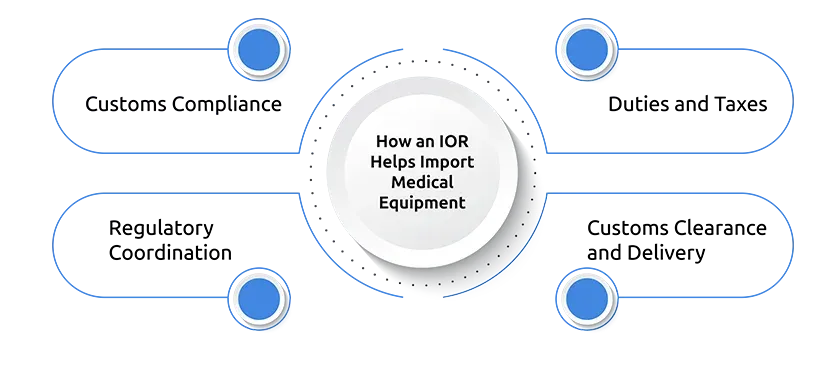
How an IOR Helps Import Medical Equipment
An experienced IOR can handle some important stages of the import process.
1. Customs Compliance
The IOR is responsible for ensuring that the shipment is correctly declared to customs. This can include reviewing product descriptions, HS classifications, customs values, country of origin, commercial invoices, packing lists, & other needed documentation.
Accurate classification is mainly important because medical equipment may have specific tariff classifications & regulatory impact.
2. Regulatory Coordination
A nation’s health or medical-device regulator may have jurisdiction over medical equipment. A product’s need for registration, licensing, certification, or other regulatory documentation prior to importation can be determined with the aid of an IOR.
The exact requirements depend on the destination country and the type of equipment.
3. Documentation Management
Medical equipment shipments often need more documentation than ordinary commercial goods. Depending on the market, documentation may include product specifications, certificates, manufacturer information, conformity documents, invoices, declarations, licenses, & regulatory approvals.
An IOR can help coordinate these documents before shipment, reducing the possibility of customs holds.
4. Duties and Taxes
The importer may be responsible for paying applicable customs duties, import taxes, VAT, GST, or other government charges.
An IOR can help determine the applicable charges & ensure that payments & customs declarations are managed correctly.
5. Customs Clearance and Delivery
The IOR collaborates with brokers, freight forwarders, customs officials, and other clearance process participants after the shipment arrives.
The equipment can be transported to the specified hospital, lab, warehouse, data center, research facility, or other site following customs clearance.
Country-Specific Medical Equipment Regulations
One of the biggest challenges of global medical equipment imports is that regulations differ from country to country.
Therefore, businesses should not assume that approval in one market automatically permits importation into another.
An effective international IOR strategy should begin with a country-specific assessment of the product, intended use, classification, regulatory status, importer needs, & customs process.

How to Prepare for a Medical Equipment Import
Before shipping, businesses should confirm the product’s classification, regulatory status, importer needs, documentation, customs value, country of origin, applicable duties & taxes, & delivery needs.
It is also important to determine whether the shipment is a permanent import, temporary import, repair shipment, demonstration unit, or another special import category.
Early preparation allows potential compliance issues to be identified before the equipment reaches the border.
Conclusion
Transporting medical equipment globally needs more than arranging transportation & customs clearance. Businesses must navigate customs procedures alongside country-specific healthcare & medical-device regulations.
For businesses entering markets without a local presence, an Importer of Record for medical equipment offers an organized method to handle these obligations.
An IOR can assist companies in reducing import delays and create a more dependable procedure for transporting medical equipment across international borders by tying together customs knowledge, regulatory coordination, paperwork management, and local importing capabilities.
Did you know?
World Health Organization estimates that more than 2 million different types of medical devices are available worldwide. This wide range of products, from simple diagnostic tools to complex imaging and monitoring systems, means that regulatory requirements can vary significantly between products and countries.
FAQ
1. What is an Importer of Record for medical equipment?
An Importer of Record is the party responsible for ensuring that medical equipment complies with the destination country’s customs, import, and applicable regulatory requirements.
2. Why do medical equipment companies need an IOR?
An IOR can help companies manage customs clearance, documentation, duties and taxes, import requirements, and applicable medical-device regulations, especially when they do not have a legal entity in the destination country.
3. What documents are required to import medical equipment?
Requirements vary by country and product but may include commercial invoices, packing lists, HS codes, product specifications, certificates, regulatory approvals, licenses, conformity documents, and manufacturer information.
4. Can an IOR import medical equipment without a local entity?
In many markets, an IOR can provide the local importing capability required to clear eligible shipments when the overseas company does not have its own local legal entity. However, specific requirements depend on the destination country’s laws and the type of medical equipment.
5. Does medical equipment require regulatory approval before import?
Some medical equipment requires registration, authorization, certification, or other regulatory approval before importation. The requirements depend on the product, intended use, classification, and destination country.