Introduction
Global data centers depend on the fast & safe movement of servers, storage systems, networking equipment, & other IT hardware across different countries. Every global shipment must follow the customs rules of the final location country. This process is known as customs compliance. It added with managing the accurate paperwork, following import & export laws, & meeting customs requirements. When businesses follow these rules, they can avoid shipment delays, extra costs, & customs penalties. Good customs compliance also helps data center projects stay on schedule & ensures important IT equipment reaches its final location safely & on time.
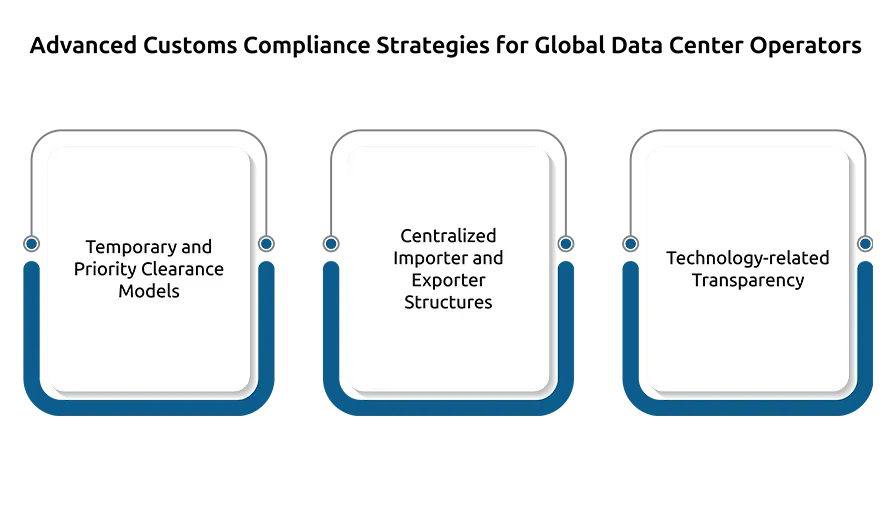
Advanced Customs Compliance Strategies for Global Data Center Operators
Temporary and Priority Clearance Models
Certain officials allow data center equipment to be cleared using priority or provisional release devices. These methods allow equipment to be released quickly while post-clearance verification continues in parallel, minimizing downtime.
Centralized Importer and Exporter Structures
Using a centralized exporter of record service and an Importer of record Service simplifies approval across multiple shipments. This approach confirms continuous declarations and reduces the risk of issues during customs checkups.
Technology-related Transparency
Advanced customs environments increasingly depend on blockchain in supply chain systems to improve traceability and data integrity. These technologies support faster verification of shipment data and reduce manual intervention.
Benefits of Special Customs Procedures for Data Center Equipment
Risk Mitigation and Compliance Control
Special customs procedures are commonly used to reduce regulatory risks when importing high-value system devices. These procedures allow authorities to confirm agreement without holding shipments for extended periods. For data center operators, this means faster access to equipment while maintaining full legal conformity.
Faster Release for Mission-Critical Deployments
Because data centers support critical digital services, governments and customs authorities frequently allow expedited processing. This confirms continuity for cloud services, fintech platforms, and organizations’ IT systems dependent on timely infrastructure deployment.
Simplified Documentation Handling
Data center shipments frequently include difficult trade invoices, technical descriptions, and valuation data. Special customs clearance device simplifies documentation review and reduces disputes related to categorization or valuation under the HTS Harmonized Tariff Schedule.
Understanding Country-Specific Customs Regulations for Data Center Equipment
Importing data center equipment into multiple countries is not as simple as shipping a shipment from one location to another. Every country has its own set of customs regulations, import laws, & approval processes. As a result, before moving IT equipment to a different country, businesses must first understand its regulations. This reduces delays & keeps the import process running smoothly. Import licenses are also required in some countries for specific servers, networking equipment, & telecom goods. Many countries also have their own certification processes in place to make sure that imported products follow local safety & technical standards. Shipments may be delayed or stopped at customs if the required approvals are not approved. Timing is important for businesses handling global data center deployment projects. Equipment must usually reach on time in multiple countries so that installation may start without delay. Businesses may make international IT equipment shipping & cross-border hardware imports easier, faster, & cost-effective by following local laws, using reliable data center logistics, & following to global trade compliance.
Customs Duty Benefits for Data Center Infrastructure
In many cases, countries offer duty benefits or special schemes to support digital infrastructure growth. These incentives are designed to attract investment in data centers, cloud services, and IT infrastructure, which are critical for economic and technological development.
Governments may provide reduced or zero customs duties on specific IT hardware, exemptions under project import schemes, or tax benefits for companies setting up large-scale data centers. In India, initiatives aligned with the country’s digital expansion supported by bodies like the Central Board of Indirect Taxes and Customs can allow simplified clearance processes, concessional duty rates, and faster approvals for essential equipment such as servers, cooling systems, and networking gear.

Conclusion
Customs compliance helps businesses ship data center equipment from one country to another without delays. By following the correct import & export rules, companies can avoid extra costs, customs issues, & shipment delays.
Since every country has different customs regulations, it is important to prepare the correct documents & follow local needs before shipping. Working with experienced customs & logistics experts can also make the process easier.
Good customs compliance helps businesses deliver IT equipment on time, protect valuable hardware, & keep data center projects running smoothly.
Did you know?
The global data center direct-to-chip cooling market is projected to grow from USD 3.33 billion in 2026 to USD 17.31 billion by 2032, at a CAGR of 26.5% during the forecast period.
FAQs
1. Why is customs compliance important for global data center operators?
Customs compliance helps data center operators import and export IT equipment without unnecessary delays, penalties, or extra costs. Following customs regulations also keeps projects on schedule and helps equipment reach its destination safely.
2. What documents are usually required for importing data center equipment?
The required documents may include a commercial invoice, packing list, bill of lading or air waybill, import permits (if required), certificate of origin, and customs declaration forms. The exact requirements depend on the destination country’s regulations.
3. What can happen if customs regulations are not followed?
If customs rules are not followed, shipments may be delayed, held by customs authorities, returned to the sender, or subject to fines and additional duties. Incorrect documentation can also slow down data center deployment projects.
4. Can data center equipment qualify for customs duty benefits?
Yes. Some countries offer reduced customs duties, tax incentives, or special import schemes for data center and IT infrastructure projects. The available benefits depend on the country’s customs policies and the type of equipment being imported.
5. How can businesses simplify customs compliance for international IT shipments?
Businesses can simplify customs compliance by preparing accurate shipping documents, using the correct HS codes, understanding local import regulations, and working with experienced customs brokers or Importer of Record (IOR) service providers for international shipments.