
Introduction
Artificial intelligence & machine learning are growing quickly, & GPUs have become an important part of this technology. They help train AI models faster & support tasks like data processing, image recognition, & language learning. As more businesses build AI systems, the demand for AI servers & GPU clusters continues to increase around the world. However, GPU import compliance involves much more than simply shipping hardware. Companies follow customs rules, export control rules, product certification requirements, & prepare the correct import documents. Missing any of these steps can lead to customs delays, extra costs, & legal problems. For businesses importing AI hardware into different countries, an Importer of Record (IOR) can help make sure all import requirements are follow & shipments local rules.
In this guide, you will learn everything about GPU import compliance, including customs clearance, export controls, required documents, certifications, common import challenges, & best practices for importing AI servers and GPU hardware successfully.
Why GPUs Are Essential for AI and Machine Learning
A graphics processing unit is a strong processor that can do multiple calculations at same time. It can manage larger data faster than a CPU, making it useful for AI & machine learning. Companies may use GPUs to train AI models faster, improve performance, & save time. They help AI systems with learn from data, understand text, detect images, & giving faster results. As more companies develop AI systems, they invest in AI servers & GPU clusters to support advanced AI applications. GPU import compliance has become more important problem as demand for AI equipment grows. To safely and legally transport GPU hardware across borders, businesses must follow to customs processes, export controls, & import rules.
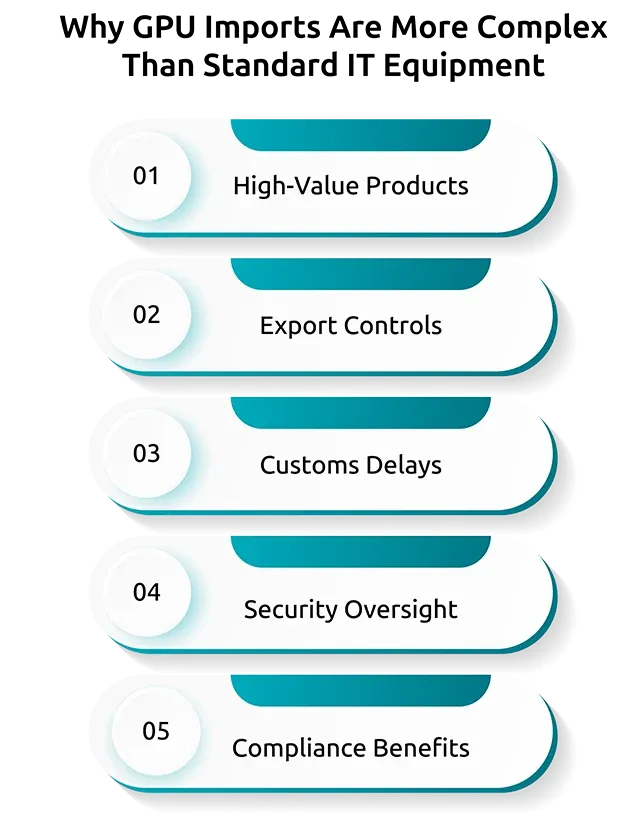
Why GPU Imports Are More Complex Than Standard IT Equipment
Importing GPUs is more difficult than importing regular IT equipment because they are high-value products used in AI, machine learning, & high-performance computing. Since GPUs are powerful & advanced, many countries have strict rules for importing them. Some GPUs are considered dual-use technology, which means they can be used for both commercial and government & research purposes. Because of this, they may be treated as export-controlled products, & businesses may need special approvals & export licenses before shipping them to certain countries. Many countries also require country-specific certifications before GPU hardware can be imported. If the required details & import documents are missing, customs authorities may delay or stop the shipment. There are also security problems because advanced GPUs can be used in sensitive technologies. For this reason, governments have legal oversight to monitor GPU imports & ensure businesses follow customs rules, export control laws, and local compliance requirements. Follow GPU import compliance rules helps companies avoid delays, charges, & supply chain disruptions.
Understanding GPU Import Compliance and Common Import Challenges
GPU import compliance is the process of following all the rules required to import GPU hardware, AI servers, and GPU clusters into another country. Before shipping, companies must check export controls such as EAR (Export Administration Rules), BIS rules, ECCN classifications, & end-user verification. These rules help governments control where advanced GPU technology is shipped and who will use it. After export requirements are completed, businesses must follow customs compliance rules. This includes using the correct HS Codes, submitting import details, paying duties and taxes, and preparing correct commercial bills. Many countries also require product certifications before GPU hardware can enter the market.
For example, BIS certification may be required in India, KC in South Korea, CCC in China, SIRIM in Malaysia, & SABER in Saudi Arabia. AI companies can face several GPU import compliance challenges if these requirements are not followed. Common problems include using the wrong HS Code, missing product certifications, delays in getting export licenses, customs inspections, verification of high-value shipments, documentation errors, & country-specific import restrictions. These issues can delay the delivery of AI hardware, increase costs, & slow down AI infrastructure and project deployment. Following the correct compliance process helps businesses avoid customs delays and import their GPU equipment smoothly.
GPU Import Compliance Process and Required Documents
The GPU import compliance process starts with planning the shipment & handling the correct HS Code for the GPU hardware. Next, businesses check export controls, obtain any required licenses, & complete country-specific certifications. If needed, an Importer of Record (IOR) handles the import process. After preparing the shipping documents, the shipment goes through customs clearance, is delivered to the data center, & is ready for AI deployment. To import GPUs successfully, businesses need important documents such as a Commercial bills, Packing List, Air Waybill & Bill of Lading, Certificate of Origin, Import License, Export License, Product Certifications, End User Certificate, Customs Details, & Purchase Order. Having the correct documents helps make sure smooth GPU import compliance & avoids customs delays.

Why Importer of Record (IOR) & GPU Import Compliance Are Important for AI Deployments
An Importer of Record (IOR) is the legal entity responsible for importing GPU hardware, AI servers, & GPU clusters into a country. The IOR handles customs documents, pay charges and taxes, and makes sure the shipment follows local import rules. Many AI companies use an IOR when they do not have a local business entity in the destination country. Using an Importer of Record (IOR) makes GPU import compliance easier and helps businesses avoid customs problems. It reduces customs delays, fewer compliance risks, & faster delivery of AI hardware. This helps businesses complete AI projects on time, improve supply chain insight, maintain reliable delivery on time, & deploy AI systems more efficiently.
Conclusion
As the demand for AI, machine learning, & GPU hardware grows, GPU import compliance is important for smooth global shipping. Following customs processes and preparing the correct documents will help you avoid delays and extra costs. One Union Solutions provides trusted Importer of Record (IOR) services as well as compliance support to help businesses in import AI hardware quickly, safely, and legally.
Did you know
The global GPU as a service market size is estimated to hit around USD 37.10 billion by 2035, increasing from USD 4.96 billion in 2025, with a CAGR of 22.29%.
FAQ
Why is GPU import compliance important for AI companies?
It helps AI companies avoid delays, charges, & shipment problems while importing GPU clusters for machine learning & AI work.
How does GPU import compliance help AI deployment?
It helps deliver AI hardware faster, reduces risks, & makes sure smooth setup of AI infrastructure & data centers.
Does One Union Solutions support global GPU shipping?
Yes, it helps with global logistics for GPU imports, AI infrastructure, & data center equipment over multiple countries.
How does an Importer of Record (IOR) help AI companies?
An IOR handles all legal import responsibilities like customs filing, tax payment, and compliance checks, especially for companies without a local entity.
What does One Union Solutions do in GPU import compliance?
One Union Solutions helps companies handle GPU import compliance, customs clearance, documents, & legal import steps for AI servers & GPU hardware in different countries.