Introduction: From Visibility to Autonomy in Global Logistics
In today’s global trade, supply chains are not just about checking shipments on dashboards. Businesses are moving toward self-healing supply chains in 2026, while advance AI systems can automatically identify and solve problems. These systems can detect delays, track customs clearance process issues, and even adjust shipping plans. They can also compare air freight vs sea freight, use tools like an air freight calculator, and even help in Freight rates changed without waiting for human choices. Big companies and platforms like SAP and GEP are already using AI to make supply chains more automatic. This includes better freight forwarding services, smoother global trade compliance, and faster response to shipping issues. AI can also take decision on export compliance, customs clearance, and importer of record help to avoid delays and charges.
What is a Self-Healing Supply Chain?
A self-healing supply chain is a advance system that improves global shipping management by using AI, automation, and real-time data. It can detect issues such as delays, tariff issues, or problems with customs clearance. Then it identify the reason for the issue, which may be bad weather, political issues, or a lack of space in freight forwarding services. After that, it can automatically solve the problem by changing paths, choosing new carriers, or deciding between air freight and sea freight using an air freight calculator to save time and money. It also makes it simpler for companies to handle an importer of record needs and follow trade rules. As per ScienceDirect and Taylor & Francis research, these systems are going toward closed-loop logistics, in which the supply chain can automatically track, fix, and improve itself.
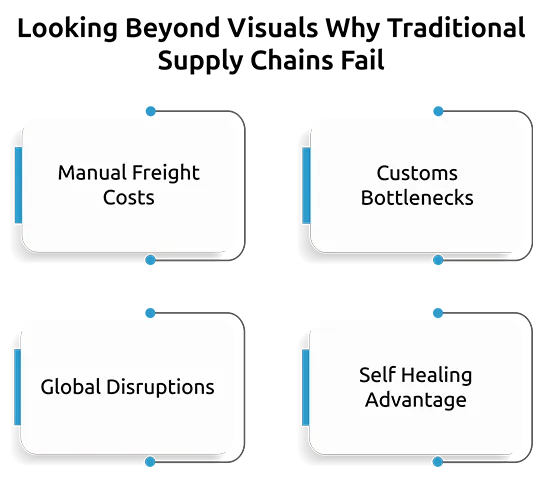
Looking Beyond Visuals: Why Traditional Supply Chains Fail.
Traditional supply chains are based on static reports, which help businesses to track shipments but not change quickly. They also use manual freight trade, which takes time and increase costs. Updates in the customs clearance process are often slow, and freight forwarding services are not always well connected across systems. Because of this, there is no real-time freight increasing, and companies face global trade compliance when rules or costs change suddenly. Problems like port delays, Red Sea route changes, or decisions between air freight vs sea freight are handled slowly by manual freight forwarders.
Overall, traditional supply chains fail because they are slow, not connected, and depend too much on manual work, while self-healing supply chains solve these problems automatically and faster.
How AI Systems Negotiate Their Own Freight Rates
By 2026, AI-driven supply chains will be helped to track and handle freight rates without human support. For freight rate optimization, AI uses an air freight calculator to review live prices and quickly chooses between air freight and sea freight based on cost and speed. It also improves pricing by calculating a volumetric weight to avoid extra shipping costs. For automated carrier negotiation, AI systems talk directly with shipment businesses and set flexible prices. They can also change contracts based on needs, available space, and other freight forwarding factors. AI finds less costly global trade centers and chooses better shipping ways for route and cost intelligence. It may reroute shipments through efficient routes, reducing costs and speeds up global shipping while improving trade compliance.
Customs, Compliance and Legal Intelligence Layer
Businesses can handle customs and compliance more easily because of self-healing supply chains. They can help with automating customs clearance, following new rules, and making sure export compliance. AI can also check delivery times after clearance and avoid delays through quicker decisions. Businesses may improve trade process, increase compliance, and keep shipments shipping smoothly across global markets by working with One Union Solutions.
The Future of Logistics Optimization in Self-Healing Supply Chains
As technology improves, self-healing supply chains will become more automated and efficient. AI will handle freight forwarding, improve customs clearance, and help global trade compliance in countries using real-time data. It can also track shipment updates, like in transit, means when the shipment has moved customs, to keep goods shipping without delay. Such devices will save time, reduce shipping costs, and improve global supply chains by helping them to make faster decisions and handle logistics efficiently.
Conclusion
Self-healing supply chains are making global trade simpler and more efficient. Businesses can use AI to improve freight forwarding, improve the customs clearance process, and faster global trade compliance. These systems help avoid delays, save money, and keep shipments on track. Businesses can use One Union Solutions to handle global shipping and trade rules and develop strong and more reliable supply chains.
Did you know
AI-powered supply chains can respond to disruptions 30–40% faster than traditional systems, helping improve logistics and supply chain efficiency.
FAQ
How do self-healing supply chains reduce delivery delays?
They detect problems in real time and quickly select different routes, carriers, or ways to travel.
Can self-healing supply chains improve global trade compliance?
Yes. They can monitor trade rules, make sure compliance, and limit the risk of shipping issues.
How can One Union Solutions help self-healing supply chains?
One Union Solutions helps businesses to manage customs clearance, export compliance, importer of record services, and global logistics processes more efficiently.
What technologies are used in self-healing supply chains?
AI, machine learning, automation, cloud platforms, and real-time tracking technologies are commonly used.
How do self-healing supply chains improve risk management?
They identify possible problems early and take corrective action before big challenges occur.