Introduction
In 2025 and 2026, the world trade routes were impaired by geopolitical risks in the Red Sea & important waterways. These canals are growth drivers connecting Africa, Asia, & Europe. They transport specialized equipment, including IT/data center equipment, aircraft equipment, automobile equipment, & sensitive medical equipment. Rising tensions & clashes, especially with armed groups and local authorities, meant shipping companies had to reroute. This diversion resulted in longer shipping times, high freight and insurance rates, and serious difficulties in assuring stable and reliable supply chains.
Key Factors Driving Rising Freight Rates in 2026
Freight rates are expected to rise greatly in 2026 due to a combination of global supply chain delays, increasing ongoing geopolitical risks. Ocean freight prices are being impacted by port blockages, limited container availability, & strong environmental rules, while air freight rates continue to increase due to high demand for fast and reliable shipping. Additionally, labor shortages and increased compliance requirements are adding to working costs across logistics networks. Importers must stay preventing by planning shipments in advance, expanding transport modes, & working with experienced logistics partners to manage costs & avoid delays in an increasingly changeable shipping environment.
Maritime Shipping Disruptions and Global Trade Fragility
One of the most important challenges facing global logistics today is the increasing frequency of maritime shipping delays. These delays are often caused by cross- border conflicts, port backlog, strong weather events, & working barriers in major shipping hubs.
When critical maritime routes are affected, the impact is immediate and extensive. Delays in shipment schedules lead to production slowing, increased warehousing costs, & working gaps across global supply chains. The connected nature of latest trade means that a delay in one region can quickly cascade across multiple economies, exposing the instability of global logistics networks.
Rising Ocean Cargo Insurance Premiums and Risk Exposure
As lack of clarity in maritime transport increases, financial risk has also increased, specificly in the form of ocean cargo insurance premiums. Insurers are now pricing higher risk into shipping routes that pass through politically unstable regions.
This increase in insurance costs is driven by a higher likelihood of cargo loss, piracy incidents, redirecting, & extended transit times due to route changes. For exporters & importers, these rising premiums add an important layer of cost to global trade, making supply chain planning more expensive & complex than ever before.
Alternative Shipping Routes & Logistics Adaptation
In response to ongoing volatile , global businesses are enhancing exploring alternative shipping routes to reduce exposure to high-risk maritime zones. These alternative pathways often involve longer transit distances or multi-modal transport systems combining sea, rail, and road logistics.
While these redirecting strategies help improve security & reliability, they often come with balanced in terms of cost & delivery time. though this, companies are focusing on strength over efficiency, recognizing that stable supply chains are more valuable than minor cost savings in today’s volatile environment.
Strait of Hormuz Trade Impact and Strategic Vulnerability
The Strait of Hormuz trade impact remains one of the most complex problem in global maritime logistics. As a key transit point for global sensitive shipments, any delay in this narrow waterway can have immediate effects for global energy markets.
A interruption in this region can activate sharp increases in energy prices, price incresing pressure across economies, & extensive delays in shipping schedules. Because of its strategic importance, the Strait of Hormuz represents a major instability in global supply chain systems, highlighting the risks associated with over-rely on limited maritime corridors.

Supply Chain Risk Mitigation in a Volatile Global Environment
In response to growing imbalanced, businesses are increasingly focusing on supply chain risk reduction as a core planned priority. Companies are varying suppliers, increasing inventory buffers, & investing in digital supply chain visibility tools to better forecast delays .
There is also a growing shift toward by location mixed sourcing strategies and closer alignment with politically stable trade partners. These approaches aim to reduce exposure to geopolitical risks while ensuring flow of supply even during global delays.
Structural Shift in Global Maritime Trade
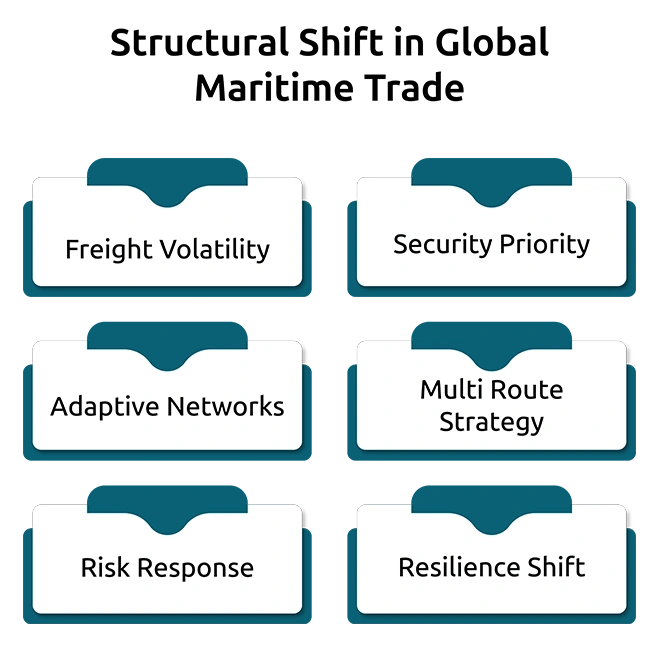
The combined effect of rising global frictions, freight volatility, & shipping delaysis leading to a structural transformation in global trade systems. The focus is slowly shifting away from pure cost efficiency toward resilience, security, & adaptability.
As businesses adapt to this new environment, global maritime trade is becoming more broken yet more systematically managed. Companies are no longer relying on single supply routes or focused on sourcing models. Instead, they are building flexible & adaptive logistics networks capable of responding to sudden long-term risks.
Conclusion
The rise of geopolitical shipping-related risks & rising freight costs is transforming global supply chains, from unstable freight rates to rising insurance premiums. delays like the Strait of Hormuz trade impact & ongoing shipping challenges highlight the need for stronger supply chain risk reduction & alternative shipping routes.
Ultimately, global trade will depend more on resilience & adaptability than efficiency alone.
To manage these challenges, One Union Solutions provides reliable end-to-end logistics & DDP solutions for seamless global trade.
Did You Know?
Volatility continued into 2025 amid tariff announcements by the United States of America and mounting geopolitical risks, including around the Strait of Hormuz.
FAQ
Why are shipping companies shifting away from the Red Sea route in 2025 & 2026?
Continuing global conflicts & security risks in the Red Sea have caused many carriers to redirect cargo ships. These reroutings have increased transit times, freight charges, & pressure on global supply chains.
How do geopolitical risks affect freight rates?
Geopolitical disruption often leads to longer shipping routes & increased insurance costs. These factors contribute to rising freight rates across both ocean & air shipping networks.
Why are ocean cargo insurance costs increasing?
Insurance costs have increased because of greater risks related to high-risk sensitive maritime regions. Longer transit times & route rerouting have also increased the overall risk for cargo insurers.
How are businesses reducing supply chain risks in 2026?
Many companies are expanding their supplier base, maintaining larger stock, & adopting alternative shipping routes. These approaches help improve supply chain strength & reduce reliance on high-risk regions.
Why is the Strait of Hormuz important for global trade?
The Strait of Hormuz is one of the world’s most important shipping routes for power & business cargo. Any delays in this region can affect freight costs, shipping times, & the security of global trade stability.