
Overview of the rapid expansion of AI technologies
The quick development of AI technologies is shaped by massive growth in generative AI, business adoption, & network development, with global adoption reaching ~16.3% of the population by early 2026. Made by huge investments, AI is changing industries through automation, data analytics, & increased productivity, with AI-ready data center demand expected to rise 33% annually through 2030.
Understanding the AI Hardware Boom
The AI hardware development is a huge growth in demand for specialized computing components, mainly Graphics Processing Units & Application-Specific Integrated Circuits needed to train & run difficult artificial intelligence models. This, as of May 2026, is driving an unmatched investment in data center networks to support Generative AI, making AI hardware a critical bottleneck & driver of international technological growth.
Artificial intelligence has become an important backbone of the global economic outlook, confirmed by the unprecedented scale of announced investment commitments aimed at developing an AI-related network. The growth of AI is also mainly changing international trade by developing demand for important inputs & between goods needed to build data centers. This surge in AI-related investment has already supported global trade since early 2025, with strong demand for important components developing exports in main supplier economies.
The AI Infrastructure Growth
AI-supported main investment has advanced mainly in recent years, with newly announced projects pointing to a long-term & significant growth ahead. U.S. data-center spending alone is expected to grow to half a trillion dollars in 2025. As documented in Haag (2025), the U.S. leads globally in terms of the AI network build-out & planned investments, followed by China, with other economies, notably Europe, weak. The U.S. & China drove a huge development in AI-related computing capacity in 2024, with the U.S. rising higher through the first half of 2025.
AI-related computing output is expected to increase heavily through 2030, as shown by planned development. According to one estimate from Epoch AI, these projections suggest that the boom in AI-related computing capacity is set to accelerate further in the coming years. According to these data, the U.S. is expected to maintain a leading position, but several other economies, particularly in Asia and the Middle East, are also planning notable expansions.
Why Air Freight Is Important for AI Hardware
Air freight has become an important backbone of the artificial intelligence hardware supply chain, with over two-thirds of the value of AI-related goods transported by air in 2025. The rapid speed of AI development, merged with the high value & important nature of components like GPUs & servers, makes fast, secure air transport crucial for connecting manufacturers in Asia to data center developers in the U.S. & Europe.
Unmatched Speed for Time-Sensitive Deployments
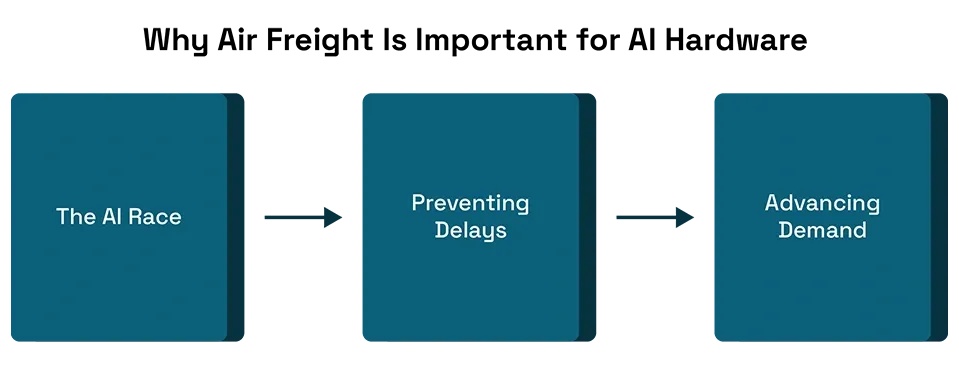
The AI Race: The rapid development of processors means replacement cycles are reducing, making speed a complete necessity.
Preventing Delays: Companies cannot afford to wait weeks for ocean freight. Air cargo ensures that chips & servers move from factories to data centers quickly, preventing issues in the global AI infrastructure race.
Advancing Demand: Air cargo has been used to “frontload” high-value shipments, moving $157 billion in goods in early 2025 to keep up with demand.
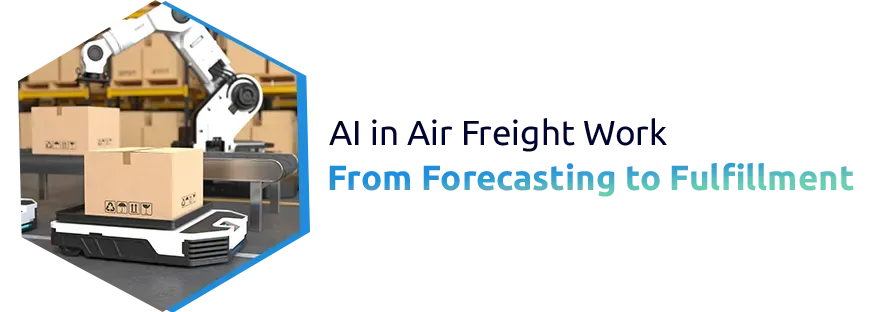
AI in Air Freight Work: From Forecasting to Fulfillment
Across air shipping work, AI delivers end-to-end tracking and efficiency from demand forecasting to shipment. AI-powered route planning systems analyze airport overcrowding, tariff changes, and geopolitical risks to show the most effective path for cargo shipment. These systems also increase live shipment tracking, giving shippers clarity over every stage of shipment, from aircraft loading to last-mile delivery services. Automating classification reviews combined with HS code or HTS harmonized tariff schedule requirements, AI minimizes customs delays and avoids costly errors. For organizations handling sensitive cargo under DAPs or Delivered Duty Paid service terms, such tools confirm that all Import duties and tariffs are calculated correctly, allowing smooth cross-border movement. AI fulfillment systems in place, air freight becomes a dependable part of broader supply chain optimization plans.
Conclusion
The fast development of artificial intelligence is not only changing digital progress but also developing international trade, logistics, & network development. As AI adoption works in the whole world, the demand for specialized hardware such as GPUs, ASICs, servers, & semiconductor components continues to grow, driving significant investment in hyperscale data centers & updated computing environments.
AI infrastructure has enhanced air freight into a strategic component of the international technology supply chain. The speed, security, & usability of air cargo make it essential for transporting high-value, time-sensitive AI hardware across global markets. AI-powered logistics solutions are enhancing shipment visibility, route optimization, customs processing, & whole supply chain improvement.
Did you know?
Air cargo enabled $157bn in accelerated imports and supported the AI boom as global trade expanded 2.4% in 2025 despite policy uncertainty.
FAQ
1. How are AI tools disrupting the logistics industry?
The precision offered by AI in logistics is unparalleled. AI systems can analyze vast amounts of data with high accuracy, reducing the likelihood of human error. In inventory management, AI algorithms can predict demand patterns more accurately, ensuring that stock levels are optimal.
2. What are the common problems with air freight?
Even little mistakes in air freight can cause delays, higher expenses, damaged goods, and unhappy customers. Poor route planning, documentation, cargo handling, real-time tracking, or freight partner selection might cost your organization more than time. They can undermine trust, reputation, and profits.
3. How will AI affect freight forwarding?
AI-powered freight forwarding refers to the use of artificial intelligence to optimize planning, execution, and monitoring across freight operations. Instead of relying mainly on spreadsheets, emails, and manual calculations, AI-powered platforms analyze large volumes of data to support better decisions.
4. Which 3 jobs will survive AI?
The three primary fields best positioned to survive and thrive alongside AI are AI and technology specialists (coders), energy experts, and life scientists. These roles remain human-led due to their requirement for high-level creativity, strategic oversight of complex systems, and scientific innovation.
5. What are the 4 C’s of aviation?
The 4 C’s of aviation, often used as a mnemonic for pilots when they are disoriented, lost, or in an emergency, are Climb, Communicate, Confess, and Comply. These actions are designed to prioritize safety and ensure orderly assistance from air traffic control.