Introduction
India’s demand for computers, servers, & other IT hardware is developing quickly as businesses grow & make digital. From small startups to large companies, everyone needs usable systems to run daily operations. Since local manufacturing cannot fully meet this demand, imports have become more useful. Importing IT hardware is not just about finding a supplier & placing an order. You need to follow clear government rules, get the right licences, and complete proper documentation.
Who Can Import Computer Hardware in India
Any registered business in India can import computer hardware, provided it holds the required licences & complies with the applicable trade policies. This includes proprietorships, partnership firms, LLPs, & private limited companies. Individual users importing personal devices under baggage rules are exempt from the commercial import restrictions discussed in this guide.
If you are setting up a new operation mainly for electronics hardware import, selecting the right business structure matters. A private limited company or LLP offers limited liability protection & improves reliability with international suppliers, banks, & customs authorities.
Registrations & Licences Required
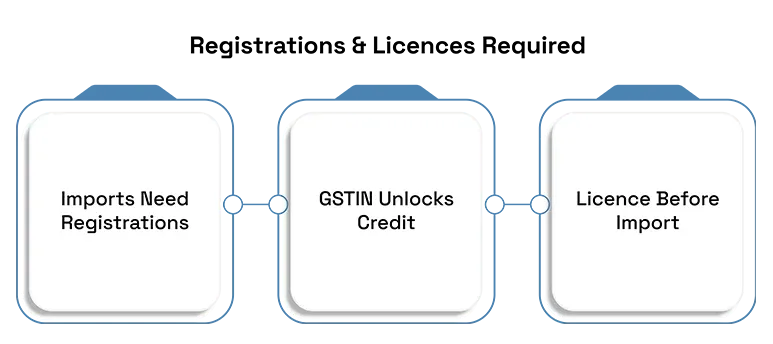
Before you can import computer hardware, some registrations must be active. Missing even one can delay or block your shipment at the port.
An active GST registration is critical because IGST is levied on all imports at customs clearance. Your GSTIN allows you to claim Input Tax Credit on the IGST paid, reducing your effective tax burden. Ensure your GST returns are filed consistently to retain eligibility for this credit.
BIS certification is mainly important for electronics hardware import. Some IT products, added power adapters, cables, & some monitors, fall under compulsory BIS registration. Foreign manufacturers must obtain a BIS licence before their products can be legally imported & sold in India. Always verify the latest Quality Control Orders before finalising your supplier.
Step-by-Step Procedure to Import Computer Hardware
Once your registrations are complete, here is the systematic process for bringing IT hardware into the country.
Step 1: Obtain IEC and Set Up Business Registrations
Apply for IEC via the DGFT portal. Mainly, activate your GST registration, create your ICEGATE profile, & ensure your business PAN is linked to all platforms.
Step 2: Apply for DGFT Import Authorization
If your product falls under HSN 8471, log in to the DGFT website and submit your Import Authorization application through the Import Management System. Specify the product category, estimated quantity, value, & country of origin. You may submit multiple applications during the year.
Step 3: Select Your Supplier & Classify the Product
Source hardware from global manufacturers or distributors in countries like China, Taiwan, Vietnam, South Korea, or the United States. Identify the correct HSN code for each product. Personal computers fall under 84713010, processors under 84715000, motherboards under 84733020, & other computer parts under 8473. Correct classification determines your duty liability.
Step 4: Negotiate Terms & Arrange Payment
Agree on Incoterms, payment terms, & delivery schedules. Most IT hardware trades use Letters of Credit or advance payment. Factor in currency fluctuation risks, especially for large orders.
Step 5: Arrange Shipping & Insurance
IT hardware is sensitive to moisture, shock, & static. Use freight forwarders experienced in electronics cargo. Arrange complete insurance to manage transit damage, fraud, & managing risks. Retain all shipping documents for customs filing.
Step 6: File the Bill of Entry and Clear Customs
Upon arrival at the Indian port or airport, file a Bill of Entry through ICEGATE. Attach the commercial invoice, packing list, bill of lading or airway bill, insurance certificate, DGFT Import Authorization, BIS certificate, & certificate of origin. Customs officers will verify the documents & may inspect the consignment physically.
Step 7: Pay Customs Duty and IGST
Pay the assessed Basic Customs Duty, Social Welfare Surcharge, & IGST electronically. Once payment is confirmed, customs will release the goods. Retain all receipts for accounting & ITC purposes.
Step 8: Take Delivery & Maintain Records
Collect the hardware from the port warehouse or arrange transportation to your facility. Update inventory records, file your GST returns promptly, & store all import documentation for a minimum of five years for audit purposes.

The Initial Restrictions
India’s growing tech sector, coupled with a growing middle class, has led to a surge in electronic imports. While this growth is positive, it also highlights the nation’s reliance on foreign manufacturers. The government’s initial plan to restrict imports aimed to address this dependency & stimulate domestic production.
The proposed restrictions invited criticism from many stakeholders, with global tech giants & domestic industry players. Concerns were raised about potential price hikes, supply chain issues, & the whole impact on the Indian tech ecosystem.
Conclusion
Transporting IT equipment into India can be the best business, but only when you follow the rules carefully. Correct registrations to understanding product verification & customs duties, every step matters. Even small mistakes cause delays, extra costs, or blocked shipments.
India is mainly trying to balance imports with local manufacturing. This means policies may change, & businesses need to stay updated to avoid any fines. If you verify all processes well, select the right suppliers, & stay complete with regulations, importing IT hardware can be easy & profitable. The key is to stay informed, organised, & ready to adapt to changes in the market.
Did you know?
In January 2025, the Directorate General of Foreign Trade (DGFT) revised Schedule II (Export Policy) to introduce a more granular, item-level classification system across all ITC (HS) codes.
FAQ
Which ports handle IT hardware imports in India?
Major ports for IT hardware import include Delhi (IGI Airport), Mumbai (JNPT and air cargo), Bengaluru, Chennai, and Hyderabad. Air cargo is the preferred mode for high-value, time-sensitive electronics shipments.
How long does the DGFT Import Authorization take?
Processing times for Import Authorization under the IMS can vary, but most applications are processed within a few working days if the documentation is complete. Importers can submit multiple applications and request amendments through the DGFT portal during the authorization’s validity period.
Is Import Authorization mandatory for all computer hardware?
No. Import Authorization under the DGFT Import Management System is mandatory only for restricted IT hardware under HSN 8471, which includes laptops, tablets, all-in-one PCs, ultra-small form factor computers, and servers. Spare parts, components, and peripherals like keyboards and mice do not require this authorization.
What is the customs duty on laptops imported to India?
Basic Customs Duty on laptops (HSN 84713020) is nil under the ITA commitment. However, IGST at 18% applies at the time of customs clearance. The IGST can be claimed as Input Tax Credit by registered businesses.
Can I import refurbished or second-hand computers into India?
Import of second-hand or refurbished IT equipment is restricted under the Foreign Trade Policy. Specific permissions or authorizations from DGFT may be required depending on the product and its end-use. It is advisable to consult a trade compliance expert before attempting such imports.