Introduction to Smart Containers and IoT in Shipping
Smart containers are transforming the movement of equipment on international air freight paths. IoT sensors are installed on each unit, relaying the temperature, humidity, and route data in real time. Digital transformation in logistics has become a significant part of the operation of airports, allowing for the control of the state of each shipment until its arrival.
IoT in shipping is much more than tracking; it’s a connected ecosystem linking airports, warehouses, and customs points. This digital network ensures that precision cargo is delivered safely while keeping every checkpoint visible throughout its transit. The adoption of smart shipping solutions is redefining modern logistics efficiency worldwide.
The Role of IoT Technology in Revolutionizing Container Management
IoT technology enables accurate control and tracking through connected devices and data-sharing systems. These systems improve container management by reducing delays and helping operators monitor each shipment’s health. With IoT-enabled networks, logistics optimization becomes data-driven & efficient.
Container management systems at major air hubs like Frankfurt, Dubai, and Incheon Airport use digital terminals to analyze cargo in real time. This level of visibility supports compliance with customs duty management and reduces manual paperwork. Smart containers, thus, become a reliable digital extension of a logistics manager’s eyes on every trade route.

Benefits of Using Smart Containers for Global Trade Efficiency
Smart containers improve trade activities worldwide by providing visibility, security, and economic costs. Using sensors to show real-time readings, logistics teams can intervene early to avoid temperature differences or errors in the handling procedure. This enhances efficiency in time-sensitive cargo transfer.
The technology will offer complete supply chain visibility in the airports and port transitions. Automation reduces human error and aids in the optimization of routes through the practice of cost reduction. Added security and tracking help to prevent loss or tampering of high-value shipments. As the exact analytics are present, air freight costs decrease, and the operational trust is higher.
The Environmental Sustainability of Smart Containers
Smart containers also result in energy-efficient operations whereby the IoT data controls airflow, cooling, and power use. Sustainable shipping aims to lower carbon emissions through maximum energy consumption per container in the air or storage.
IoT tracking to reduce carbon footprint can be used to accomplish regulatory reporting transparency. There are many models of Containers that self-regulate temperature with intelligent sensors and minimize fuel consumption in refrigeration. This change to environmental responsibility creates a cleaner cargo system with a balance between growth and sustainability.
Difficulties & Solutions in the Implementation of Smart Container Technology
Integration issues with existing systems remain a key challenge, while adoption grows. Many older distribution networks need system adjustments to connect with modern IoT devices. Integration platforms now resolve this using scalable software that automatically translates sensor data into logistics reports.
Cybersecurity concerns arise due to data sharing across wireless networks. Advanced encryption and regulatory compliance reduce these risks while preserving trade data integrity. Training in new platforms ensures smooth adaptation without disrupting existing workflows.
When customs and trade logistics and compliance specialists support the country properly, countries align within the new frameworks, such as DGFT, IEC, and HS code regulations. Bit by bit, connected shipping becomes the new standard of all those delivery services that need to work with time as a crucial factor.
Future of Shipping: Smart Containers and IoT
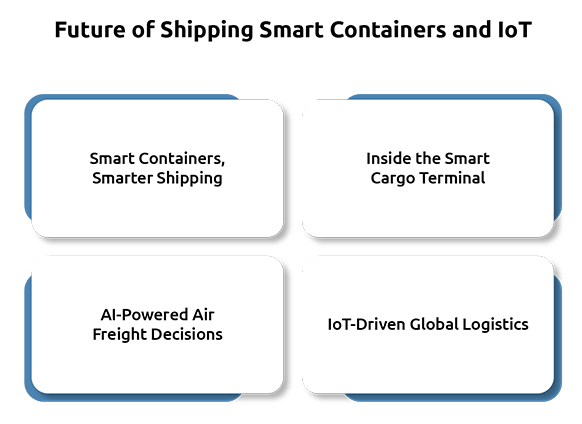
The future of logistics will rely entirely on intelligent shipping networks. Predictive analytics for global trade is expected to guide air freight decision-making before a shipment even departs. Smart containers will merge with artificial intelligence, allowing predictive maintenance and route recalibration mid-journey.
Incoterms like DDP and DAP will gain digital transparency through automated payment and document verification systems. Smart airports are preparing to adopt connected cargo terminals with AI-assisted inspection systems capable of identifying container anomalies in seconds.
Market Research Insights
Recent market research conducted by the government indicates a lot of development in IoT-enabled supply chains. According to the United Nations Trade Data Report 2025, the investments in smart shipping infrastructure will exceed the figure of $40 billion USD by 2030. Air freight networks are allocated to predictive IoT systems to optimize the process of customs documentation and real-time cargo allocation.
The integration of smart containers supports consistency in handling sensitive cargo and compliance with import export registration, ECCN classifications, and tariff frameworks. Airport logistics centers with updated digital infrastructure demonstrate up to 28% higher throughput capacity, proving the efficiency of connected container models.
Smart Trade with Intelligent Infrastructure
The use of IoT networks and intelligent containers has transformed the shipping of products all over the globe to become more transparent, predictive, and ecological. Goods that used to be handled by manual records are now reported in real-time digital networks, ensuring the quality of goods remains consistent and the outcome of finals is predictable. Automated management of customs duty, HS code mapping, and digital documents enhances the coordination of all air freight routes.
At One Union Solutions, we combine these new capabilities with Importer of Record, Exporter of Record, and DDP shipping solutions to provide a smooth customs flow and minimal operational risk. The future (with smart logistics becoming a $39 billion USD industry in 2025) is set to have a sustainable, accurate, and interconnected system of commerce in the global cargo movement.
Did You Know?
The data of the International Transport Forum 2025 show that the air cargo shipments, organized under the container technology of IoT-based technologies, advanced by 31% annually, and the accuracy of the deliveries was enhanced by 22%.
FAQs
- What does a smart container mean in international shipping?
A smart container has IoT sensors to monitor environmental conditions, route information, and conditions on the way to delivery to deliver cargo safely.
- How does IoT improve container management?
IoT connects logistics systems through live monitoring and automated alerts. It streamlines container management by predicting delays or issues before they occur.
- Are smart containers environmentally sustainable?
Yes, they reduce energy waste and optimize routes, lowering greenhouse emissions and supporting clean shipping practices.
- What customs regulations apply to IoT-enabled cargo?
Smart container shipments comply with international codes such as HS code, ECCN, and DGFT IEC standards to meet global customs requirements.
- What is the role of DDP shipping in smart logistics?
DDP shipping means duties and taxes are prepaid, simplifying customs clearance for IoT-tracked shipments and ensuring smooth delivery.