Global trade is becoming increasingly difficult due to always-changing regulations, diverse customs requirements across countries, & growing geopolitical & economic risks. Businesses engaged in global trade may face challenges like compliance delays, high making costs, & difficulties in keeping up with developing rules. Overcoming these challenges, companies are mainly changing to Artificial Intelligence to simplify & update their trade operations. AI helps automate main processes like document management, product verification, risk detection, & regulatory management, enabling businesses to enhance accuracy, minimize errors, & ensure faster compliance in global trade environments.
Challenges of Complex Trade Regulations
Global trade is a huge tool for our economic growth & global competitiveness. This changing landscape presents many challenges, with customs procedures being one of the most difficult and costly.
Main Customs Challenges:
Global trade compliance is becoming mainly difficult due to the change of customs regulations across many countries. Each nation has its own unique rules, which create a divided regulatory environment for businesses engaged in global trade. This variation increases the chance of errors & delays during customs clearance. Tariff & non-tariff risk, such as import duties, taxes, & trade rules, further develop management costs & create risk due to a lack of transparency in how these measures are applied, making business planning more difficult. Delays in customs clearance procedures can also slow down the movement of goods, resulting in financial losses, contract issues, & damage to business reputation. Companies often struggle with limited visibility & control over customs processes, which minimize their ability to track shipments & make informed decisions. The increasing digitization of customs operations has introduced cybersecurity & fraud risks, growing sensitive business & customer data to potential cyberattacks & unauthorized access.
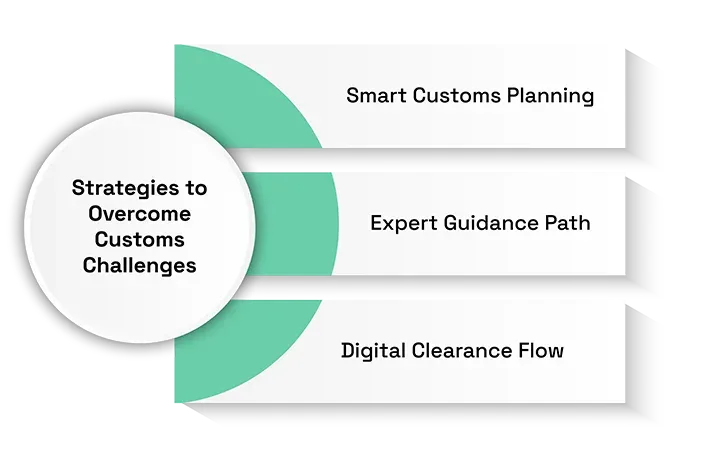
Strategies to Overcome Customs Challenges:
To overcome customs challenges, businesses need to use a combination of planning, technology, & strategic partnerships. Proper customs management planning, along with a strong understanding of country-specific regulations, is useful to avoid costly errors, & consulting customs experts can help reduce difficult needs more easily. The use of technology & digitalization, such as customs management systems & online tracking platforms, improves visibility, control, & efficiency across the whole customs process. Companies can also minimize risk by changing export markets & developing strategies to manage currency fluctuations & tariff-related uncertainties. Building collaboration with reliable customs agents & trusted logistics partners further supports easier clearance processes & ensures expert assistance at every stage. Investing in cybersecurity measures & staff training is important to secure sensitive information, prevent fraud, & update overall customs security.
Role of AI in Trade Compliance
Artificial Intelligence transforms global trade compliance by automating manual workflows, ensuring real-time regulatory adherence, and mitigating supply chain risks. It replaces error-prone human data processing with advanced algorithms that instantly handle complex international requirements.
Manage global trade uncertainty by leveraging AI for compliance
The lasting fraud of new tariffs & retaliatory measures not to mention geopolitical tensions and evolving trade compliance demands are putting tremendous pressure on businesses that move goods across borders. Savvy businesses are integrating automation and AI for compliance to replace the manual processes and documentation that make global trade management such a complex affair.
How automation and AI streamline global trade
The amount of uncertainty and change in global trade has rendered the older trade compliance and documentation processes obsolete. With the high cost of non-compliance, businesses that adopt automation and AI for compliance purposes stand to gain a competitive advantage in their global trade operations. Here’s how:
Product classification automation
Supply chain AI can automate product classification using machine learning (ML) models to analyze product data and assign the correct Harmonized System (HS) codes and tariff classifications.
Enhanced due diligence screening
Using AI for compliance enhances due diligence processes by providing more comprehensive screening capabilities, such as unstructured data processing and transliteration of localized names.
Unstructured document processing
Invoices, customs declarations, and shipping records are often processed from unstructured documents. Instead of manual conversion, our AI-powered unstructured document processing automates the extraction and mapping of relevant data into structured electronic formats.

Building resilience with supply chain AI
Given how many businesses source components and materials from overseas, supply chain resilience has never been more important. AI and automation give businesses a important complete advantage by enabling them to reduce the impact of tariffs or regulations through:
End-to-end visibility
A centralized platform that connects all functions & partners in real time can use automation & AI for compliance to easily manage trade regulations across all regions & provides the flexibility to take decision action quickly.
Flexible sourcing strategies
AI & automation can help businesses reduce costs & change their supplier base by identifying advantageous free trade agreements & partners who give more helpful trade terms.
AI-powered duty management
AI accesses real-time data & trade agreements to automatically calculate & manage duties, which helps to minimize costs, manage compliance, & reduce the effect of tariffs.
Enhanced compliance
AI for compliance mainly manages trade regulations, FTA updates, & ESG-driven compliance demands to give businesses the flexibility to respond immediately.
Conclusion
Global trade is becoming more difficult due to changing regulations, geopolitical tensions, & increasing digital risks. Past compliance methods are no longer enough to handle this fast-changing environment. Businesses now face many difficulties such as strict customs rules, delays in clearance, higher costs, & limited visibility across supply chains.
AI & automation are becoming useful tools for modern trade compliance. They help businesses simplify processes like product classification, document management, risk inspection, & duty calculation while improving accuracy and speed. AI also provides better visibility across the supply chain & helps companies respond quickly to regulatory changes.
Did you know?
One respondent to the 2026 Global Trade Report survey highlighted a common tension: “Tariffs make it difficult to maintain product quality when using alternate suppliers.” This observation underscores how cost-driven supplier changes can create conflicts between financial pressures and ESG standards.
FAQs
1. How is AI helping businesses manage complex trade regulations?
AI helps businesses by automating compliance tasks such as product classification, document processing, risk screening, and tariff calculation, making trade operations faster and more accurate.
2. What are the main challenges in global trade compliance?
The main challenges include different regulations across countries, high tariffs and trade barriers, customs delays, limited visibility in supply chains, and increasing cybersecurity risks.
3. How does AI improve customs and trade processes?
AI improves customs processes by reducing manual work, speeding up clearance, identifying risks early, and ensuring businesses follow the latest trade regulations in real time.
4. Can AI reduce costs in international trade?
Yes, AI can reduce costs by optimizing duty calculations, avoiding penalties from non-compliance, improving supply chain decisions, and reducing delays in customs clearance.
5. What is the future of AI in trade compliance?
The future of AI in trade compliance includes fully automated compliance systems, real-time regulatory updates, smarter supply chain management, and stronger integration with global customs authorities.