Why Do Undersea Cables Matter?
Undersea cables are the invisible routes of global communication. Carrying over 95% of global data, these deep-sea connections support internet traffic, cloud applications, and cross-border transactions. Their importance extends beyond everyday browsing; they are vital for financial services, aviation communication systems, IT devices, and global logistics. When the U.S. imposes reciprocal tariffs, the impact on the technology sector extends to these cables and the equipment required to build and maintain them. Any tariff increase on telecom imports raises costs for businesses investing in cable infrastructure. This has a direct effect on global supply chain services, as organizations depend on smooth connectivity to run digital trade and cross-border operations. Also, undersea cables do not just connect continents; they connect businesses to global growth.
How We Help You Navigate the Complexity of Import Compliance for Telecom Equipment
Importing telecom equipment like undersea cable systems, routers, and servers is not straightforward. Organizations face strong import-export regulations that require agreement at every stage. This is where importer of record services and export customs brokerage become crucial. By confirming proper customs clearance support and aligning imports with HS code and HTS harmonized tariff schedules, businesses can avoid penalties and delays. Comprehensive import-export support, including delivery duty-paid logistics and DDP shipping, enables organizations to smoothly land their goods under Incoterms. Import-export registration and approval, in accordance with international export regulations, confirm that equipment enters the U.S. market without disruption. At One Union Solutions, we help organizations simplify these requirements through global trade facilitation and importer of record services.
Undersea Cable Technologies and Global Network
The growth of undersea cable technologies is central to a connected global economy. These cables allow businesses to integrate IT operations, cloud services, and digital platforms across borders. However, to import such advanced technology, companies must follow the right Incoterms, whether DAP or DDP, to clarify responsibility between sellers and buyers. Freight forwarding services and exporter of record services also play a major role in confirming timely delivery. By combining logistics expertise with global supply chain services, businesses can keep telecom imports steady despite tariff barriers. Export register approval and customs clearance support further strengthen this process, reducing the risk of unexpected costs.
Threats to Undersea Telecommunication Cables
Undersea cables already see risks from natural disasters, geopolitical tensions, and damage. Reciprocal tariffs add another layer of challenge. Higher import duties could make it costlier to expand or repair these critical infrastructures, slowing the growth of international connectivity. Also, companies must pay closer attention to international export regulations and the Delivery Duty Paid service obligations to avoid disruptions. Approval with the exporter of record services and the correct use of HS code classifications confirms that telecom equipment moves legally and effectively. Without strong customs clearance support and comprehensive import-export support, businesses may incur delays that weaken global trade competitiveness.
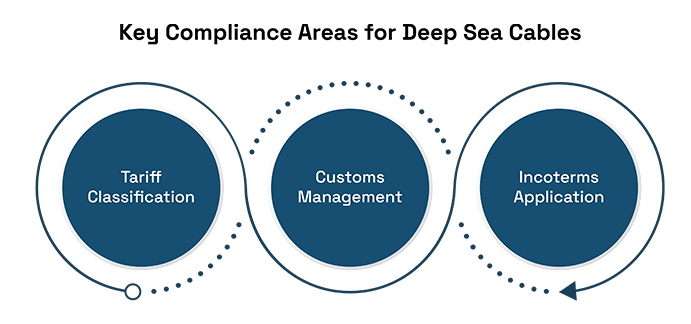
Key Compliance Areas for Deep Sea Cables
When importing undersea cable technologies, organizations must focus on:
- Tariff Classification – Proper use of HS code and HTS harmonized tariff schedules.
- Customs Management – Relying on the importer of record services and export customs brokerage for smooth customs clearance support.
- Incoterms Application – Choosing the right Incoterms, such as DAPs or DDP shipping, to define obligations in delivery duty paid logistics.
Conclusions
For companies dealing with undersea cable systems and related equipment, the stakes are high. Approval with HTS harmonized tariff rules, proper use of Incoterms, and dependence on the importer of record services are key to staying competitive. By using comprehensive import-export support, global supply chain services, and Delivery Duty Paid logistics, businesses can mitigate the risks of tariffs. Freight forwarding services, export customs brokerage, and global trade facilitation confirm that telecom imports remain unwanted despite changing tariff guidelines.
DID YOU KNOW?
Global sales of submarine cables are estimated to be worth US$30.9 billion in 2025 and are expected to reach US$56.9 billion by 2035.
FAQs:
Q1: Why are undersea cables important for global trade?
Undersea cables carry over 95% of global data, powering the internet, financial services, aviation, IT, and logistics, making them the backbone of digital trade.
Q2: How do tariffs affect undersea cable imports?
Tariffs increase the cost of telecom equipment imports, raising expenses for building and maintaining undersea cables, which can slow global connectivity.
Q3: What role does an Importer of Record (IOR) play in telecom imports?
An IOR ensures compliance with customs, manages HS code classification, and handles documentation so telecom equipment enters a market legally and smoothly.
Q4: Why are Incoterms like DAP and DDP important for telecom imports?
Incoterms clarify responsibility between buyers and sellers for shipping, tariffs, and delivery, preventing disputes and ensuring efficient logistics.
Q5: How can businesses reduce risks in importing undersea cable technologies?
By using IOR services, freight forwarding, and customs clearance support, businesses can avoid penalties, delays, and unexpected costs in global telecom trade.