Overview
The post-clearance audit (PCA) process is a structured examination, after Customs has released the cargo, of the relevant commercial data, sales contracts, financial and non-financial records, physical stock and other assets of traders.
With a view to expediting the release of goods, each Member shall adopt or maintain post-clearance audit to ensure compliance with customs and other related laws and regulations.
Why Do Customs Authorities Review Import Documentation?
The documentation required for importation may not provide the complete picture and context of a commercial transaction to customs officials. Attention is invited to the provisions under Section 18A, inserted vide the Section 93 Finance Act, 2025 providing a facility of revision of entry(ies) already made in relation to the goods, after customs clearance has been given, in a manner as prescribed.
When a declaration is made and the customs officer has reason to doubt the truth or accuracy of the particulars or of documents produced in support of this declaration, the customs officer may ask the importer to provide further explanation, including documents or other evidence.
When Can Customs Review the Value of Cleared Goods?
The post-release controls aim at ensuring the accuracy and completeness of customs declarations in a specific area, for instance, anti-dumping or origin/preference, verification of origin certificates, determination of the customs value, controls carried out following a request for mutual assistance. Transaction Based Audit (TBA): Examination of BE/SB for verifying compliance to all the legal provisions and to check for any short levy or non-levy.
Premise Based Audit (PBA): Here the legal compliance and correct assessment of Customs duties will be verified at the premise of the importers and exporters.
Since post-importation audit may take time and the national laws may provide a time limit for recovery of short-levied duty, it is necessary to fix a time limit under the national laws requiring the importers to keep the records relating to import transactions till then.
What Can Lead to a Post-Clearance Valuation Dispute?
The transaction value method cannot be applied in cases where the buyer and seller are related and the relationship has influenced the price.The price actually paid or payable should be adjusted to include all the costs and services (dutiable valuation factors) specified in sub-Rule 9 (1).Royalties and license fees related to goods being valued that the buyer must pay either directly or indirectly, as a condition of sale.
How Do Customs Authorities Conduct a Post-Clearance Audit?
Singapore Customs may contact the trader auditee to request documents or to arrange an interview with relevant personnel.
Customs will verify the accuracy of declarations and/or other returns submitted to Singapore Customs against the relevant trade documents provided by the auditee.A report should be produced to ensure that all findings and other relevant issues are fully shared and discussed.The proper officer may conduct audit either in his office or in certain cases at the premises of an auditee.
The proper officer shall inform the auditee of the objections, if any, before preparing the audit report to provide him an opportunity to offer clarifications with supporting documents.
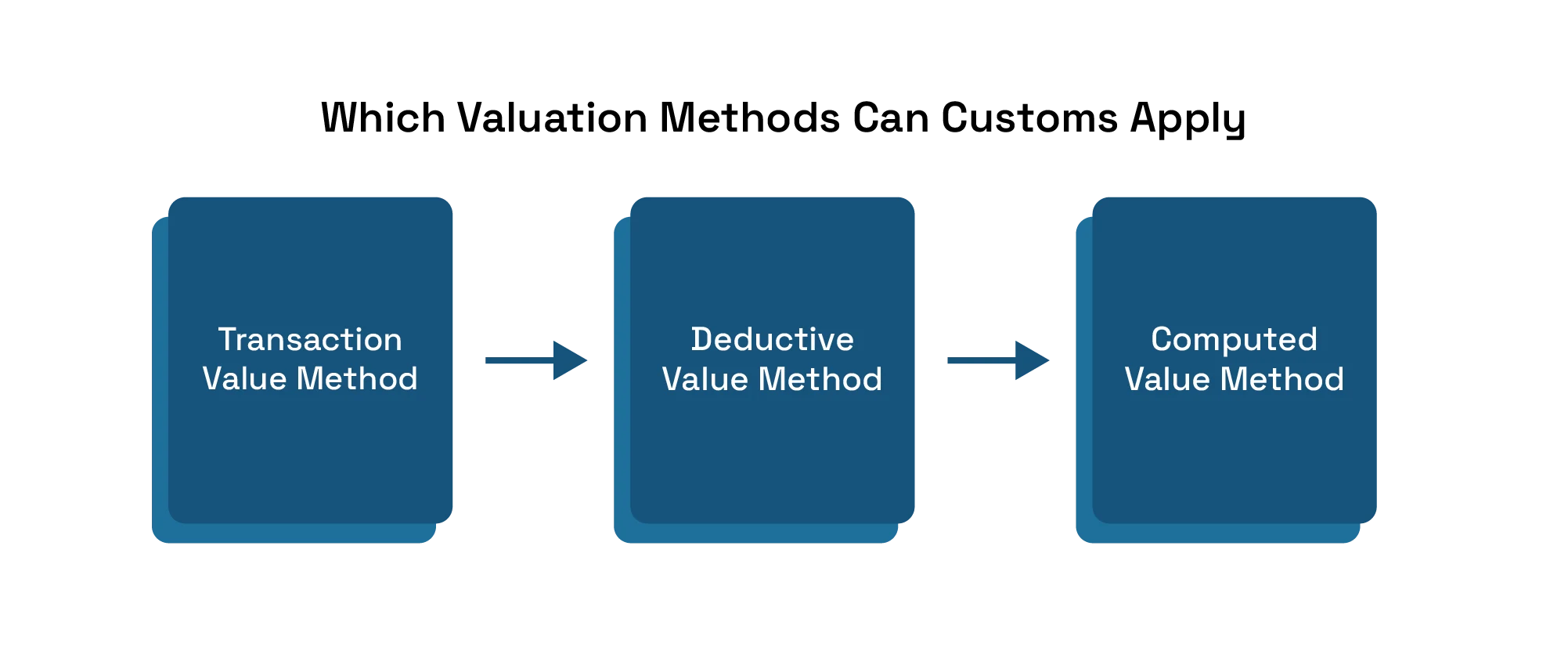
Which Valuation Methods Can Customs Apply?
The WTO Agreement on Customs Valuation provides an internationally recognised framework for determining the customs value of imported goods
Transaction Value Method
The customs value of imported goods shall be the transaction value, that is the price actually paid or payable for the goods when sold for export to the country of importation.
Transaction Value of Identical Goods
If the customs value of the imported goods cannot be determined under the provisions of the customs value shall be the transaction value of identical good.
Transaction Value of Similar Goods
If the customs value of the imported goods cannot be determined under the provisions the customs value shall be the transaction value of similar goods.
Deductive Value Method
The customs value of imported goods under the provisions of this Article shall be based on the unit price at which the imported goods.
Computed Value Method
the customs value of imported goods under the provisions of this Article shall be based on a computed value.
Fall-back Method
the customs value shall be determined using reasonable means consistent with the principles and general provisions of this Agreement.
How Should Importers Respond to a Reassessment Notice?
The customs officer may ask the importer to provide further explanation, including documents or other evidence.The importer is given an opportunity to justify the self-assessment either in writing or in person through Video Conferencing.The importer shall have the right to an explanation in writing from the customs administration as to how the customs value of his/her goods was determined.
Organization should also check the response deadline and appeal rights stated in the notice. A written response supported by transaction records offers a clear basis for addressing the valuation issue.

Conclusion
Recognizing the need for a fair, uniform and neutral system for the valuation of goods for customs purposes. The primary basis for customs value under this Agreement is transaction value & customs value should be based on simple and equitable criteria consistent with commercial practices. One Union Solutions supports businesses with Importer of Record (IOR) and trade compliance services for IT, telecom, medical, automotive, and aviation equipment across 190+ countries. Its team assists with import documentation, customs valuation considerations, and country-specific import requirements.
Did You Know?
According to the Comptroller and Auditor General of India’s Customs Audit Report No. 21 of 2025, during FY 2022–23, Transaction-Based Post-Clearance Audits covered 8,67,669 Bills of Entry and Shipping Bills. The audit detected duty evasion of ₹799.50 crore, of which ₹146.39 crore was recovered.
FAQ
Can customs reject the declared value of imported goods?
Yes. Customs regulators may reject the declared shipping value if reasonable doubts remain about its truth or accuracy after examining the importer’s explanation.
What documents can customs request during a post-clearance valuation review?
Customs may examine commercial invoices, bills of lading, sales contracts, payment records, valuation declarations, or other similar shipping documents.
What Happens When Customs Doubts the Declared Value?
Customs may ask the importer for further explanations & supporting documents. The importer must also be given a reasonable opportunity to respond before a final decision.
Are the customs officers bound to accept the value declared by the importer as the customs value in all cases?
No. Customs authorities can examine the truth & validity of the declared value, compliance with valuation conditions, or supporting data before accepting it.
What Should Importers Do When Customs Questions the Declared Value?
Customs may ask the importer for further explanations & supporting documents. The importer must also be given a reasonable scope to respond before a final decision.