Why Did The Peak Season Arrive Earlier in 2026?
2026 is not just a seasonal uptick in the transport market but a confluence of factors. Strong demand , port delays & limited cargo shipping space have resulted in increased rates on some key routes. Shipping lines also adjust schedules & capacity , which can tighten available space during busy times.
Regional events have increased pressure. Changing shipping routes can result in longer distances to travel and less capacity available on some services. This means that importers could be facing higher freight costs even before the traditional year-end peak season starts.
Ocean Freight Rates Are Not the Same as Customs Costs
Ocean Freight Rates Are Different to Customs Costs Higher ocean freight rates are not to be confused with customs duties or import tariffs. Freight is the cost of moving the goods and customs duties and taxes are based on the import regulations that apply. However, in some jurisdictions and under some valuation rules, freight may still be included in the customs value and importers should be aware of how transport costs are treated in the country to which they are importing.
This distinction becomes important when companies prepare import budgets. A higher carrier quotation does not automatically mean that the customs duty rate has changed. Equally, an importer should not assume that a lower freight quotation will reduce every part of its import bill. Freight, customs valuation, duty, VAT or other import taxes need to be reviewed separately.
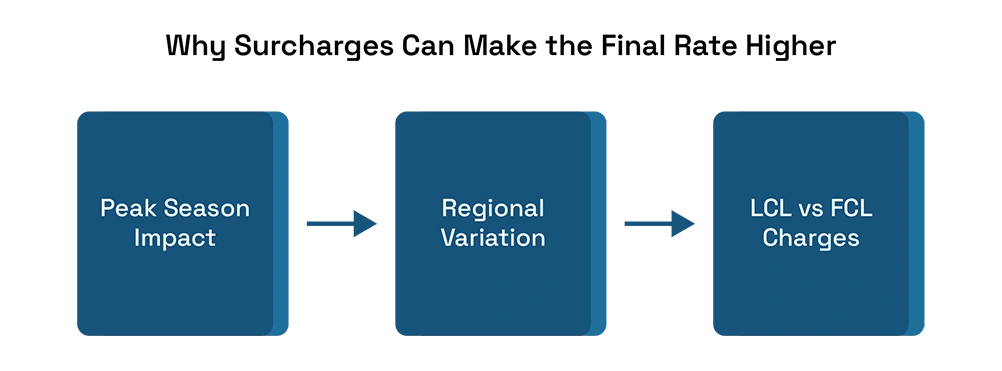
Why Surcharges Can Make the Final Rate Higher
The base ocean freight rate is only one part of the amount an importer may pay. Additional services may be subject to surcharges, by trade lane, container type, environment, capacity conditions and timing of the shipment. For example, the Peak Season Surcharge is a charge that carriers can change as market conditions change.
For example, Maersk published 2026 Peak Season Surcharges updates for various India and Indian Subcontinent trade lanes. The notice showed different levels of surcharge for the September and October-December periods for LCL shipments from the Indian Subcontinent to the US and Canada East Coast. Other applicable charges will be separate.
How Higher Rates Affect Inventory Planning
The Impact of Rising Rates on Inventory Planning Should ocean freight become expensive or less reliable on timing, importers may need to reconsider when and how much inventory to order. Building inventory ahead of time can help mitigate future rate increases or delays, but it also means paying for inventory earlier and potentially at a higher storage cost. Waiting until rates are lower could save on freight, but you might find yourself without any inventory when it’s needed for production or customer orders.
This is especially true for IT equipment, telecom hardware, automotive parts and medical equipment where delivery dates may be associated with installation projects or operational needs. A cheaper freight option is not necessarily cheaper overall if it creates additional warehousing, demurrage, production or project costs.
What Importers Should Check Before Accepting a Higher Rate
Importers should first establish exactly what the quoted ocean rate includes. A quotation may cover the main ocean leg but exclude terminal charges, documentation, handling, destination charges, surcharges or inland transportation. Comparing two quotations only by their headline container rate can therefore produce a misleading result.
It is also worth checking the validity period of the quotation and the conditions attached to it. A rate valid for a few days is different from a contracted rate covering a longer period. Importers should review the booking date, sailing date, price calculation date, surcharge conditions and any exclusions before comparing offers. This gives the purchasing team a clearer picture of the actual transportation cost.

What Higher Ocean Rates Mean for DDP Shipments
Higher Ocean Rates Effect on DDP Shipments For shipments arranged under DDP, higher ocean freight can affect the overall delivery cost to the seller since the seller is responsible for the agreed transport costs under the Incoterms® 2020 DDP arrangement. The higher freight cost does not however change the applicable customs duty or automatically change who is legally recognized as the importer.Thus, it is important that the seller has accurate costing before quoting a DDP price. The calculation may need to account for ocean freight, insurance where applicable, destination charges, customs duties, import taxes and final delivery costs.If freight rates fluctuate significantly after a quote is made, the terms of the commercial contract and the quote determine if the seller can pass on the increased cost to the buyer.
How Importers Can Manage the Impact
Managing higher ocean rates starts with understanding the shipment rather than simply searching for the lowest freight quote. Importers can compare sailing schedules, container options, routing and total landed cost while considering how much inventory is already available.For recurring shipments, reviewing freight performance over several months can also show whether a rate increase is temporary or part of a wider market movement.The customs side should be reviewed at the same time. Correct HS classification, customs valuation, importer details and required documentation help prevent avoidable costs after the container arrives.Conclusion: Higher Rates Require Better Cost Visibility
Conclusion: Higher Rates Require Better Cost Visibility
An early peak season can change the economics of an import shipment well before the traditional holiday period.The higher rates on many of the major routes in 2026 are not only down to seasonality, but also a mix of demand, capacity management, fuel costs and geopolitical disruption. Current market data also shows that rates can move in different directions across individual trade lanes. For importers, the practical response is to look at the complete landed cost instead of the ocean rate alone. Freight, surcharges, customs duties, taxes, destination charges, storage and delivery should be considered together.
Did You Know?
Global goods trade reached US$13.7 trillion in H1 2026, up 12.5% year-on-year, according to UNCTAD.
Frequently Asked Questions
Does peak season always mean higher ocean freight rates?
Not necessarily.Peak-season demand can put upward pressure on rates, but freight prices also depend on vessel capacity, fuel costs, port congestion, routing and carrier decisions. Different trade lanes can move in different directions at the same time.
What brings ocean freight to be higher in 2026?
Higher 2026 rates on key trade lanes as strong shipping demand and capacity management drive rates. Regional delays , with varying impact by trade lane and shipment type.
Do higher ocean rates result in higher import duties?
No, not automatically. Ocean freight charges and customs duties are separate costs.However, freight and related transport costs can be relevant to customs valuation depending on the rules of the destination country and the terms of the import.
Can an importer avoid peak season surcharges?
There is no universal way to avoid them. An importer can look at carrier quotations, sailing dates, routing options and contract terms to see if a Peak Season Surcharge applies. The applicable charge depends on the carrier, trade lane, shipment and effective date.
What should importers check when ocean rates rise?
For importers, it is necessary to check the full freight quotation including base rate, surcharges, validity period, destination charges and inland delivery costs. They also need to check customs duties, taxes, storage exposure and the delivery date needed for the shipment before comparing the transport options.